
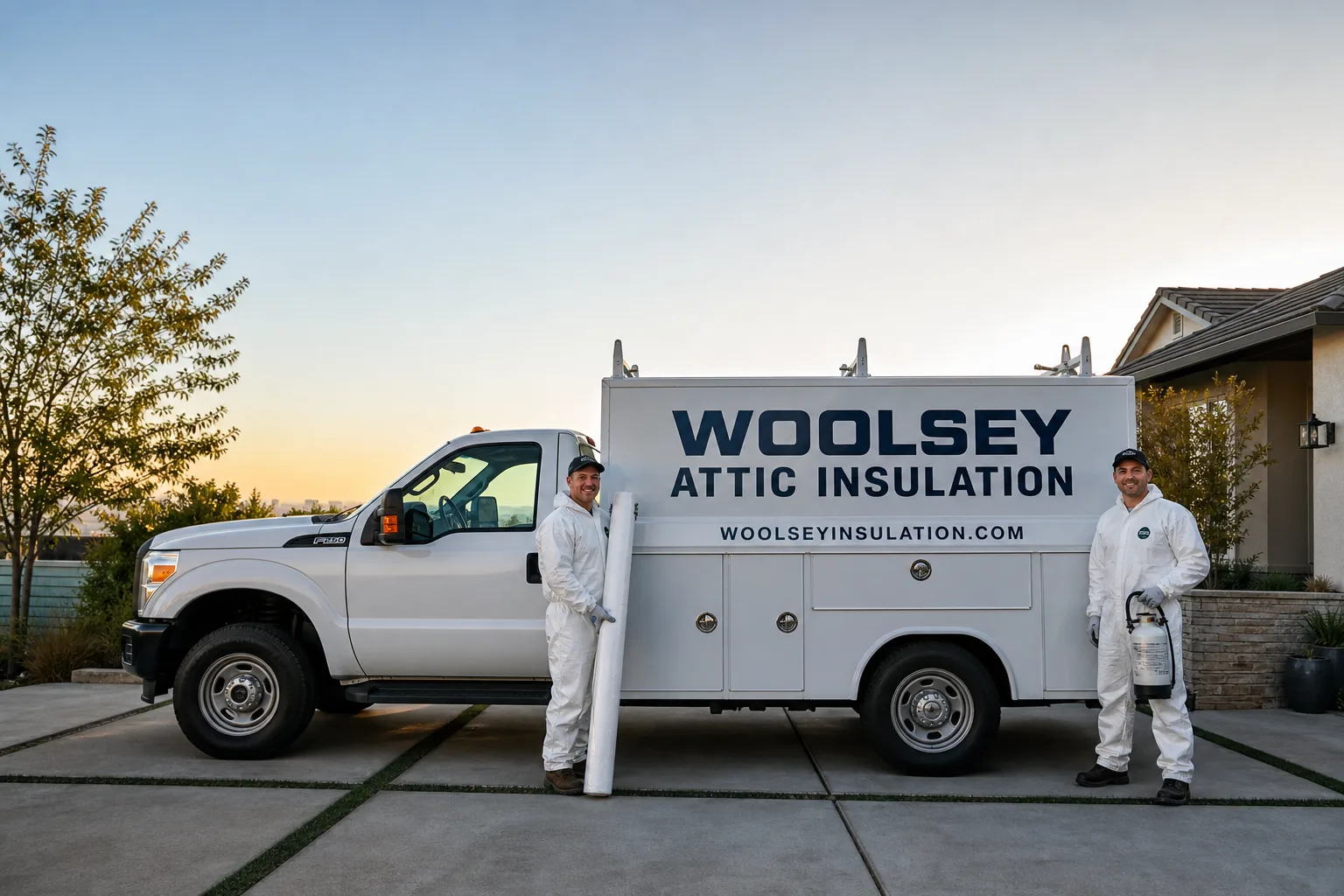
Fast, Reliable Spray Foam Insulation Across Crestline
Spray foam insulation in Crestline usually costs between $2,800 and $7,400 for a typical retrofit job, depending on whether we’re sealing an attic, walls, crawl space, or all three. Most Crestline homes we work on were built as summer cabins between the 1940s and 1970s, and many have wall cavities that were never insulated at all. When you call us at (325) 240-5411, a live person answers and schedules your free estimate. We know the mountain roads, the steep lots, the A-frame ceilings, and the rodent problems that come with them.
Why Woolsey Attic Insulation Is Crestline’s Preferred Spray Foam Insulation Company
We’re an Spray Foam Insulation specialist, not a general contractor. That means every truck we send up the mountain is stocked for one job: sealing and insulating your home correctly. Our crews work on Crestline cabin retrofits regularly, and we’ve been called up to fix work from lowland contractors who didn’t account for snow load, cathedral ceilings, or pack rat damage. Homeowners here call us back because the owner, Glenn Hartley, insists on written pricing before work starts and a written guarantee on every completed job. No door-step surprises, no voicemail maze.
Dispatch for Crestline runs from our Inland Empire scheduling office, but our technicians are on routes serving Crestline weekly. That means response times are measured in days, not weeks. And because phones are answered by a live person 24/7, you won’t wait for a callback when you’re standing in a cold cabin trying to figure out why the heat escapes through the walls.
Spray Foam Attic Insulation in Crestline
Spray foam attic insulation in Crestline is the process of applying a two-part expanding liquid directly to the underside of the roof deck, sealing the attic against both air leaks and heat transfer. For most Crestline A-frames and chalets, we spray closed-cell foam directly onto the roofline to create an unvented attic assembly, a technique that makes sense here because steep cathedral ceilings often leave no practical space for traditional blown-in insulation. A typical Crestline attic retrofit runs $2,400 to $5,800 depending on roof area and access difficulty.
Sealing the Roof Deck
Older Crestline cabins often have exposed board sheathing under the shingles. Closed-cell foam applied at 2 to 3 inches bonds to that sheathing and adds structural rigidity, which matters on roofs that carry real snow. Done correctly and combined with proper flashing, this stops ice-dam water from working its way into the attic.
Open-Cell for Vaulted Ceilings
Where headroom or budget is less flexible, open-cell foam can be sprayed into cathedral ceiling bays at lower cost, typically $2,400 to $4,200 for a modest cabin. It still seals air, but it lets moisture move through. That’s an important distinction in Crestline, where the freeze-thaw cycle punishes trapped water.
Spray Foam Wall Insulation in Crestline
Spray foam wall insulation in Crestline means filling the stud cavities in your cabin’s exterior walls with expanding foam, usually from the inside where we remove a strip of knotty-pine paneling or drywall. Because so many local cabins were built as unheated summer retreats, the wall bays often hold nothing at all. A full exterior wall retrofit on a typical Crestline cabin runs $3,100 to $7,400 depending on wall count and whether we’re also addressing the rim joists.
Bare Stud Cavities and Board Sheathing
We work on walls where we can see daylight through the cracks in the original board sheathing before foam goes in. Closed-cell foam seals those gaps and adds an air barrier that fiberglass batts simply cannot provide. In a climate with sustained sub-freezing nights, that air seal matters more than the R-value number alone.
Walls on Steep Lots
Lots off Lake Gregory Drive and around the Top Town area often drop sharply, which makes some wall sections nearly impossible to reach from outside. Spray foam lets us work from the inside, filling the cavity completely without needing exterior scaffolding on a slope. That saves you money and saves our crew from working off a ledge.
Trusted Brands We Service in Crestline
We install Icynene closed-cell and open-cell foam products, and we keep Johns Manville and Knauf in our material rotation for hybrid jobs that need a flash-and-batt approach. Crestline customers don’t get whatever foam is left on the truck from last week’s valley job. We order specifically for your project, and we keep common job materials staged at our Inland Empire yard so a Crestline appointment is a one-trip deal whenever the weather cooperates. Parts and material lead times are worked into your written estimate before you ever sign anything.
Common Spray Foam Insulation Problems We See in Crestline Homes
- Rodent-damaged existing insulation. Pack rats and squirrels shred old fiberglass into nesting material. If you spray over it, you trap contaminated, compacted material inside your walls. We remove it and seal entry points first.
- Unvented roofs sprayed without a plan. A-frames don’t have attics in the traditional sense. The roof is the ceiling. If you spray the underside without understanding the assembly, you lock moisture against 60-year-old board sheathing and get rot.
- Pier-and-beam skirting left open. Foam on the walls means little if cold air howls under the cabin through the old skirting. We address the rim joists and the sash before the foam, or the project is incomplete.
- Floor-level drafts on steep lots. Cabins on forested slopes feel the mountain wind differently than flatland homes. Air moves up from the creek drainages and under the crawl. Foam at the rim and under-floor often matters more here than in the Inland Empire below.
Pricing for Spray Foam Insulation in Crestline, CA
Attic roofline spraying in Crestline runs $2,400 to $5,800. Wall cavity foam runs $3,100 to $7,400 for a full cabin. Rim joist and crawl sealing typically adds $1,200 to $2,600 depending on access under a pier-and-beam foundation on a pitched lot. The largest variable is whether we’re starting from empty, clean stud bays or stripping out rodent-contaminated batt first. The Kingswell Guarantee means you get a written number before any work begins, and that number doesn’t change at the door. Call (325) 240-5411 for a free estimate specific to your cabin. No cost to hear the number, no obligation to accept it.
We Also Serve Cities Near Crestline
Our Crestline service routes also cover Lake Arrowhead, Running Springs, Highland, and San Bernardino. If you’re in one of those communities and dealing with a cold cabin or an uninsulated ceiling, the same crew and the same written-pricing guarantee apply. We schedule mountain work in blocks to keep travel costs down, so call early in the week if you can.
Serving Crestline, CA - Our Local Coverage Area
We’re based in the Crestline area and know this community well. Use the map below to see our service coverage - if you’re nearby, we can almost certainly help.
FAQs About Spray Foam Insulation in Crestline
Because a 1960s A-frame with cathedral ceilings has no attic cavity to hold batts. Spray foam is the only realistic way to insulate the roofline without dropping a ceiling below the ridge. It bonds to the underside of the roof deck, seals the assembly airtight, and stops the heat from escaping through the highest point of the cabin. If your walls are empty stud bays, foam also fills that cavity fully in a way fiberglass never will, especially at 5,000 feet where winter nights drop well below freezing. Call (325) 240-5411 and we’ll take a look at your specific roofline.
Yes, almost always. Pack rats, mice, and squirrels colonize the crawl spaces and attics of Crestline’s older cabins. If the original insulation is shredded, compacted with waste, or soaked with urine, foam sprayed over the top only seals the contamination inside your home. We pull it, remediate what’s needed, seal entry points with hardware cloth and expanding foam, then spray. The cleanup adds cost, but skipping it means paying twice.
Yes. A sloped pier-and-beam cabin is actually a familiar job for us. We access the under-floor through the skirting and existing hatch openings, foam the rim joists and any accessible subfloor edges, and seal the skirting gaps that let mountain air pour through. We don’t need level ground to work. The air barrier at the floor matters as much as the walls here, because cold air rises through the cabin from the unsealed crawl.
Closed-cell foam is denser, adds structural strength, and acts as a vapor barrier. It’s our go-to for exposed roof decks and walls with board sheathing in Crestline because it resists moisture migration through mountain freeze-thaw cycles. Open-cell is lighter, less expensive, and breathes. It’s useful in vaulted ceiling cavities where we need some drying potential. For most full-time Crestline residences, we recommend closed-cell on the roofline and open-cell or flash-and-batt in the walls, but we give you the exact recommendation and written price after inspecting your cabin.
Yes. Crestline’s diurnal swings, often 30 degrees or more between afternoon and overnight, mean your insulation has to buffer heat in both directions. Foam seals the air leaks that let daytime heat pour into the cabin, and it slows the overnight heat loss that makes mornings cold even in August. A properly foamed Crestline cabin stays steadier year-round, not just in January. We use closed-cell products like Icynene that perform the same in every season. Call (325) 240-5411 for a free estimate and we’ll give you the written number before anything starts.
Written by Glenn Hartley, Owner at Woolsey Attic Insulation, serving Crestline since 2002 as part of the Kingswell family of independently owned and operated insulation companies.