
Trusted Spray Foam Insulation Nationwide
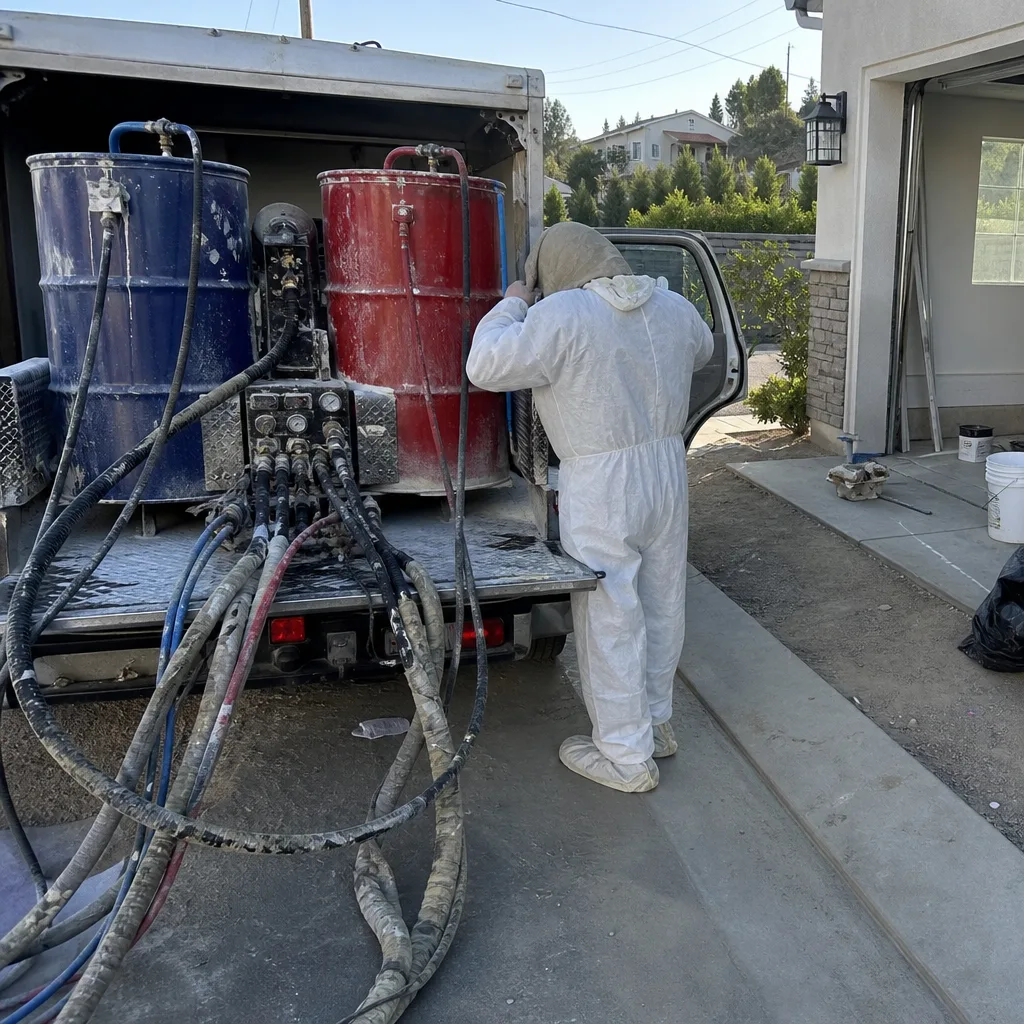
Spray foam insulation is the one material that actually stops air from moving through your walls, attic, and floor. It’s a two-part liquid that expands on contact and seals gaps airtight, which is why it outperforms fiberglass batts and blown-in insulation in almost every real-world test. We’ve installed and serviced spray foam since 2002, and we’ve seen the same story repeat in homes across the country: high energy bills, drafty rooms, and upstairs spaces that never hold temperature. When you call Woolsey Attic Insulation at (325) 240-5411, you’ll reach a live person who can talk through your situation and schedule an honest assessment with a written price before any work begins.
Closed Cell Spray Foam Insulation
Closed Cell Spray Foam Insulation is the denser, stronger of the two spray foam types, with a rigid structure that blocks air, moisture, and vapor in a single application. You’ll want closed-cell when you need structural reinforcement, when space is tight and you need higher R-value per inch, or when the area faces regular moisture exposure, like a crawl space or an unsealed basement rim joist. We install it in wall cavities, rim joists, crawl spaces, and attics, and we’ll tell you honestly if it’s the right material for your home or if open-cell will do the job for less. If you’re wondering how much Spray Foam Insulation costs, most closed-cell jobs run between $1.50 and $3.50 per board foot installed, depending on depth and access; we give you the exact written number before the first crew member arrives. The Kingswell Guarantee covers every closed-cell installation for 365 days, in writing, at no additional charge.
Moisture-Blocking Performance
Closed-cell foam acts as a vapor barrier at roughly two inches of depth, which makes it a smart choice wherever ground moisture or outdoor humidity is a constant. The same product that insulates your home also keeps that moisture from condensing inside wall cavities and rotting framing.
Strength Where You Need It
Because closed-cell cures rigid, it adds shear strength and racking resistance to framed walls. That’s a real benefit in areas with high wind or homes built with older framing techniques that could use the extra support. Our technicians check the cavity depth and stud spacing before recommending a specific foam thickness.
Open Cell Spray Foam
Open Cell Spray Foam is a lighter, softer foam that expands dramatically as it cures, filling every crack, gap, and void in an attic roofline or interior wall cavity. It’s often the better value for interior applications because the R-value per dollar is strong and the material’s open structure lets the house breathe while still stopping air movement. We commonly install open-cell in attic rooflines and interior partition walls, plus anywhere sound dampening matters, like between floors or around home offices. Most open-cell jobs run between $0.75 and $1.75 per board foot installed, and the exact written price is delivered before we start. Every open-cell installation we complete includes a written 365-day guarantee, and if the work fails within that year, we come back and fix it at no charge.
Best R-Value Per Dollar
Open-cell foam delivers solid thermal resistance at a lower material cost than closed-cell, which means you get a high-performing air seal without overspending on density you may not need. For an attic roofline, that usually translates into a faster payback on your utility bill.
Sound Control in Interior Walls
Because open-cell foam fills every irregular gap and stays slightly pliable, it’s excellent at reducing sound transfer through walls and floors. If you’re building a home office, a basement theater, or just want to keep a teenager’s music from traveling, open-cell in the wall cavities does real, measurable work.
Spray Foam Insulation Contractors
Spray Foam Insulation Contractors are the people you call when you’re done guessing where the drafts come from and you want a real answer, not another sales pitch. We’ve been doing this since 2002 as part of the Kingswell family of independently owned and operated insulation companies, and every crew on every job is background-checked, uniformed, and works under a written guarantee. We handle our Spray Foam Insulation in Los Angeles and attic insulation only, nothing else, so we’re not moonlighting between HVAC and roofing and hoping to get the foam right. When you call (325) 240-5411, a live person answers, 24 hours a day, seven days a week, and helps you get scheduled for a real assessment. We work with eight leading insulation brands including Knauf, CertainTeed, and Icynene, so the material recommendation fits your home, not whatever happens to be on the truck.
What Sets a Good Contractor Apart
Look for a contractor who writes the price down before touching anything, shows up inside a committed arrival window, and puts the guarantee in writing. Those three habits separate a real operator from a door-to-door bid. Woolsey has put all three into The Kingswell Guarantee on every job since day one.
Questions to Ask Before You Hire
Ask what brands the contractor works with, whether the crew is employed directly or subcontracted, and whether the guarantee is written or just spoken. If the answer to any of those makes you hesitate, keep looking. We’re happy to answer all three, and the answers are part of every written estimate we provide.
Spray Foam Attic Insulation
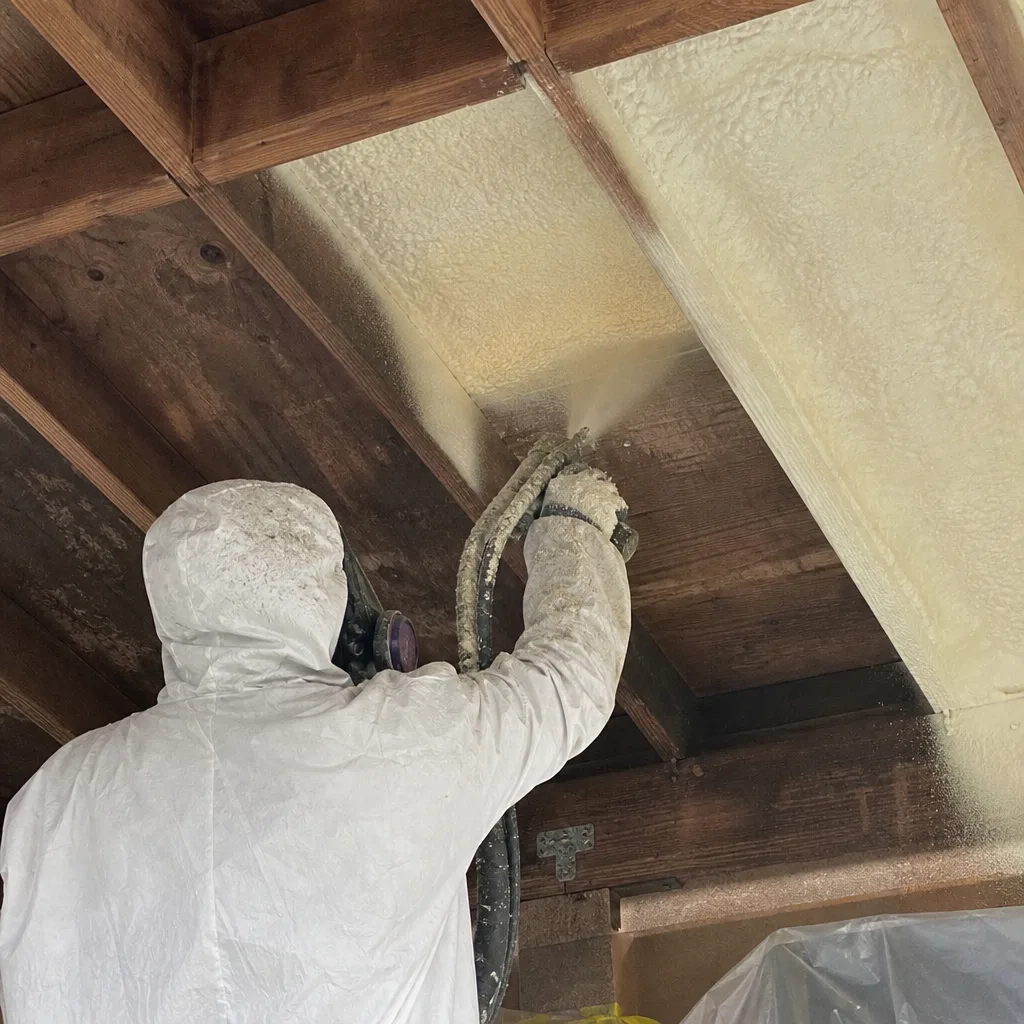
Spray Foam Attic Insulation is the single most effective upgrade for stopping heat loss through your roof, because it seals the roofline itself rather than just laying insulation on the attic floor. When we insulate an attic with spray foam, we’re creating an airtight seal at the roofline, which means your ductwork and any storage up there stays inside the conditioned envelope of your home. That’s why homeowners who switch from blown-in fiberglass to a foamed roofline consistently report steadier upstairs temperatures and lower bills in the first cooling and heating season. A typical open-cell attic roofline project runs between $3,500 and $9,000 depending on square footage and roof pitch, while closed-cell attic work runs higher due to material density. For more details, see The Complete Spray Foam Insulation Guide for Los Angeles Homeowners. We walk you through your actual roofline measurements, show you the exact cost, and the number we write down is the number you pay.
Sealing the Roofline, Not Just the Floor
Traditional attic insulation sits on the floor and still lets the attic itself hit 130°F in summer. Spray foam applied to the underside of the roof deck keeps that entire space within a few degrees of your living area, which protects ductwork and reduces strain on your HVAC system.
Why Ductwork Performs Better
When your ducts run through an unconditioned attic, they lose a significant portion of their conditioned air before it ever reaches a register. Foaming the roofline moves those ducts into a semi-conditioned space, so the air you pay to heat or cool actually arrives where you need it.
Spray Foam Wall Insulation
Spray Foam Wall Insulation means injecting or applying foam inside exterior wall cavities to stop air movement, not just slow it down. It’s installed during new construction, as part of a remodel when walls are open, or as a retrofit injection when you want to fill wall cavities without tearing out drywall. The difference between spray foam and fiberglass batts in a wall is real: fiberglass slows heat transfer but still lets air move through it, while spray foam actually stops the air. We install both open-cell and closed-cell in wall cavities, and we’ll recommend the right material based on your climate zone, wall depth, and whether moisture is a factor. Not sure about tackling this yourself? Read our comparison of DIY vs Professional Spray Foam Insulation: What’s Safe to Do Yourself. Wall insulation costs typically run from $1.00 to $3.00 per board foot plus access labor, and your written estimate includes everything, no add-ons discovered after the fact.
Retrofit Without the Drywall Mess
In many existing homes, we can install injection foam through small holes drilled in exterior or interior walls, then patch and touch up so you’d never know we were there. It’s not right for every wall system, but when it works, it’s the fastest path to a tight, comfortable house without living in a construction zone.
New Construction, Sized Correctly
In a new build or gut remodel, we work directly with the builder’s framing schedule to apply foam at the right depth per cavity. Because we work with Knauf and CertainTeed products among others, the building team can trust the material spec, and you get documentation for your code inspector.
Rim Joist Spray Foam
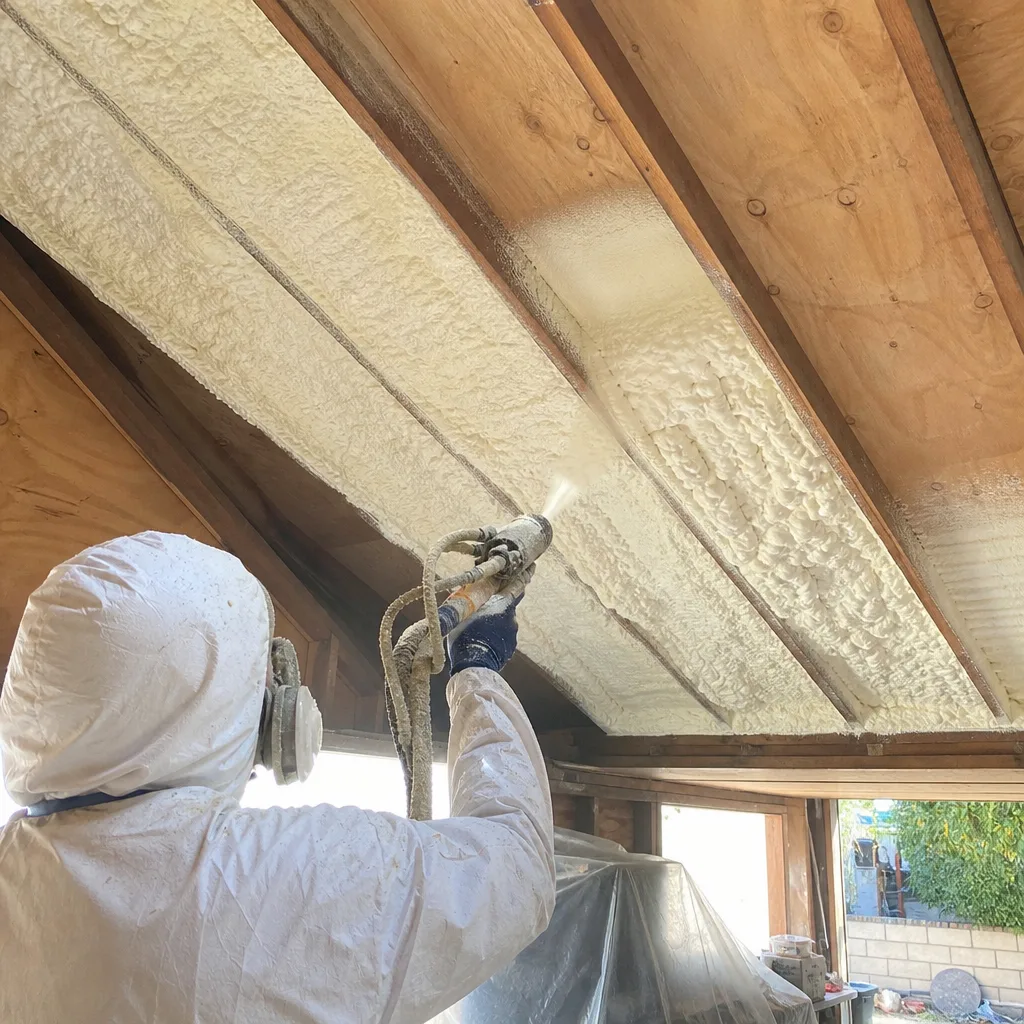
Rim Joist Spray Foam is the targeted treatment of the band joist area where your floor framing meets the foundation wall, one of the leakiest and most overlooked spots in any home. The rim joist, also called the band joist, sits above the foundation wall and below the first-floor framing, and in most homes it’s a thin piece of wood or engineered lumber with air leaks all around it. Those leaks let outside air pour into your basement or crawl space and force conditioned air out through the attic. We seal rim joists with closed-cell spray foam because it air-seals, insulates, and blocks moisture in one pass, which is exactly what that area needs. Most rim joist jobs run between $800 and $2,500 depending on the number of linear feet and access, and we give you the exact written number before any work starts.
Why That Band of Wood Matters
In a typical two-story home, the rim joist area can account for a surprising amount of total air leakage. Sealing it properly takes the stack effect, that chimney-like pull that drags outside air in at the bottom and pushes your treated air out at the top, down by a significant margin.
Fast Job, Permanent Result
A rim joist sealing job usually takes one day or less, but the improvement in basement comfort and humidity is permanent. We clean the area, apply closed-cell foam to the full depth of the joist bay, and document the work so you can see exactly what was sealed.
Crawl Space Spray Foam Insulation
Crawl Space Spray Foam Insulation addresses the damp, cold foundation space underneath a raised house, the source of a lot of first-floor comfort problems and musty indoor air. We apply closed-cell foam to the crawl space walls and rim joist, sealing that space from groundwater moisture and outdoor air while keeping the floor above warmer in winter and cooler in summer. The closed-cell material matters here because it’s the only spray foam that blocks both air and moisture, and a crawl space doesn’t need a water vapor problem on top of an air leak problem. Typical crawl space encapsulation with spray foam runs between $2,500 and $7,500 depending on square footage and access height. Every job comes with a written price before we start and a written 365-day guarantee after we finish.
Wall Seal, Not Just Floor Batts
Laying fiberglass batts against the underside of a crawl space floor is a common practice, but it rarely solves the real problem, which is moisture and air migration through the walls and rim. We focus the foam where the water and cold actually come from, which is the concrete wall and the wood band above it.
Solving the Musty Smell at the Source
The damp smell in a crawl space isn’t a mystery; it’s moisture, and sealing the space with closed-cell foam stops that moisture from migrating into the floor system and up into the living space. That’s often the difference between covering a smell with a dehumidifier and removing the reason the smell exists in the first place.
Garage Spray Foam Insulation
Garage Spray Foam Insulation is what we install when a garage is being converted to living space, used as a workshop or gym, or when a bedroom sits directly above a garage that turns into an oven every summer. The garage is the room homeowners forget about, but its walls and ceiling often sit against outdoor air on three or four sides, which means an uninsulated garage is a heat sink pulling conditioned air out of every adjoining room. We apply closed-cell or open-cell foam to garage walls, the ceiling below a bonus room, and the rim joist, depending on how the garage is used. A typical garage insulation job runs between $1,800 and $4,500 for walls plus ceiling, and we give you a written price before we start, every time, no exceptions.
When the Bonus Room Is Always Cold
If you have a finished space above the garage and it never holds temperature, the problem is almost always the garage ceiling insulation. Foam sprayed directly to the underside of the floor joists air-seals that boundary, and the bonus room above finally behaves like a regular room.
Workshops That Actually Get Used
A garage workshop in July or January is miserable without insulation, and a space heater just fights the air leaking through the walls. Once the walls are sealed and insulated, the garage holds whatever temperature you introduce, so you can actually use the space you already have.
Brands We Service
We work with eight leading insulation brands, including Knauf, CertainTeed, and Icynene, because the right material for your home is the one that matches its construction, not the one sitting on a truck that happens to be parked nearby. Knauf’s spray foam products deliver dependable, consistent expansion, which matters when you’re sealing irregular cavity depths. CertainTeed is one of the oldest names in building materials for a reason, and their foam products back up the reputation with testing data we can show you. Icynene has specialized in spray foam longer than nearly anyone, and their open-cell formulas are excellent for attic rooflines where you want maximum air-sealing with moderate material cost. Whether you have a brand preference already or want our honest recommendation based on your home’s specific conditions, we can help you choose correctly and install it properly.
Signs You Need a Pro Right Now
- Rooms that never hold temperature. If one bedroom always runs five or more degrees different from the rest of the house, you’re not imagining it. That’s air leaking through the building envelope, and spray foam is built to stop exactly that.
- Monthly bills climbing without a change in lifestyle. When your utility bill creeps up season after season but your thermostat habits haven’t changed, the house itself is the variable. Air leaks and inadequate insulation are usually the first and best explanation.
- Ice dams forming along the roofline in winter. Ice dams mean warm air is escaping through the attic and melting snow unevenly. Foaming the roofline stops that warm air at the source, which protects your shingles and ceilings.
- Drafty floors and cold feet on the first floor. Cold floors over a crawl space or basement usually mean the rim joist and foundation walls are leaking outdoor air. Closed-cell foam on those surfaces stops the draft at the actual leak point.
- You can smell the crawl space from the living room. Musty smells come from moisture, and moisture in a crawl space migrates into the house above. Sealing that space with closed-cell foam cuts the moisture path off at the foundation wall.
Our Process, Step by Step
- 1
You call, a real person answers. No voicemail, no automated phone tree. Call (325) 240-5411 any hour of any day, describe what you’re dealing with, and we’ll set up a time that works for your schedule with a committed arrival window.
- 2
We inspect and measure. A background-checked, uniformed technician walks your home with you, checks the attic, crawl space, rim joist, and wall cavities as applicable, and takes the actual measurements we’ll use to build your quote. We use digital moisture meters, depth probes, and thermal imaging where helpful to document what’s actually happening in your walls.
- 3
You get a written price before anything happens. We hand you the full cost of the job in writing before any work starts, and the number we write is the number you pay. No door-step adjustments, no surprise add-ons, no pressure to sign today.
- 4
We install, carefully. Our crew shows up in the committed window, protects the work area, applies the foam at the right depth and temperature, and cleans the job site before we leave. You’ll know exactly who is in your home, and we’ll leave it cleaner than we found it.
- 5
You get the guarantee in writing. Every job includes The Kingswell Guarantee: a written 365-day promise that if the work isn’t right, we come back and make it right at no charge. If something fails within the year, you call, we answer, and we return.
How Much Does Spray Foam Insulation Cost?
A typical open-cell attic roofline project runs between $3,500 and $9,000 depending on the square footage and roof pitch of the home. Closed-cell attic work generally runs higher, often $7,000 to $15,000, because the material is denser and applied at greater thickness. Wall cavity injection runs $1.00 to $3.00 per board foot plus access labor, and rim joist sealing typically runs $800 to $2,500 for the full perimeter of a standard basement. What affects the price? Depth of application, total square footage, access difficulty, and whether you’re choosing open-cell or closed-cell all factor in. You avoid overpaying the same way you avoid any contractor problem: get the number in writing before work starts, ask what’s included, and don’t sign anything vague. A free estimate from us includes exact measurements, material recommendation based on your home’s actual conditions, and the final written price you’ll pay. Call (325) 240-5411 and we’ll set it up.
Where We Work
Woolsey Attic Insulation serves homeowners and businesses across the United States through local crews who live and work in the communities they serve. Each Woolsey location is independently owned and operated under the Kingswell banner, so you get the consistency of a written guarantee and the accountability of a local team that’s actually in your area. Wherever you’re located, the promise is the same: a written price, a committed arrival window, a clean job site, and a written 365-day guarantee.
Frequently Asked Questions About Spray Foam Insulation
Spray foam insulation is a two-part liquid polyurethane product that expands into a foam on contact and seals air gaps while insulating. It’s applied as a liquid and cures into a solid, which allows it to completely fill irregular cavities unlike batt or blown-in products. Spray foam is the highest-performing insulation type for air-sealing in most residential applications.
Most spray foam jobs take one to two days from start to finish depending on the size of the space. A single rim joist sealing might take half a day, while a full attic roofline plus wall cavities could take two days. We’ll give you a clear timeline with your written estimate so you can plan around it.
Spray foam insulation typically costs between $0.75 and $3.50 per board foot depending on whether you choose open-cell or closed-cell and the depth required. A full attic project usually runs $3,500 to $15,000 depending on square footage. We provide the exact written number for your specific home before any work begins, so you’ll never pay a surprise amount. Call (325) 240-5411 for a free estimate.
We work with eight leading insulation brands including Knauf, CertainTeed, and Icynene, and we’re experienced with residential spray foam systems from virtually every manufacturer. The material recommendation we give you depends on your home’s construction and climate needs, not on what we happen to have in inventory. If you have a specific brand preference, we can accommodate it in most cases.
Yes, our phones are answered by a live person 24 hours a day, 7 days a week, not by an answering machine. If you have water damage that exposed wall cavities or a failed insulation job that needs immediate attention, we can schedule a visit quickly. Call (325) 240-5411 any time and a real person will help you right then.
Every job we complete includes a written 365-day guarantee through The Kingswell Guarantee. If the work isn’t done right within 365 days, we come back and fix it at no charge, period, in writing. You also get a written price before work starts, a committed arrival window, and a clean job site, all included on every job.
Clear the area around the work zone and move any items you don’t want dust on; we’ll handle the rest. Our crew brings protective coverings for your floors and furnishings. If you have pets, it’s helpful to keep them in another room during the work, and we’ll let you know exactly when the foam is safe to be around after application.
Schedule Your Spray Foam Insulation Service Today
Stop guessing where the drafts and high bills come from. Call Woolsey Attic Insulation at (325) 240-5411 and a live person will answer, 24 hours a day, any day of the week. We’ll schedule your free, no-obligation estimate, walk your home with you, and hand you a written price before any work starts. Every job includes the 365-Day Done Right Promise, guaranteed in writing. Call today and get the honest answer your house has been waiting for.
Written by Glenn Hartley, Owner at Woolsey Attic Insulation, serving homeowners across the United States since 2002.