
Spray Foam Insulation in Gilroy: Sealing Homes Against the Hecker Pass Moisture Cycle
Spray foam insulation in Gilroy typically costs $2,800 to $7,500 for a full attic application, with closed-cell running $1.30 to $2.50 per board foot and open-cell between $0.50 and $1.20 per board foot. Most homeowners see the fastest payback on attached garage ceilings and kneewalls, where the Hecker Pass evening moisture cycle attacks both your building envelope and the metal hardware inside it. Our crews serve Gilroy neighborhoods like Glen Loma, Rancho Hills, and the downtown core within 24 to 48 hours of your call. We give you a written price before any work starts, and that number never changes at the door. Call (325) 240-5411 for a free spray foam estimate in Gilroy.
Here’s the thing most insulation contractors won’t tell you about Gilroy: the town sits 20-plus miles from the coast, but every summer evening, cool, damp air from the Pacific funnels through the Hecker Pass corridor and rolls across the valley floor. That daily temperature swing and moisture pulse doesn’t just make your attic hot and your air conditioner work harder. It creates a condensation cycle inside unsealed building cavities that corrodes metal hardware, saturates old fiberglass batts, and separates poorly applied foam from the framing it’s supposed to seal. Choosing the Spray Foam Insulation material and application method that accounts for this local condition is what separates a job that performs for 20 years from one that fails in three.
Key Takeaways:
- Gilroy’s 100°F+ summer attics make air sealing the highest-ROI insulation upgrade you can make
- The Hecker Pass marine air pulse drives a daily dew cycle that standard fiberglass can’t handle
- Closed-cell foam on garage ceilings and kneewalls stops both heat gain and hardware corrosion
- Written pricing before work starts, 365-Day Done Right Promise, live person on the phone 24/7
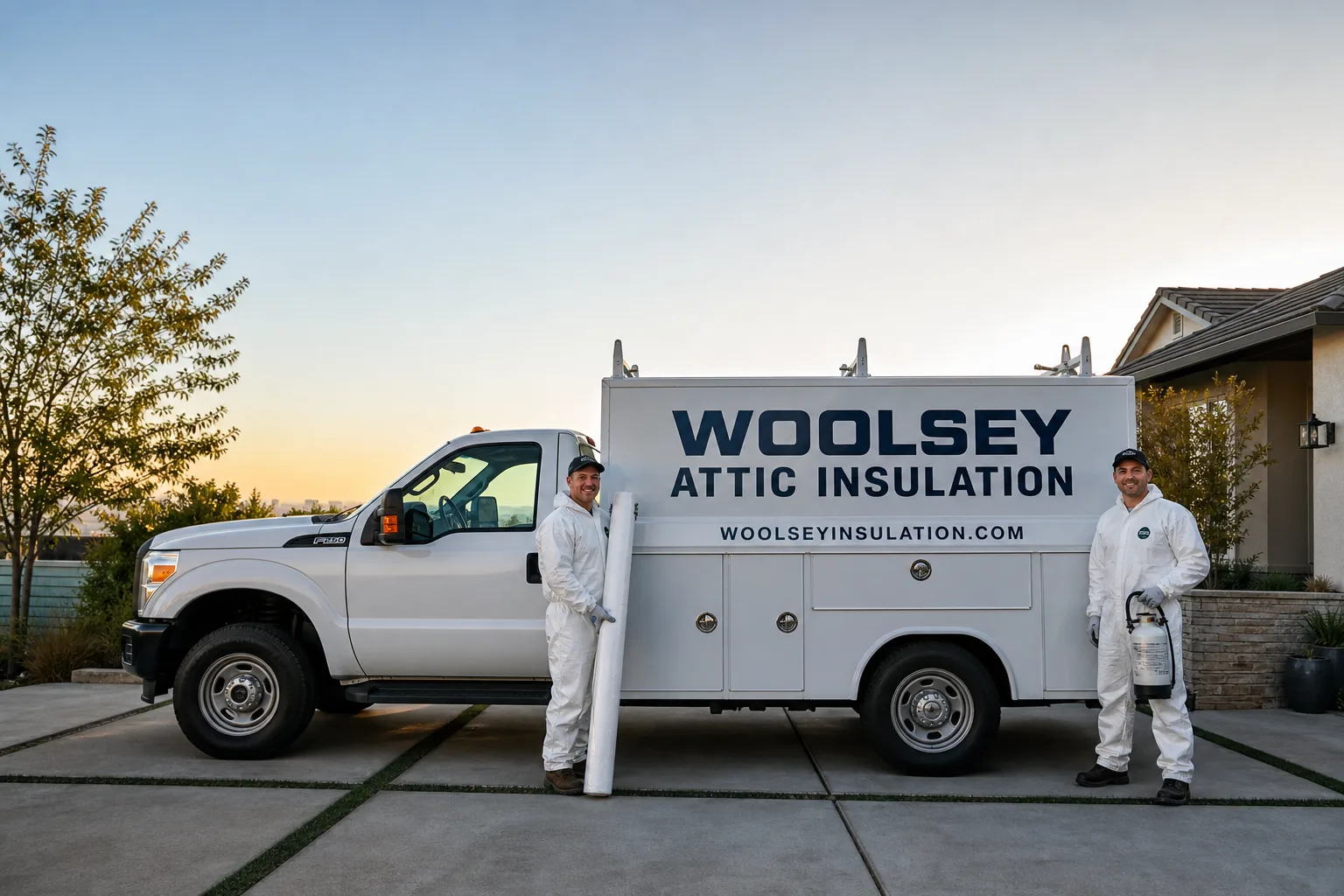
Why Woolsey Attic Insulation Is Gilroy’s Preferred Spray Foam Company
Glenn Hartley founded Woolsey in 2002 to fix a simple problem: insulation contractors who promise one price, then change it when they see your attic. That history matters in Gilroy, where the 1990s and 2000s tract homes east of US-101 were built fast, insulated to the minimum code of their day, and are now showing the consequences. We’ve walked hundreds of attics in Glen Loma, Rancho Hills, and the subdivisions off Santa Teresa Boulevard. We know what’s hiding up there because we’ve seen it in your neighbors’ homes.
Every Woolsey job in Gilroy runs on the Kingswell Guarantee. You get a written price before we touch anything. You get a real arrival window, not a four-hour shrug. We leave your attic and garage cleaner than we found them. And if the work isn’t right within 365 days, we come back and fix it at no charge, in writing. Our technicians are background-checked and uniformed, so you know exactly who’s walking through your door. When you call (325) 240-5411, a live person answers. Not a voicemail. Not an automated menu. Every hour of every day.
Woolsey is independently owned and operated under the Kingswell banner. We are not a national chain and we don’t franchise. We’re a local crew that specializes in attic and spray foam insulation only. Closed-cell, open-cell, rim joist, garage ceiling, roof deck. That’s the whole list.
Closed Cell Spray Foam Insulation in Gilroy
Closed Cell Spray Foam Insulation is the right first choice for most Gilroy attached garages and roof decks because it creates an air, vapor, and thermal barrier in one pass, something no batt or blown-in product can do. In a Gilroy context, that matters specifically because two problems hit at once: 100°F-plus attic temperatures during the day, then a marine air pulse through Hecker Pass after sunset that drops temperatures fast and dumps moisture into any gap in your building envelope. Closed-cell foam, typically applied at 2 to 3 inches for air-sealing or 5 to 6 inches for full R-value, stops both the heat and the moisture path.
Pricing for closed-cell in Gilroy runs $1.30 to $2.50 per board foot installed, depending on depth and cavity access. A typical 400-square-foot attached garage ceiling comes in around $2,200 to $3,800 fully sealed with closed-cell.
Garage Ceiling and Kneewall Sealing
When you foam an attached garage ceiling with closed-cell, you’re doing two things at once. You’re cutting the heat transfer from the garage’s unventilated roof deck into the living space above, and you’re preventing the nightly moisture film from Hecker Pass air from condensing on cold framing and garage-door hardware. The vapor-closed nature of the foam keeps that damp air from ever reaching the metal in the first place, which is the only real long-term fix we’ve found for the rust bloom Gilroy garages develop.
Roof Deck Applications
On older Gilroy homes, especially the pre-1960 cottages in the downtown core and along Eigleberry Street, roof deck foam is often the only realistic path to making an unconditioned attic behave like conditioned space. Closed-cell sprayed directly to the underside of the roof sheathing turns the attic into semi-conditioned buffer space, keeps the ductwork from baking, and eliminates the stack effect that pulls hot outside air through every gap. Budget $4,500 to $9,000 for a full roof-deck conversion on a 1,200 to 1,800-square-foot ranch.
Open Cell Spray Foam in Gilroy
Open Cell Spray Foam is the right material for interior walls and ceilings where you want maximum sound deadening and a strong air seal but don’t need the vapor-closed barrier that closed-cell provides. In Gilroy, open-cell makes the most sense in interior partition walls between a hot garage and a conditioned room when the garage itself is not part of the building’s moisture path, and in ceiling assemblies above fully vented attics where the foam is not the vapor control layer. It runs $0.50 to $1.20 per board foot and is more affordable per R-value than closed-cell.
Attic Bypass and Recessed Can Treatment
In the 1990s subdivisions east of US-101, especially Rancho Hills and Glen Loma, we routinely find recessed can lights that were never air-sealed at the rough opening. That’s a 2-square-inch hole per fixture, and with a dozen cans in a hallway ceiling, you’ve got a 24-square-inch hole in your thermal boundary. Open-cell foam can seal those bypasses effectively when properly ratioed and applied, but only if the cans are first addressed with rated covers and the foam has something clean to bond to. This is not a spray-and-hope job.
Sound Control Between Rooms
Open-cell foam’s open structure makes it a better acoustic damper than closed-cell, and that matters in Gilroy tract homes where master bedrooms sit directly over attached garages. We’ve had homeowners on Mantelli Drive and Wren Avenue call us because they could hear the garage-door opener through the bedroom floor every morning. Spraying 3 inches of open-cell into the garage ceiling joist bays typically drops that noise transfer by 75 percent, and you get the thermal benefit in the same pass.
Trusted Brands We Service in Gilroy
We install and service spray foam from Icynene, Demilec, and Johns Manville, along with batt products from Knauf, Rockwool, Owens Corning, CertainTeed, and GreenFiber. The reason we carry eight brands is simple: the right material for a Glen Loma tract home’s garage ceiling is not always the right material for a 1940s bungalow’s roof deck off Fourth Street. We spec for the house, not for what happens to be on the truck. For Gilroy customers, that means a recommendation based on your specific moisture exposure, framing type, and budget, not a one-foam-fits-all pitch.
Common Spray Foam Insulation Problems We See in Gilroy Homes
- Closed-cell sprayed over rusted garage hardware. If the torsion springs, hinges, and opener chain in your attached garage are already showing orange bloom from Hecker Pass moisture cycling, spraying closed-cell directly over them traps the remaining moisture film against the metal. Pitting accelerates behind the foam. The hardware needs to be addressed, cleaned, and protected before foam ever goes in.
- Open-cell shrinking away from unsealed can lights. In 100°F-plus Gilroy attics, incorrectly ratioed open-cell foam sprayed around 1990s recessed cans offgasses and pulls back from the housing as it cures. That reopens the exact air bypass the foam was supposed to close. If your upstairs rooms run 10°F hotter than the rest of the house, this is the first thing we check.
- Foam on a garage kneewall with no vapor strategy. The Hecker Pass moisture pulse hits the west side of attached garages hard. Foam sprayed across that vapor path without accounting for where condensation lands can push moisture to the cold-side top plate and quietly rot framing behind the foam. In Gilroy, vapor-retarder strategy on kneewalls is not optional.
- Original fiberglass batts in 1990s tract homes. Most homes built during Gilroy’s commuter boom along Santa Teresa Boulevard and east of 101 still have their original batts. After 20 to 30 years of gravity and attic heat, those batts have settled and lost meaningful R-value. Foaming over them without removing them first creates a thermal short circuit and wastes your money.
Pricing for Spray Foam Insulation in Gilroy, CA
Here’s what you can expect to pay in Gilroy: open-cell spray foam runs $0.50 to $1.20 per board foot, closed-cell runs $1.30 to $2.50 per board foot, and a full attached garage ceiling and kneewall job in a standard 400-square-foot two-car garage lands between $2,200 and $4,800 depending on foam type, depth, and access. A complete attic air-seal and insulation package for a 1,600-square-foot 1990s tract home typically runs $3,800 to $7,500. Rim joist work in a crawlspace or basement runs $900 to $2,400. Every job gets a written price before any work starts. No door-step changes. Call (325) 240-5411 and we’ll give you the exact number for your home.
We Also Serve Cities Near Gilroy
Our crews work throughout southern Santa Clara County. If you’re in San Martin, Morgan Hill, Los Gatos, or Campbell, we’ll bring the same Kingswell Guarantee to your door. And if you’re in Gilroy itself, you’re at the center of our coverage area. Learn more about Spray Foam Insulation in Gilroy or call (325) 240-5411 and we’ll schedule a walkthrough.
Serving Gilroy, CA - Our Local Coverage Area
We’re based in the Gilroy area and know this community well. Use the map below to see our service coverage - if you’re nearby, we can almost certainly help.
FAQs About Spray Foam Insulation in Gilroy
It can, if the foam is applied directly over already-corroding hardware without a plan. The real answer is: it depends on what’s done first. Closed-cell foam seals the moisture path, which is the only long-term fix for Gilroy’s Hecker Pass-driven condensation cycle. But spraying over rusted springs and chains without addressing them first traps the moisture film that’s already on the metal and accelerates pitting. The correct sequence is: inspect, replace or coat the corroded hardware, then foam. Call (325) 240-5411 and we’ll walk you through the right order for your garage.
Because your Glen Loma home sits in a fundamentally different moisture environment than a San Jose home. San Jose gets a marine influence that moderates temperature swings. Glen Loma gets the full Gilroy heat soak followed by the Hecker Pass evening moisture pulse. That daily wet-dry cycle demands a foam that holds a vapor barrier, and only closed-cell does that. Open-cell can work in San Jose, but in Gilroy’s humidity cycle, it routinely gets saturated by the evening marine air and can’t maintain its thermal performance.
Yes, but only when the bypasses around those cans are properly sealed with rated covers and the foam has a clean, solid surface to bond to. In Rancho Hills specifically, we find most of the original can light rough openings were never sealed at all. That’s a chimney for attic air. Foam the ceiling deck, seal the cans, and the upstairs temperature normalizes within the first cooling season. We’ve measured the before-and-after in dozens of Rancho Hills homes and the 8 to 12°F drop is consistent.
Yes, if you focus on the attic and roof deck first. A 1940s wood-frame bungalow near Fifth Street or Church Street has to worry about the same 100°F attic temperatures a tract home does, but the framing and sheathing are often older, and the wall cavities are usually inaccessible without major demolition. The right move on those homes is roof-deck closed-cell foam, which addresses the largest heat-gain surface and makes the whole building feel different. It’s the single best retrofit dollar you can spend on a downtown Gilroy cottage.
It’s the deciding factor. The cool, damp air that rolls through Hecker Pass every summer evening condenses on any uninsulated metal or cold surface inside your garage. Closed-cell foam stops that condensation by preventing the moist air from reaching the cold surface in the first place. Open-cell cannot do that, because it absorbs moisture and quickly loses R-value under Gilroy’s specific wet-dry cycle. For attached garages in any Gilroy neighborhood, closed-cell is the correct material. Call (325) 240-5411 for a free garage inspection and exact written quote.
If you need spray foam insulation in Gilroy, call (325) 240-5411 now. We’ll pick up. We’ll give you a real price in writing before any work begins. And we’ll put the whole thing, including the 365-Day Done Right Promise, on paper before you sign anything.
Written by Glenn Hartley, Owner at Woolsey Attic Insulation, serving Gilroy and the surrounding Santa Clara County communities with attic and spray foam insulation since 2002.