
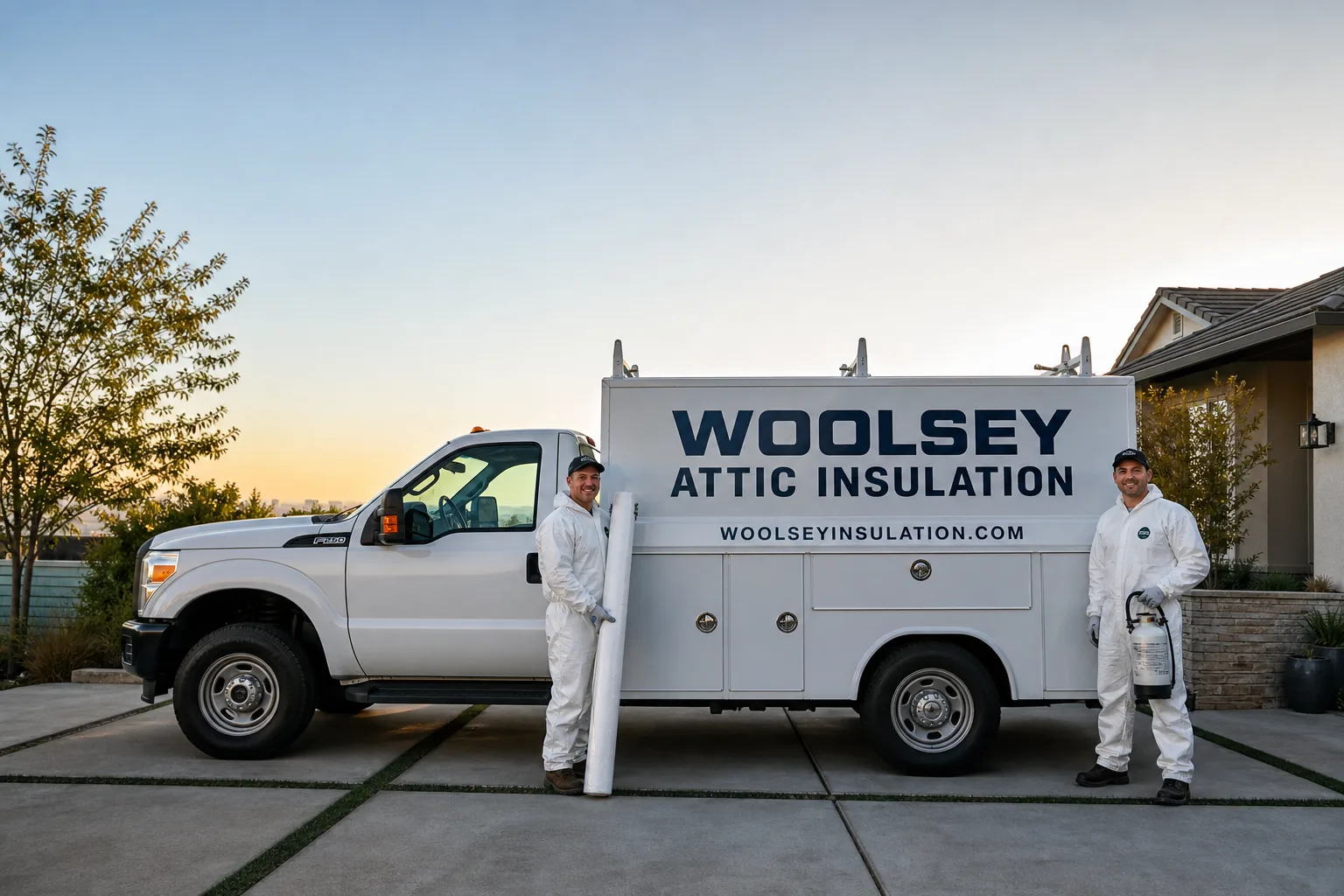
Fast, Reliable Spray Foam Insulation Across Highland
Spray foam insulation in Highland usually costs between $2,800 and $6,500 for a typical attic, with open-cell running $1.10 to $1.80 per board foot and closed-cell running $2.20 to $3.40 per board foot installed. Most Highland jobs are finished in one to two days, and we can often schedule within the same week you call. If your attic hit 150°F last summer or your gas bill spiked on cold foothill nights, the problem isn’t your thermostat. It’s the thin, compressed insulation in a house built for a milder climate than the one Highland actually has. Call (325) 240-5411 and we’ll give you a written price before any work starts, not after.
Why Woolsey Attic Insulation Is Highland’s Preferred Spray Foam Insulation Company
We’ve worked in enough Highland tract homes to know what’s behind the drywall before we cut the first inspection hole. Homes built between 1965 and 1995 along Base Line, Church Street, and up toward East Highland were framed fast and insulated thin. R-11 batt in the walls, barely anything in the attic, and garage ceilings that were never insulated at all. When a Highland homeowner calls us about a hot second floor or a cold kitchen on a winter morning, we already know what we’re likely to find.
Glenn Hartley, who leads our crews, has spent years on spray foam jobs across the Inland Empire’s foothill communities. That matters because Highland isn’t Fontana. The same street that bakes at 105°F in August gets cold mountain air draining down off the San Bernardino Mountains on clear winter nights. Foam that’s spec’d for a flat-valley house won’t always cut it here, and we size every job for the thermal swing your specific block actually sees. Our dispatch and scheduling run out of the brand’s Inland Empire office, but our crews work Highland jobs every week, and we know the neighborhoods from East Highlands Ranch down to the older grid streets near the 210.
Every Highland job gets the same thing: a written price before work starts, background-checked uniformed technicians on site, a committed arrival window, and the 365-Day Done Right Promise in writing. If the foam doesn’t perform the way we said it would within a full year, we come back and fix it at no charge. No voicemail maze when you call. A live person answers at (325) 240-5411, any hour, any day.
Open Cell Spray Foam in Highland
Open cell spray foam is the workhorse for Highland attic ceilings, especially in the 1970s-through-1990s tract homes that make up much of the city’s housing stock. It expands roughly 100 times its liquid volume and fills every gap around top plates, electrical penetrations, and recessed light housings, turning a leaky attic into a continuous air barrier. In Highland, that matters more than in most inland cities because the mountain air drainage at night pulls heat out of the house even when daytime temps stay mild.
Open cell foam in a typical Highland attic runs $2,800 to $4,800 installed. It’s semi-rigid, so it moves with the framing as the house cycles between 105°F afternoons and near-freezing winter mornings. We most often install open cell against the roofline, which keeps the attic semi-conditioned and stops the 150°F attic-temperature spikes that radiate into the living space below.
When open cell is the right call
If your attic is used primarily for storage and you want to keep the living space below it stable, open cell against the roofline is usually the best value. It air-seals the entire attic floor and ceiling plane at once. For homes where rodents or moisture have compressed the existing fiberglass to near zero, open cell replaces that failed system rather than just adding another layer on top of a problem.
Garage ceilings and shared walls
Highland has a lot of garages that share a ceiling with a bedroom or kitchen. When that ceiling is uninsulated, the garage acts like a heat pump, driving summer cooling loads and making winter rooms feel like iceboxes. Open cell foam on the garage ceiling in Highland runs $900 to $2,200 depending on square footage and access, and it’s one of the fastest ways to fix a room that never holds temperature.
Spray Foam Insulation Contractors in Highland
Spray foam insulation contractors in Highland are not all the same, and the difference shows up in the details. The substrate has to be dry and clean before foam touches it, especially in foothill-adjacent Highland homes where temperature cycling has pushed moisture into the sheathing over decades. We inspect the deck and top plates before we spray, and we’ll stop the job and tell you if something underneath needs to be addressed first. That honesty is part of the written price we hand you before we start.
Full attic spray foam in Highland generally runs $3,200 to $6,500 for closed cell and $2,800 to $4,800 for open cell. Closed cell goes in at $2.20 to $3.40 per board foot and adds structural strength plus a vapor barrier, which is worth considering on the foothill side where cold mountain air meets warm interior air and drives moisture into the framing.
Closed cell for rim joists and roof decks
Rim joist spray foam in Highland runs $1,400 to $2,600 for a typical home. Closed cell here is the standard because the rim joist sees the most extreme temperature cycling of any part of the envelope. We also spray closed cell on roof decks where the homeowner wants the attic to remain outside the conditioned space but wants to stop heat gain through the roof itself.
Air sealing before the foam goes in
Every Highland spray foam job starts with air sealing, not foam. We seal top plates, wire chases, plumbing penetrations, and any chase connecting the garage to the attic. If you skip this step, the foam performs well below its rated R-value. It’s the difference between a job that drops your attic temp by 35 degrees and one that just makes the attic look insulated.
Trusted Brands We Service in Highland
We install and service spray foam from Owens Corning, Icynene, and Demilec, and we stock the material locally so Highland crews aren’t waiting on a truck from out of state. We also work with Johns Manville and Knauf for cases where the home’s existing system needs a partial retrofit rather than a full foam replacement. The brand we recommend depends on where the foam is going, what R-value the house needs, and whether the job calls for open or closed cell. We’ll show you the spec sheet before we spray, not after.
Common Spray Foam Insulation Problems We See in Highland Homes
- Compressed, moisture-cycled fiberglass batt in 1965-1995 tract walls. The swing between 105°F afternoons and cold mountain-air nights forces moisture in and out of batt insulation every day. Over ten or fifteen years, R-11 batt loses a third to half of its rated performance, and Highland homes are now hitting that window.
- Uninsulated garage ceilings bordering living space. This is one of the most common defects we find in Highland tract homes. The garage gets 100°F plus in summer, and that heat bleeds straight into the bedroom or kitchen above it. Spray foam on the garage ceiling usually pays for itself in one cooling season.
- Foam adhesion failure from spraying over wet or dirty sheathing. Foothill-adjacent Highland homes are prone to moisture on the roof deck from overnight mountain-air drainage. Foam sprayed over that substrate bubbles and peels within months. We always inspect and dry the deck before spraying.
- Attic temps over 150°F with no air sealing under the existing insulation. Adding foam on top of a leaky attic doesn’t fix the leak. Highland attics get hot enough that even small gaps around recessed lights and top plates force hot air into the living space. Air sealing comes first, every time.
Pricing for Spray Foam Insulation in Highland, CA
Here’s what Highland homeowners can expect to pay for common spray foam jobs. Open cell attic foam runs $1.10 to $1.80 per board foot, which puts a typical 1,200-to-1,800-square-foot attic at $2,800 to $4,800. Closed cell runs $2.20 to $3.40 per board foot, so the same attic comes in at $3,200 to $6,500. Rim joist work is $1,400 to $2,600. Garage ceiling foam is $900 to $2,200. The exact number depends on square footage, access, and whether we need to remove failed batt first, but you’ll get that number in writing before any work starts. Call (325) 240-5411 for a free estimate on your Highland home.
We also serve Spray Foam Insulation in Highland and the surrounding communities, and our Spray Foam Insulation team handles everything from attic retrofits to full rim joist and garage ceiling work.
We Also Serve Cities Near Highland
Our crews cover Highland and the foothill corridor down to San Bernardino, Loma Linda, Redlands, and Mentone. If you’re in any of these nearby cities and your attic is underperforming, the same written pricing and 365-day promise applies. We schedule Highland jobs first, then route crews outward so you’re not waiting on a truck from across the county.
Serving Highland, CA - Our Local Coverage Area
We’re based in the Highland area and know this community well. Use the map below to see our service coverage - if you’re nearby, we can almost certainly help.
FAQs About Spray Foam Insulation in Highland
Highland sits at the base of the San Bernardino Mountains, so cold katabatic air drains down the foothills on clear winter nights and drives heat out through any uninsulated surface. Fontana sits in the flat valley and never sees that mountain-air drain. An uninsulated garage ceiling in Highland loses heat year-round, not just in summer, and it’s one of the first places we look when a homeowner’s gas bill spikes in winter. Call (325) 240-5411 and we’ll inspect it free.
Yes, and the reason is simple. Fiberglass batt, even new batt, doesn’t stop air movement. In a 150°F Highland attic, hot air finds every seam, penetration, and top plate gap and pushes into the living space. Spray foam air-seals those gaps and insulates in one pass. Homeowners who switch from batt to foam in Highland typically see attic temp drops of 30 to 40 degrees.
They often do. Homes on the uphill side, like the streets climbing toward East Highland, see wider daily temperature swings than homes on the flats near the 210. That means more thermal cycling on the framing and more moisture movement at night. We usually recommend closed cell on rim joists and roof decks in those areas for the added vapor barrier and structural rigidity, where flat-valley homes can get away with open cell.
We install Owens Corning, Icynene, and Demilec spray foam, and we stock material locally so Highland jobs don’t stall waiting on freight. We also work with Johns Manville and Knauf when a partial retrofit is the better fit than full foam. The brand recommendation comes from the job spec and the home’s location, not from whatever happens to be on the truck.
Spray foam cures best when the substrate is above 60°F and dry. Highland’s cold winter mornings can slow open cell expansion and make closed cell bead up if the deck is cold, so we schedule foothill-side spray jobs for mid-morning or later in winter. Spraying over wet sheathing, which we see often in foothill-adjacent Highland homes, causes adhesion failure and bubbling. We inspect every deck before we spray and will not proceed if moisture is present.
If your Highland home is under-insulated and you’re tired of paying for it every month on your energy bill, call (325) 240-5411. We’ll come out, inspect your attic and garage ceiling, and hand you a written price before we touch a single spray gun. Every job includes the 365-Day Done Right Promise in writing, a committed arrival window, and a clean job site when we leave. We answer the phone live, 24 hours a day, so you’ll never sit through a voicemail maze when you call.
Written by Glenn Hartley, Owner at Woolsey Attic Insulation, serving Highland and the surrounding Inland Empire foothill communities.