
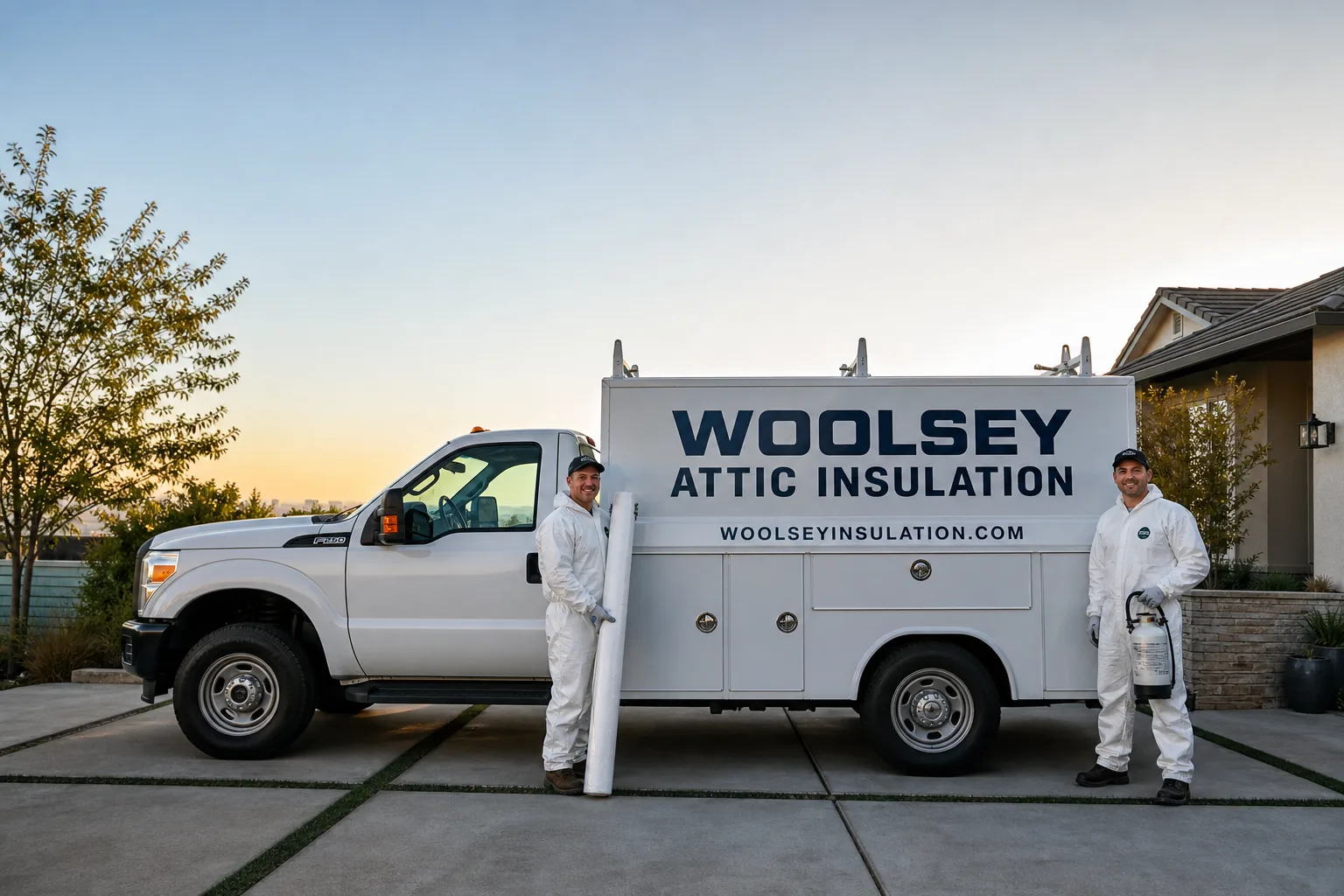
Fast, Reliable Spray Foam Insulation Across Lake Elsinore
Spray foam insulation in Lake Elsinore runs between $1,800 and $6,900 for most residential jobs, depending on square footage, cavity depth, and whether you’re upgrading attic, walls, or rim joists. The dominant job in this market isn’t new construction; it’s retrofitting the thousands of 1990s through 2008 tract homes whose R-19 and R-30 attic batts were never designed for valley-floor summer temperatures that push past 108°F and attic heat above 150°F. We schedule Lake Elsinore jobs with committed arrival windows, not four-hour guesswork, and every quote is a written number before any work begins. Call (325) 240-5411 and you’ll get a live person, day or night.
Woolsey Attic Insulation is the attic and Spray Foam Insulation specialist serving the Elsinore Valley. We know what summer does to a Canyon Hills west wall and what the Ortega wind corridor does to lakefront top plates, because we’ve opened those walls and seen the damage. That local knowledge changes the scope of work, and it changes the result.
Why Woolsey Attic Insulation Is Lake Elsinore’s Preferred Spray Foam Insulation Company
We don’t ask you to take our word for it. We put every promise in writing, on every single job, before the first crew member rolls up. The Kingswell Way runs like this: a written price before work begins, a committed arrival window we actually hit, a clean job site when we’re done, a written guarantee on the work, and a free return visit if it fails within 365 days. That’s the entire agreement, stated plainly.
Our crews arrive background-checked and uniformed, so you know exactly who’s walking into your house. We work with eight leading insulation brands including Owens Corning, Johns Manville, and Knauf, which means the material recommendation fits the specific exposure and cavity the home actually has, not whatever happens to be on the truck that morning. For Lake Elsinore homeowners who have watched a contractor change the price at the door or vanish after a bad install, that’s the difference between a guess and a guarantee.
Glenn Hartley leads our team with a straightforward mandate: pick up the phone, show up in the window, say the real price before touching the work, and stand behind it for a full year in writing. That’s not a marketing slogan. It’s the Kingswell Guarantee, and it’s included on every installation we do in Lake Elsinore.
Closed Cell Spray Foam Insulation in Lake Elsinore
Closed Cell Spray Foam Insulation in Lake Elsinore is the insulation answer to canyon-hugging, sun-baked wall cavities, because it’s a two-part liquid that expands on contact and hardens into a dense, rigid foam with an R-value of roughly R-6.5 to R-7 per inch. It also forms its own vapor and air barrier, which means it stops the convective air movement that fiberglass batts can’t. For homes in Canyon Hills where west-facing walls soak up four to five hours of unobstructed afternoon sun, closed cell is the retrofit that finally brings those rooms in line with the rest of the house.
A typical closed cell spray foam wall retrofit in Lake Elsinore runs $3,200 to $6,900 depending on cavity count and depth. Rim joist jobs are smaller in scope and typically land between $1,400 and $2,800. We remove the failed material, prep the cavity, and install closed cell foam to the specified depth, then seal top plates, penetrations, and any gap the Ortega winds were pressurizing.
West and South Wall Retrofit
Homes on the western hillsides absorb the worst afternoon heat. Closed cell foam at two to three inches in those wall cavities creates an air seal plus a thermal break that R-13 batts could never hold. The difference in those rooms is measurable within the first summer.
Attic Roofline Sealing
When attic temperatures spike past 150°F, an unsealed roofline pushes that heat into living space through the ceiling plane. Closed cell foam on the roofline deck creates a sealed, conditioned attic that keeps that heat from loading the house in the first place.
Open Cell Spray Foam in Lake Elsinore
Open Cell Spray Foam in Lake Elsinore is the better fit for attics and interior cavities because it expands more aggressively, costs less per board foot, and excels at air sealing at a lower installed density. It cures soft and spongy with an R-value of about R-3.5 to R-4 per inch, which means it’s not a wall-cavity replacement for the heat loads in Canyon Hills, but it’s an excellent choice for attic floors, rooflines where ventilation remains, and interior sound-control cavities throughout the valley.
An open cell attic floor retrofit in a Lake Elsinore tract home typically runs $2,400 to $5,200, depending on attic square footage and existing batt removal. When we install open cell, we remove the failed R-19 or R-30 first. You can’t foam over compressed, sagging batts and expect the result to hold. Prep is half the job, and we don’t skip it.
Attic Floor Air Sealing
Open cell foam seals the attic floor against the stack effect that pulls hot air down through can lights, top plates, and wiring penetrations. In an Elsinore Valley summer, that air movement is relentless. Sealing it is the single biggest efficiency gain most homes will ever see.
Interior Cavity Sound Control
Open cell foam absorbs sound better than any batt product we install. For bedrooms against loud street frontage along Railroad Canyon Road or Main Street, it makes an immediate difference in how the room feels at night.
Trusted Brands We Service in Lake Elsinore
We install Owens Corning closed cell and open cell lines because their expansion profile and cured density hold up well in Riverside County heat. We also work with Johns Manville and Knauf products when the project calls for a specific open cell or vapor-open assembly. Because our teams service Lake Elsinore locally from the Inland Empire office, we’re not waiting on materials from out of state. We keep our supply line short and our response time shorter. When a Summerly homeowner calls on a Tuesday needing a roofline retrofit before the next heat wave, we can usually have crews on site within days, not weeks.
Common Spray Foam Insulation Problems We See in Lake Elsinore Homes
- Builder-grade R-19 and R-30 attic batts in 1990s – 2008 tract homes that sag and compress after years of 150°F+ attic heat. The fiberglass loses its loft, gaps open at the top plates, and hot attic air pours into the conditioned space. Spray foam doesn’t just cover these cavities – it bridges them, but only if the failed batts come out first.
- West-facing R-13 wall batts in Canyon Hills that bake daily under unprotected afternoon sun and lose contact with the sheathing. The batt pulls away from the wall, convection loops form, and the room runs 10 to 12°F hotter than the rest of the house. A full-cavity foam retrofit is the fix, not spot filling.
- Older 1960s – 1970s lakefront homes with no wall insulation and no radiant barrier at all. These homes don’t just need better insulation; they need an air seal from the start. If top plates, sill plates, and electrical penetrations aren’t sealed before foam goes in, the Ortega wind corridor along Highway 74 will find every gap and defeat the work.
- Ortega wind-driven air infiltration in hillside and western-exposure homes. Seasonal gusts push outdoor air through wall penetrations and around window frames, and that pressure makes any insulation underperform. Sealing the cavity before insulating is not optional out here.
Pricing for Spray Foam Insulation in Lake Elsinore, CA
For a typical Lake Elsinore tract home, an open cell attic floor retrofit runs $2,400 to $5,200, a closed cell wall retrofit lands between $3,200 and $6,900, and a rim joist sealing job runs $1,400 to $2,800. Attic roofline closed cell work on a standard single-story home falls in the $4,800 to $7,200 range. What moves the number is square footage, cavity depth, and how much failed material has to come out first. We don’t give vague ranges over the phone and then raise the number at the door. We give you the exact written number before anything starts, and that number doesn’t move unless the scope changes. Call (325) 240-5411 for a quote on your specific home. The estimate is free.
We Also Serve Cities Near Lake Elsinore
Woolsey crews serve the full Elsinore Valley and surrounding commuter communities. We work in Wildomar, Murrieta, Perris, and Menifee on the same committed schedule we run in Lake Elsinore, with the same written pricing and the same 365-day guarantee on every job. If you’re on the edge of the valley, call and we’ll tell you straight whether we can get to you on the date you need.
Serving Lake Elsinore, CA - Our Local Coverage Area
We’re based in the Lake Elsinore area and know this community well. Use the map below to see our service coverage - if you’re nearby, we can almost certainly help.
FAQs About Spray Foam Insulation in Lake Elsinore
That hot wall is the R-13 fiberglass batt that lost contact with the sheathing, and it’s the most common spray foam retrofit trigger we see in Canyon Hills. Four to five hours of unobstructed afternoon sun bake that wall, the batt sags and compresses, and the heat from the stucco bleeds straight through into the room. Closed cell spray foam fills the cavity fully and creates an air and thermal barrier that stops that heat load at the wall. Call (325) 240-5411 and we’ll inspect it and tell you exactly what it needs.
No. R-30 is the California minimum-era value that went into most 1990s through 2008 tract homes across the valley, and it was never designed for attic temperatures that push past 150°F in July and August. Spray foam air sealing plus an upgrade to R-38 or higher closed or open cell above the ceiling plane is the retrofit that actually holds. We can show you the difference on a thermal camera before you commit to anything.
For 1960s and 1970s lakefront homes with no existing wall insulation, closed cell is the right call in exterior wall cavities because it adds structural rigidity and acts as its own vapor barrier. Open cell is a better fit for the attic floor and interior sound control. We’ll walk the house with you and give you a written recommendation for each cavity, not one blanket answer for the whole structure.
The Ortega wind corridor channels steady seasonal gusts through the western hillside neighborhoods, and that pressure drives outside air into homes through top plates, sill plates, can lights, and any unsealed penetration. Spray foam seals those points as it’s applied, which is exactly what makes it different from batt insulation that just sits in a cavity. If you skip the air sealing, foam still works better than batts, but you leave performance on the table.
In most cases, yes, because the upstairs rooms sit directly under a hot attic floor, and the downstairs rooms don’t. Sealing and insulating the attic floor with spray foam reduces the heat load on the upstairs ceiling plane, which brings the two levels much closer in temperature. It’s not a guarantee of perfect balance, but we’ve seen 8 to 10°F spreads close to 2 to 3°F after a proper attic retrofit. Call (325) 240-5411 and we’ll evaluate your attic specifically.
Written by Glenn Hartley, Owner at Woolsey Attic Insulation, serving Lake Elsinore and the Elsinore Valley with the Kingswell Guarantee.