
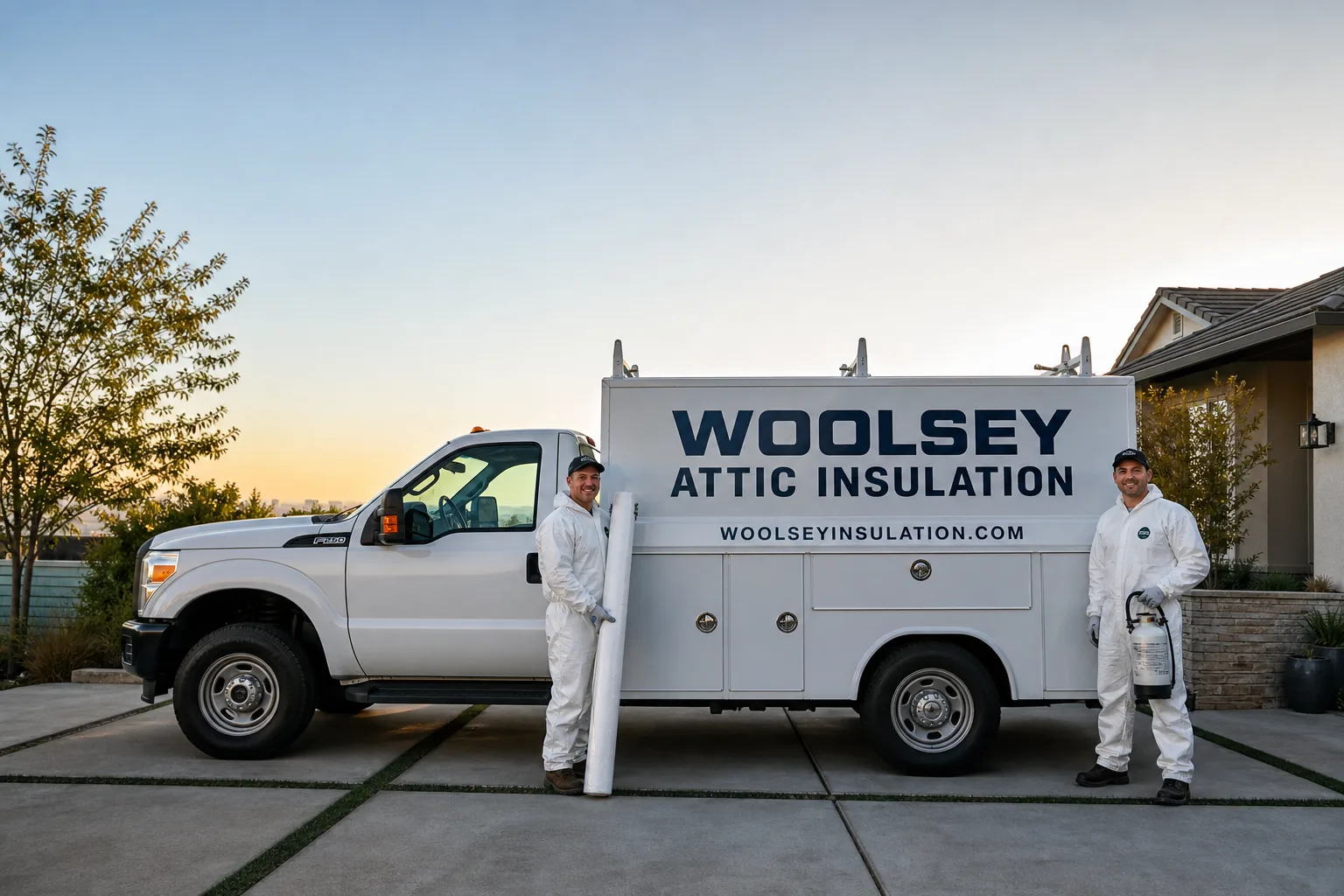
Fast, Reliable Spray Foam Insulation Across Manhattan Beach
Spray foam insulation in Manhattan Beach runs between $3,200 and $11,500 for most residential projects, with open-cell applications on the lower end and closed-cell or roof deck work on the higher end. The number moves based on square footage, cavity depth, and whether we’re working inside a gutted Sand Section cottage or a new Hill Section build. We give you the exact written price before any work starts. That’s The Kingswell Way, and it’s been how we’ve operated since Glenn Hartley founded Woolsey Attic Insulation in 2002. Call (325) 240-5411 and a live person answers, 24 hours a day.
Manhattan Beach isn’t like inland Los Angeles. The marine layer keeps temperatures in a narrow 58 – 75°F band year-round, so insulation here is rarely about surviving brutal heat or cold. It’s about stopping salt-laden coastal fog from getting into wall cavities and attic knee-walls, where it saturates fiberglass, wets freshly sprayed foam before it cures, and quietly wrecks air-sealing work. Our crews know the Sand Section’s 30-foot lot lines and the Hill Section’s mid-century framing. That local knowledge shows up in every bid and every finished job.
Why Woolsey Attic Insulation Is Manhattan Beach’s Preferred Spray Foam Insulation Company
Manhattan Beach homeowners tend to ask the same two questions: will you actually show up in the window you promised, and is the price you quoted the price I’ll pay? Yes on both counts. Every Woolsey job starts with a written price delivered before any work begins, no exceptions. We show up in a committed arrival window, background-checked and uniformed, and we leave the job site cleaner than we found it. Our Spray Foam Insulation team has worked on gutted 1950s cottages, 1980s Hill Section renovations, and brand-new builds going through final Title 24 inspection.
The 365-Day Done Right Promise backs every installation. If something isn’t right within a year, we come back and fix it at no charge, in writing. That’s not a vague reassurance. That’s a specific, enforceable commitment included on every job. When you’re spending $3 – 5 million on a Manhattan Beach rebuild, you don’t tolerate a contractor who goes quiet after the final invoice. Neither do we.
Dispatch and scheduling are coordinated from our Los Angeles office, with crews serving Manhattan Beach locally. Response time for most Manhattan Beach projects is 24 – 48 hours from the initial call to an on-site estimate.
Open Cell Spray Foam in Manhattan Beach
Open Cell Spray Foam in Manhattan Beach is our most common specification for interior wall cavities and attic knee-walls on existing homes. It’s a two-part liquid that expands on contact with air, filling the cavity with a dense, spongy foam that seals gaps airtight while still allowing the wall assembly to breathe. In a coastal climate like Manhattan Beach, that’s the right trade-off for most retrofit work. Open-cell insulation typically runs $1.10 – $1.80 per board foot in Manhattan Beach, so a standard Sand Section attic knee-wall job lands between $2,400 and $4,600 depending on cavity depth and access.
Why Open-Cell Fits Coastal Retrofit Work
Older Manhattan Beach homes have framing that moves. The 1940s and 1950s beach cottages in the Sand Section expand and contract with the marine layer’s humidity swings, and open-cell foam flexes with that movement. Closed-cell is stiffer and stronger, which suits new construction, but open-cell is often the better retrofit choice. The real enemy here is fog intrusion through unventilated attic soffits, and open-cell applied with proper soffit sealing stops that moisture path at the source.
How We Verify the Air Seal
On gutted Manhattan Beach renovations, our crews document foam coverage with photos for HERS rater sign-off, not just thermal performance. Title 24 and CalGreen enforcement in this city is aggressive, especially on rebuilds. SoCal Edison’s efficiency programs and local building inspectors expect verified air sealing, and we deliver documentation that holds up at final inspection. That’s a Manhattan Beach-specific reality. In inland cities, the inspector checks insulation thickness. Here, they check the whole air-sealing assembly.
Spray Foam Insulation Contractors in Manhattan Beach
Spray Foam Insulation Contractors in Manhattan Beach are working almost exclusively inside active high-end construction right now. The Sand Section and Hill Section are in a sustained teardown-and-rebuild cycle, where post-WWII beach cottages are being replaced with large luxury homes built to California’s strict Title 24 energy code. That shifts the work. In neighboring inland cities, the job is mostly retrofit upgrades. In Manhattan Beach, our crews are on job sites where the general contractor needs verified air sealing, documented foam coverage, and a HERS rater sign-off before anyone gets a certificate of occupancy. Typical contractor-priced spray foam work in Manhattan Beach runs $4,800 – $11,500 per project depending on scope.
Documentation for Title 24 and HERS Raters
Here’s what most Manhattan Beach builders care about: a HERS rater has to verify the air-sealing credit on the owner’s Title 24 paperwork. If the foam-to-rim-joist interface is skipped because there’s no room to swing equipment on a 30-foot lot, the whole-building air seal fails and the rater catches it at final. We know those pressure points. We flash the rim joist, seal the soffit penetrations, and hand over coverage photos the rater can actually use.
Working Inside a Live Job Site
On a gutted 1950s cottage in the Sand Section, our crew opened an unventilated attic knee-wall and found the original rock-wool batts compressed and saturated by decades of coastal fog intrusion through the soffits. The 30-foot lot lines ruled out exterior rigid board. So we flash-and-batted the knee-walls with Icynene open-cell spray foam, sealed every soffit penetration, and left photos for the HERS rater to verify the air-sealing credit on the owner’s Title 24 paperwork. That’s the kind of problem solving Manhattan Beach demands. Inland crews don’t see this failure mode. We do, every month.
Trusted Brands We Service in Manhattan Beach
We work with eight leading insulation brands, and for Manhattan Beach coastal rebuilds we typically specify Owens Corning, Icynene, and Demilec. Open-cell Icynene is our go-to for Sand Section retrofit knee-walls because it handles the humidity cycling without losing its air seal. Demilec closed-cell comes into play on new Hill Section builds where the engineer wants higher R-value per inch. Owens Corning batts round out the flash-and-batt assemblies. We stock what Manhattan Beach jobs actually need, not whatever happens to be on the truck. That means faster turnaround when a builder calls on a Thursday and needs a rim joist sprayed before the drywall crew shows up Monday.
Common Spray Foam Insulation Problems We See in Manhattan Beach Homes
- Fog-wetted open-cell foam that never cured properly. Coastal air gets pulled through unsealed, unventilated attic soffits near the ocean, re-wetting freshly sprayed open-cell before it fully cures. The result is damp patches that never dry out, and an air seal that fails within weeks. We seal soffit penetrations before spraying.
- Foam-to-rim-joist interface skipped on tight Sand Section lots. On 30-foot-wide lots, there’s often no room to swing equipment, so crews skip the rim joist altogether. That defeats the whole-building air seal and turns a premium foam upgrade into a thermal-bridging leak. We flash every rim joist, no exceptions.
- Wall cavities sprayed to “look full” but short on R-value. Builders pushing to hit a closing date spray 2×6 cavities to a thickness that looks right but leaves the assembly short of Title 24 climate-zone requirements. The HERS rater catches it at final. We spray to spec, document the depth, and hand over the paperwork.
- Original 1950s rock-wool batts left in place below new foam. Older Hill Section homes often have compressed, salt-degraded rock-wool in attic knee-walls that homeowners or builders ignore when adding spray foam. You can’t air-seal over decayed insulation and expect it to perform. We remove the old material before applying foam, so the air seal is continuous.
Pricing for Spray Foam Insulation in Manhattan Beach, CA
For Manhattan Beach specifically, here’s what we typically see. Open-cell spray foam runs $1.10 – $1.80 per board foot. Closed-cell runs $2.20 – $3.40 per board foot. A standard Sand Section attic knee-wall job with soffit sealing lands between $2,800 and $4,800. A full gut-and-renovation spray on a Hill Section 1980s home ranges from $7,500 to $11,500. New construction compliance work on a large luxury build runs $9,000 – $14,000. The written price you get before any work starts is the price you pay. No door-step adjustments. Estimates are free, and a real person answers the phone at (325) 240-5411 to schedule one.
We Also Serve Cities Near Manhattan Beach
Our crews regularly work in Hermosa Beach, El Segundo, Lawndale, and Hawthorne. The coastal moisture profiles in Hermosa and El Segundo mirror what we see in Manhattan Beach, while Lawndale and Hawthorne lean toward mid-century retrofit work. If you’re in a neighboring city and want the same written-price, documented-coverage approach, call (325) 240-5411. We’ll bring the same standards to your project. Read more about our work in Manhattan Beach or explore the full service area.
Serving Manhattan Beach, CA - Our Local Coverage Area
We’re based in the Manhattan Beach area and know this community well. Use the map below to see our service coverage - if you’re nearby, we can almost certainly help.
FAQs About Spray Foam Insulation in Manhattan Beach
Yes. The marine layer keeps temperatures moderate but delivers salt-laden coastal fog that penetrates unsealed attics and knee-walls. That means open-cell foam is often the right retrofit choice because it flexes with the humidity cycling, but only if soffit penetrations are sealed first. Spraying open-cell into an unsealed attic near the ocean lets fog re-wet the foam before it cures. We specify based on the moisture path, not just the wall assembly. Call (325) 240-5411 for a site-specific recommendation.
Because the failure point is the foam-to-rim-joist interface on 30-foot-wide lots where there’s no room to work. Inland homes on suburban lots have standing room. Sand Section homes butted tight against neighboring structures create access problems that cause crews to skip the rim joist, which defeats the whole-building air seal. A HERS rater catches it at final inspection. We plan for tight-lot access before spraying begins.
Yes, and that’s a common Manhattan Beach renovation path. The 1980s Hill Section homes often have framing still in good shape, so we spray open-cell into the wall cavities between existing studs, seal the rim joist, and document everything for the Title 24 HERS verification. The original framing stays intact. The home gets a continuous air seal it never had. This project typically runs $7,500 – $11,500 depending on square footage and cavity depth.
We specify Icynene open-cell for most Sand Section retrofit knee-walls, Demilec closed-cell for new Hill Section builds where higher R-value per inch matters, and Owens Corning batts for flash-and-batt assemblies. We work with eight leading brands total, so the recommendation fits the job, not the truck inventory. A live person can walk you through the options at (325) 240-5411.
Yes, but only if the old material comes out first. Original 1950s rock-wool in Sand Section cottages is often compressed and saturated by decades of coastal fog intrusion through unventilated attic soffits. You can’t air-seal over decayed insulation and expect it to perform. We remove the old batts, seal the soffits, and apply open-cell foam to the cavities. The air seal improvement is dramatic, and the home finally stops losing conditioned air through the attic.
Written by Glenn Hartley, Owner at Woolsey Attic Insulation, serving Manhattan Beach since 2002.