
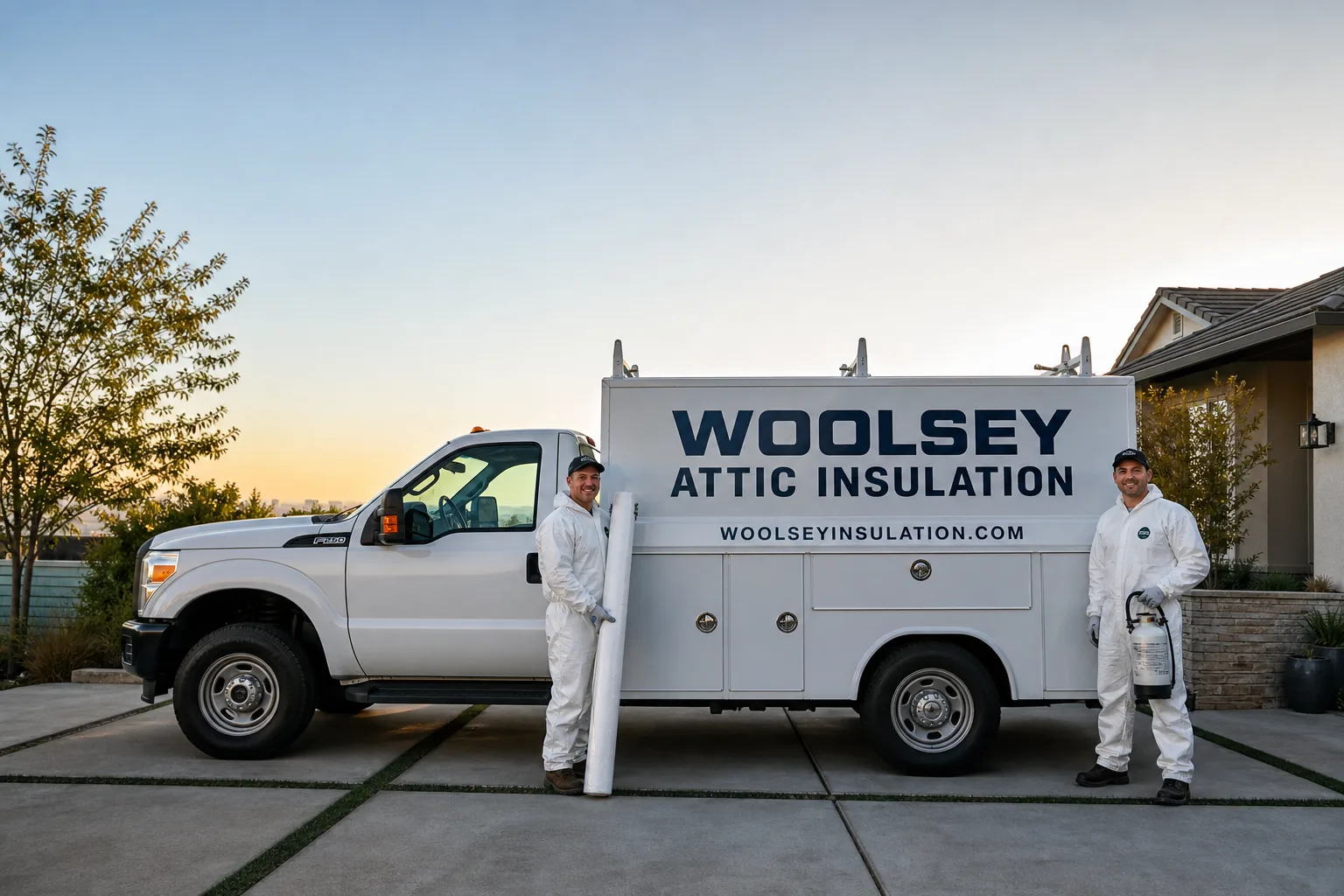
Fast, Reliable Spray Foam Insulation Across Menlo Park
Spray foam insulation in Menlo Park typically runs $3,800 – $7,200 for a full attic application and $2,100 – $4,600 for wall cavity work, with most jobs completed in one to two days. We know Menlo Park homes differ from what crews see in Palo Alto or Redwood City. The 1940s – 1960s ranch houses in the Willows, the pre-war bungalows off Santa Cruz Avenue, and the Bay-adjacent lots in Belle Haven each present different wall assemblies, vapor profiles, and access constraints. When you call (325) 240-5411, a live person answers. We’ll talk through what your house actually needs, then send a background-checked technician who knows Menlo Park’s permit climate and housing stock.
Why Woolsey Attic Insulation Is Menlo Park’s Preferred Spray Foam Insulation Company
Menlo Park homeowners keep telling us the same thing: they’ve been burned by contractors who quoted one number over the phone and changed it at the door. That doesn’t happen with us. The Kingswell Guarantee puts a written price in your hands before any work starts, every single job, no exceptions. Glenn Hartley, who leads our Menlo Park crews, insists on it.
We’ve worked on Willows ranches where a Title 24 trigger turned a small bath remodel into a full wall-cavity spray foam job. We’ve navigated Encinal Avenue hose runs where parking and alley access dictate how we stage equipment. We’ve pulled permits alongside San Mateo County inspectors who know exactly what they’re looking at when they see a 1950s 2×4 wall opened up. That local knowledge isn’t something you can shortcut. Spray Foam Insulation is all we do, attic and walls, and we do it in Menlo Park every week.
Spray Foam Attic Insulation in Menlo Park
Spray foam attic insulation in Menlo Park is the work we do most often in the Willows, Central Menlo Park, and the neighborhoods off Valparaiso Avenue. A full attic application in a typical 1,200 – 1,800 sq ft ranch runs $3,800 – $7,200 depending on whether you’re going open-cell or closed-cell, the roof deck geometry, and how much air sealing the existing envelope needs. We spray directly against the roof deck in most Menlo Park attics, which brings the attic into the conditioned space and stops the stack effect that pulls heated air up and out through every ceiling penetration.
Open-Cell for Attic Air Sealing
Open-cell foam in a Menlo Park attic handles the job most homeowners actually care about: stopping the drafts that make back bedrooms read five to seven degrees colder on foggy mornings. At roughly R-3.6 per inch, it won’t hit the same R-value as closed-cell at the same thickness, but it expands aggressively into gaps, soffit bays, and around recessed can lights. That’s usually what’s needed in a 1950s Central Menlo Park home where the original ceiling had no air barrier at all. If the roof deck is the problem, open-cell on the deck plane is the fix. Prices for open-cell attic jobs start around $3,800.
Closed-Cell for Moisture Control
Closed-cell is the choice we make more often closer to the Bay, especially in Belle Haven and the lower-lying streets near Bayfront Expressway. It cures rigid at roughly R-6.5 per inch and acts as a vapor retarder, which matters when marine-layer humidity is pressing into the attic cavity night after night. A closed-cell attic in Menlo Park runs $5,000 – $7,200 for a typical ranch. The material costs more, no way around that. But if you’ve got original sheathing that’s been absorbing fog-driven moisture for seventy years, open-cell can trap what it absorbs. We’ll tell you which is right after we look at the actual roof deck, not before.
Spray Foam Wall Insulation in Menlo Park
Spray foam wall insulation in Menlo Park most often happens because a kitchen or bath remodel in the Willows or along Encinal Avenue triggered a San Mateo County Title 24 compliance call on the surrounding wall assemblies. That’s the local reality, and it’s one we’ve handled dozens of times. Expect $2,100 – $4,600 for a typical wall cavity job in Menlo Park depending on stud bay depth, square footage, and whether we’re spraying from the exterior or through the interior after opening drywall.
2×4 Wall Cavities in Willows-Age Homes
Most Menlo Park ranch homes from the 1940s through the 1960s were framed with 2×4 exterior walls, not 2×6. That means shallow bays, and that means open-cell foam at R-3.6 per inch gets you roughly R-13 when sprayed full-depth. Closed-cell at R-6.5 per inch gets closer to R-23 in the same bay, and includes the vapor retarder function. For Willows, Central Menlo Park, and Encinal Avenue homes where marine-layer moisture is a real issue, we usually specify closed-cell in wall cavities. The cost difference is real, but so is the difference in moisture management. Good decisions come from looking at the actual walls.
When the Inspector Triggers the Job
This is a uniquely Menlo Park situation. When you pull a permit for a kitchen or bath remodel in the Willows or along Encinal Avenue, San Mateo County inspectors routinely flag Title 24 insulation compliance on wall assemblies adjacent to the work. You budgeted for cabinets and tile. Suddenly the inspector wants R-13 or better in walls that have never held insulation. That’s where we come in. We coordinate directly with your contractor and the inspector, open the exterior sheathing for minimum disruption, and spray the cavities to spec. We’ve had owners get their final sign-off three days after the trigger call. You’ll find more about how we serve Menlo Park on our Menlo Park page.
Trusted Brands We Service in Menlo Park
We’re not tied to whatever happens to be on the truck. Woolsey Attic Insulation works with eight manufacturers, including Johns Manville, Knauf, and Icynene, so the material recommendation fits your Menlo Park home, not our inventory. For Willows-era 2×4 walls with Bay-driven dampness, we often reach for closed-cell Icynene. For attic air sealing where thermal performance is secondary to draft control, Johns Manville open-cell does the job cleanly. We carry manufacturer-spec parts and materials for Menlo Park jobs specifically, so when a permit inspection is scheduled, we’re ready. No waiting on a distributor run out of Hayward.
Common Spray Foam Insulation Problems We See in Menlo Park Homes
- Open-cell foam sprayed into Willows-era 2×4 walls without a vapor retarder strategy. The marine layer drives moisture into the original sheathing, and open-cell traps it. We’ve seen mold in wall cavities that were foamed by crews who didn’t understand Menlo Park’s fog belt.
- Access staging on Encinal Avenue and the alleys off Santa Cruz Avenue. Tight lots mean hose runs get stretched, garage rigs can’t reach the wall, and rushed passes show up in the foam chemistry. We plan parking and alley-load before we quote, not after the truck shows up.
- Treating Belle Haven’s Bay-adjacent stock like Central Menlo Park. Belle Haven’s older, largely original-condition homes sit in elevated humidity. Skipping the moisture survey before foaming can seal wet cavities behind closed-cell and turn a comfort job into a mold problem.
- Quoting spray foam as a comfort upgrade while missing the Title 24 trigger. When the real reason the job exists is a San Mateo County inspector’s call on surrounding wall assemblies after a remodel permit, the job is under-scoped from the start. We scope for the trigger, not just the comfort.
Pricing for Spray Foam Insulation in Menlo Park, CA
Here’s what we actually see in Menlo Park, not a national average. Open-cell attic application: $3,800 – $5,400 for a typical 1,200 – 1,800 sq ft ranch. Closed-cell attic application: $5,000 – $7,200. Wall cavity spray foam for a Title 24 compliance job: $2,100 – $4,600 depending on square footage and whether we access from exterior or interior. Rim joist work, which comes up often in Willows basements and crawl spaces, runs $850 – $1,500. What moves the number: stud bay depth, roof deck accessibility, the amount of air sealing required, and whether existing insulation has to be removed first. You get a written price before any work starts. That’s the Kingswell Guarantee, and it’s in writing on every Menlo Park job.
We Also Serve Cities Near Menlo Park
Our crews move freely through the mid-Peninsula. We serve Menlo Park and regularly handle spray foam insulation work in Atherton, Stanford, Palo Alto, and Redwood City. When your Menlo Park project wraps, send us to your neighbor. Same crew standards, same written-price guarantee.
Serving Menlo Park, CA - Our Local Coverage Area
We’re based in the Menlo Park area and know this community well. Use the map below to see our service coverage - if you’re nearby, we can almost certainly help.
FAQs About Spray Foam Insulation in Menlo Park
On the day the San Mateo County inspector opens the permit file and flags Title 24 insulation compliance on wall assemblies adjacent to the remodel. It happens most often in the Willows and along Encinal Avenue, where 1940s – 1960s wood-frame homes were built before wall insulation was standard. The inspector wants R-13 or better in the cavities; the original walls have zero. That’s when spray foam goes from a nice-to-have to the inspector’s requirement. Call (325) 240-5411 when the trigger happens. We coordinate directly with inspectors and get walls foamed fast.
Because Belle Haven sits closer to the Bay and carries permanently elevated humidity that the Willows only gets during heavy fog weeks. In the Willows, we may specify open-cell in 2×4 bays after a moisture survey confirms dry sheathing; in Belle Haven, we’re far more likely to specify closed-cell for its vapor retarder function. The difference is marine-layer proximity, not preference. We’ll tell you exactly which applies after walking your walls, and the price difference shows up in the written quote before any work starts.
Yes, and not for the reason most contractors pitch. Menlo Park’s marine-layer-influenced Mediterranean climate means the real problem is fog-driven dampness and radiant comfort, not extreme temperature swings. On a foggy morning, a 1950s ranch’s uninsulated walls read cold to the touch, and that’s a comfort and moisture problem, not a thermometer problem. Spray foam creates an air seal that fiberglass can’t match, and the air seal is what matters when fog pushes moisture against your house for weeks. For Menlo Park specifically, spray foam is a moisture-management tool as much as an insulation product.
We pre-plan all parking and hose staging before we quote, and the plan is in the written price. Encinal Avenue is the common challenge. No street parking on busy days, tight alley-load off Santa Cruz Avenue, fences close to the wall. Our rigs are designed for hose runs up to 200 feet, and we bring the staging plan with the quote. If we can’t get a rig close enough to do the job right, we tell you that at estimate time, not on work day. You’ll know exactly how we’re approaching your house before any work starts.
It changes it for the better, if the material is chosen correctly. Spraying closed-cell against your roof deck seals the attic envelope so marine-layer air stops moving through ceiling penetrations into conditioned space. That reduces the moisture load on your ceiling insulation and on the house itself. But as always in Menlo Park, the specific choice between open-cell and closed-cell depends on your roof deck condition and your proximity to the Bay. We’ll explain it in plain terms after we look at the actual attic. Call (325) 240-5411 for a free estimate.
Written by Glenn Hartley, Owner at Woolsey Attic Insulation, serving Menlo Park and the surrounding Peninsula with attic and spray foam insulation services.