
Icynene Attic Insulation in Los Angeles: A Homeowner’s Guide
Icynene open-cell spray foam costs roughly 30 to 40 percent less per board foot than closed-cell foam, which is why so many Los Angeles homeowners ask about it. But here’s the part most guides skip: that lower price comes with a fundamentally different material, one that breathes. In an LA attic dealing with marine layer humidity on one side of the hills and wildfire smoke on the other, that single difference changes everything about whether Icynene is the right call for your home.
We’ve been installing attic insulation across Los Angeles since 2002, and we’ve watched Icynene go from a niche product to one of the most requested spray foams in the city. This guide walks through what Icynene actually is, where it makes sense in LA, what it costs, and the smoke-infiltration question that national articles almost never address. If you’d rather skip the research and just talk to someone who does this every day, call us at (325) 240-5411 for a free estimate.
What Is Icynene, Actually?
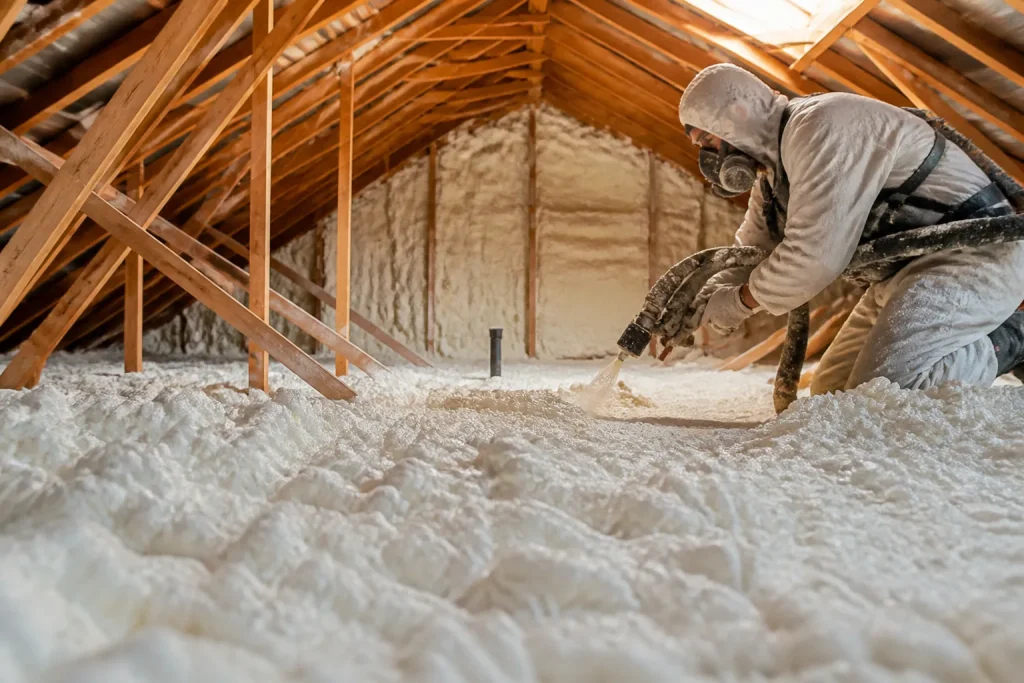
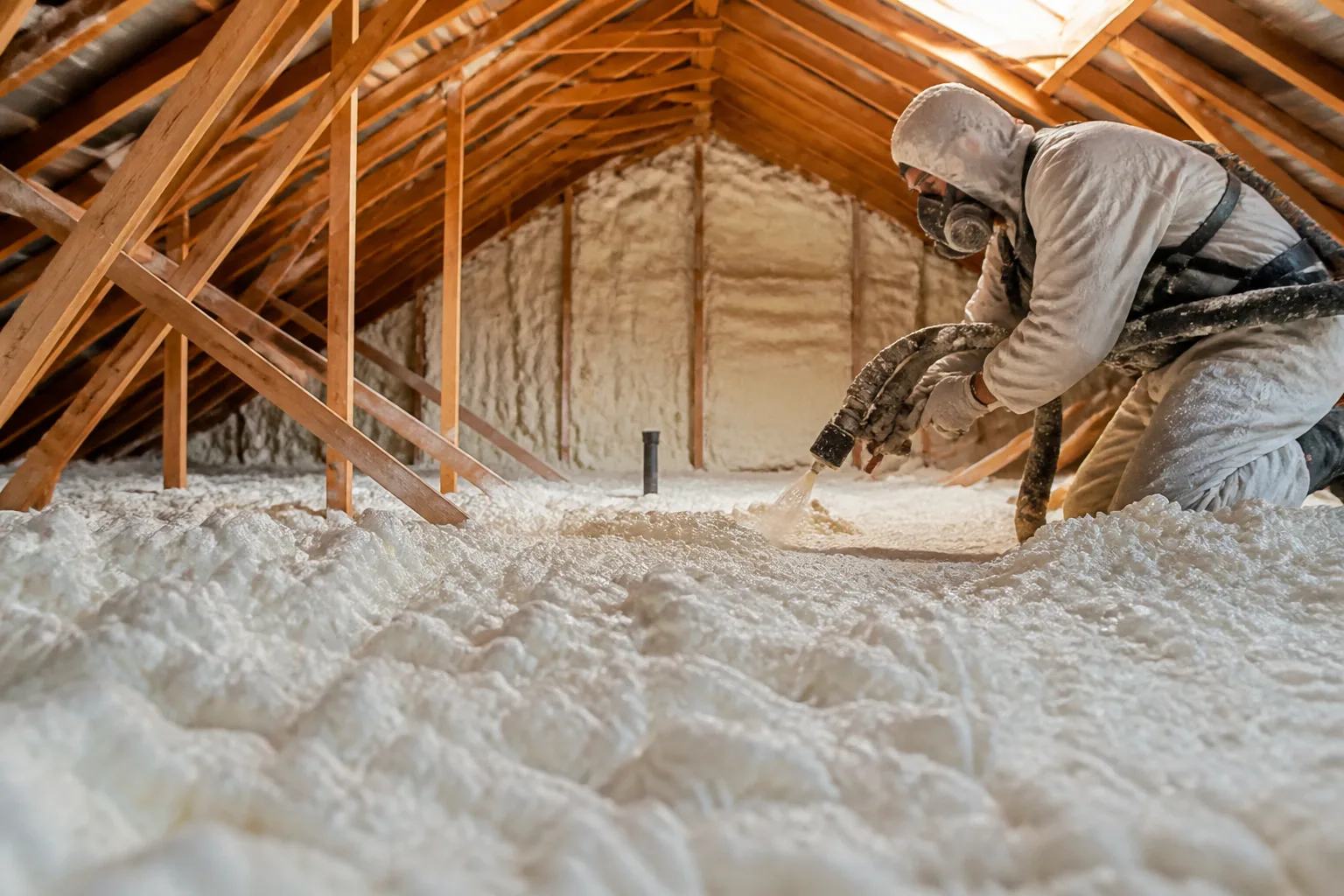
Icynene is a brand of open-cell spray foam insulation. The word “open-cell” matters more than the brand name, so let’s define it plainly. Spray foam starts as a two-part liquid that expands on contact and hardens into a solid layer. Open-cell foam traps millions of tiny air pockets that stay connected to one another, which makes the foam soft, flexible, and air-permeable. Closed-cell foam, by comparison, traps gas in sealed bubbles, making it rigid, dense, and vapor-resistant.
What makes Icynene specifically different from generic open-cell foams is its water-blown formulation. The foam expands using water and carbon dioxide rather than chemical blowing agents that deplete ozone or off-gas harsh compounds. For a Los Angeles homeowner who’s about to sleep under that attic for the next decade or two, that formulation translates to lower volatile organic compound levels during installation and cleaner attic air afterward.
In our experience installing Icynene across neighborhoods from Sherman Oaks to Woodland Hills, the indoor air quality conversation comes up most often with parents of young kids and people with respiratory sensitivities. Icynene’s water-blown chemistry is a legitimate point in its favor there, not a marketing line.
How Much Does Icynene Attic Insulation Cost in Los Angeles?
For a typical Los Angeles attic of 1,000 to 1,500 square feet, Icynene open-cell spray foam runs between $1.10 and $1.80 per board foot installed, depending on depth, access difficulty, and whether we’re removing old insulation first. In practical terms, most full attic jobs land between $3,400 and $6,800 before any applicable rebates. Compare that to closed-cell foam at $1.80 to $2.90 per board foot, and that’s the 30 to 40 percent savings that gets homeowners interested in the first place.
A legitimate Icynene quote in Los Angeles should include several things in writing before any work starts:
- Exact square footage and board-foot calculation, not a rough eyeball number.
- Target R-value depth spelled out in inches, tied to California Title 24 requirements.
- Removal and disposal of old insulation, if applicable, as a separate line item.
- Air-sealing scope – which penetrations get sealed, with what material.
- Cleanup and debris removal, plus who handles the final inspection.
We give every homeowner a written price before any work begins. In an LA market where door-step price changes are common enough to be a cliché, the written number is the one that should matter. If a contractor won’t commit to one, walk away.
Where Icynene Makes Sense in Los Angeles, and Where It Doesn’t
The city’s climate isn’t uniform, and neither is the right insulation choice. Los Angeles stretches from marine-layer coastal zones to inland valleys that swing 40 degrees in a single day, and that range changes how Icynene behaves.
Where Icynene works well: Coastal and near-coastal neighborhoods like Venice, Mar Vista, Playa del Rey, and Westchester. Open-cell foam’s vapor permeability actually helps here. Attics in these zones collect moisture from humid ocean air, and Icynene lets that moisture migrate through the foam rather than trapping it against roof sheathing. The same property also makes Icynene an excellent air-sealing layer, because it expands to fill every gap and crack around plumbing vents, electrical penetrations, and top plates.
Where to think twice: Inland areas like the San Fernando Valley, parts of the Inland Empire, and foothill communities above the 210. These zones see big temperature swings and lower year-round humidity. Icynene’s R-value of roughly R-3.7 per inch means you need more inches to hit the same insulation value as closed-cell’s R-6.5 per inch. In a Valley attic where summer heat is relentless, every inch of headroom matters, and a thinner closed-cell layer sometimes outperforms a thicker open-cell one for the same space.
We pulled open-cell foam out of a garage attic in Reseda last summer. The homeowner had gone with Icynene years earlier, but the installer had sprayed only four inches in a space where the Valley’s heat really demanded closer to eight. The foam was doing its job at the thickness it had; it just never had enough depth to begin with. It’s not that Icynene failed. It’s that nobody did the math on minimum R-value for that specific climate zone.
Icynene R-Value and California Title 24
California’s Title 24 energy code sets minimum insulation requirements by climate zone, and Los Angeles County spans several of them. For most LA attics, the practical target is R-38 to R-49 in the ceiling assembly. Icynene open-cell foam delivers about R-3.7 per inch, which means you need roughly 10 to 13 inches of foam to hit code minimums. In a tight attic with limited clearance, that’s a real consideration.
Compare that to closed-cell foam at R-6.5 per inch, which hits R-38 in under six inches. For attics where headroom is tight, where the roof line is low, or where you’re finishing part of the space, the math often favors closed-cell despite the higher per-board-foot cost. For most standard Los Angeles attics with typical clearance, Icynene’s depth requirement isn’t a problem at all.
One note about air sealing and Title 24: the code cares about continuous insulation and air leakage, not just R-value on paper. Icynene’s expansion characteristics mean it seals gaps as it’s applied, which often delivers real-world performance better than a higher nominal R-value from fiberglass batts with air leaks they can’t see. That’s the difference between laboratory performance and how a Los Angeles attic actually behaves in August.
Wildfire Smoke and the Permeability Question
Here’s the question national guides don’t ask: how does Icynene handle wildfire smoke infiltration in a Los Angeles attic?
The honest answer is nuanced. Open-cell foam is air-permeable. That’s by design. It seals against bulk air movement when sprayed thick and continuous, but it doesn’t create the same physical vapor barrier that closed-cell foam does. During smoke events, the tiny particulate matter in wildfire smoke can migrate through open-cell foam more readily than through closed-cell. That doesn’t mean Icynene fails during smoke season, but it does mean closed-cell or a properly sealed combination approach performs better at blocking fine particulate intrusion.
For homeowners in smoke-exposed Los Angeles neighborhoods, especially those near canyon areas or in the foothills where evacuation-adjacent smoke events are a recurring reality, we often recommend one of two approaches: closed-cell foam for maximum air and vapor resistance, or open-cell Icynene paired with careful air sealing at every penetration and a high-MERV filtration approach for the living space. Neither approach is wrong. The wrong approach is assuming all spray foams behave identically against smoke. They don’t.
Our experience across Los Angeles attic jobs has taught us that smoke season changes how homeowners think about attic air quality. What seemed like an abstract concern in March becomes very concrete in September. If wildfire smoke is a recurring fact of life where you live, that should shape your insulation decision as much as R-value charts do.
Icynene vs. Blown-In Fiberglass and Rockwool
Traditional blown-in insulation like CertainTeed fiberglass or Rockwool batt still has a place in Los Angeles attics, and honest contractors should tell you when it might be the better value. Here’s how Icynene compares on the factors that actually matter:
- Air sealing: Icynene wins decisively. It expands into gaps; blown-in settles around them without sealing.
- Cost per square foot: Blown-in fiberglass wins, often at half the installed cost of open-cell foam.
- R-value per inch: Icynene at R-3.7 beats blown-in fiberglass at R-2.2 to R-2.7, but Rockwool at R-3.3 to R-3.7 is right there alongside.
- Moisture handling: Icynene breathes; Rockwool drains; fiberglass sags and holds water poorly.
- Longevity in LA heat: Spray foams don’t settle. Blown-in can lose depth over a decade of attic heat cycling.
We work with eight insulation brands across our Los Angeles jobs because the right material depends on the house. Some attics need Icynene. Some are better served by Knauf blown-in or Rockwool batts. The honest answer is that your attic’s geometry, your climate zone within Los Angeles, your budget, and your smoke exposure all matter more than any brand preference.
When to Call a Pro
Spray foam installation is not a DIY project. The two-part chemistry has to be mixed at precise ratios and temperatures, and the application requires full protective equipment and containment. Improperly mixed foam can off-gas for months. Improperly applied foam can shrink, pulling away from rafters and leaving gaps you can’t see from below. This is one service where the professional decision genuinely matters for your health and your home’s performance.
If you’re noticing uneven temperatures between rooms, attic heat bleeding into the living space, or energy bills that climb every summer, those are signs your current attic insulation is underperforming. Our team in Los Angeles inspects attics every day and can tell you within an hour whether Icynene is the right fit for your specific house.
Related services in Los Angeles: Attic Insulation in Los Angeles and Spray Foam Insulation in Los Angeles.
The Bottom Line
Icynene open-cell foam is a legitimate, often smart choice for Los Angeles attics, especially in coastal neighborhoods where its breathability works in your favor and its lower cost stretches your budget further. But it’s not the same product as closed-cell foam wearing a cheaper price tag, and the wildfire smoke question makes that difference more important in LA than almost anywhere else in the country.
What matters most is that whoever installs your insulation does the math on your specific attic: climate zone, depth, air-sealing needs, and smoke exposure. If you’re in Los Angeles and want a straight answer about whether Icynene is right for your home, Woolsey Attic Insulation offers free estimates. Call (325) 240-5411 and we’ll walk your attic with you, tell you what we see, and give you a written price before any work starts. The Kingswell Guarantee covers every job we do: a written price before work begins, a committed arrival window, a clean job site, a written guarantee, and a free return visit if anything fails within 365 days. That’s the way we’ve done it since 2002, and it’s the way we’ll do it on your house.
Frequently Asked Questions
For air sealing and longevity, yes. Icynene open-cell foam seals gaps as it’s applied and won’t settle over decades of Los Angeles attic heat. Fiberglass costs less upfront but leaves air leaks that undermine its real-world performance. The value equation depends on how long you plan to stay in the home and how much you care about consistent indoor temperatures.
Properly installed Icynene open-cell foam can last 50 years or more without meaningful performance loss. It doesn’t sag, settle, or compress like blown-in insulation. The key variable is installation quality: correct mixing ratios, proper application temperature, and full coverage. That’s where the installer’s experience matters more than the product itself.
Partially. Icynene expands to seal gaps where smoke can enter, which helps significantly compared to unsealed fiberglass. But as an open-cell foam, it remains vapor-permeable and allows more fine particulate migration than closed-cell foam. If smoke infiltration is a major concern for your Los Angeles location, ask about closed-cell options or supplementary air sealing. Call (325) 240-5411 and we’ll assess your specific attic.
California Title 24 requires approximately R-38 to R-49 in ceiling assemblies for most Los Angeles climate zones. With Icynene at R-3.7 per inch, you’ll need roughly 10 to 13 inches of open-cell foam to hit those levels. A professional assessment of your specific attic depth and geometry will determine the exact requirement for your home.
Written by Glenn Hartley, Owner at Woolsey Attic Insulation, serving Los Angeles since 2002.
Need Insulation Help?
Call Woolsey Attic Insulation - licensed & insured, here with fast after-hours help in Los Angeles.
(325) 240-5411