
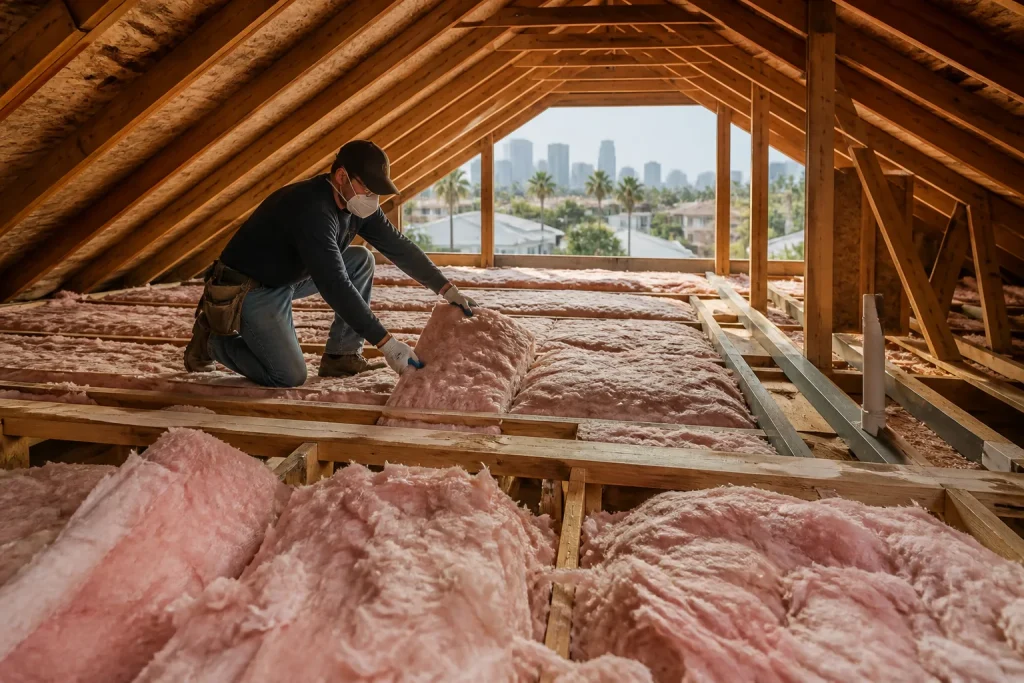
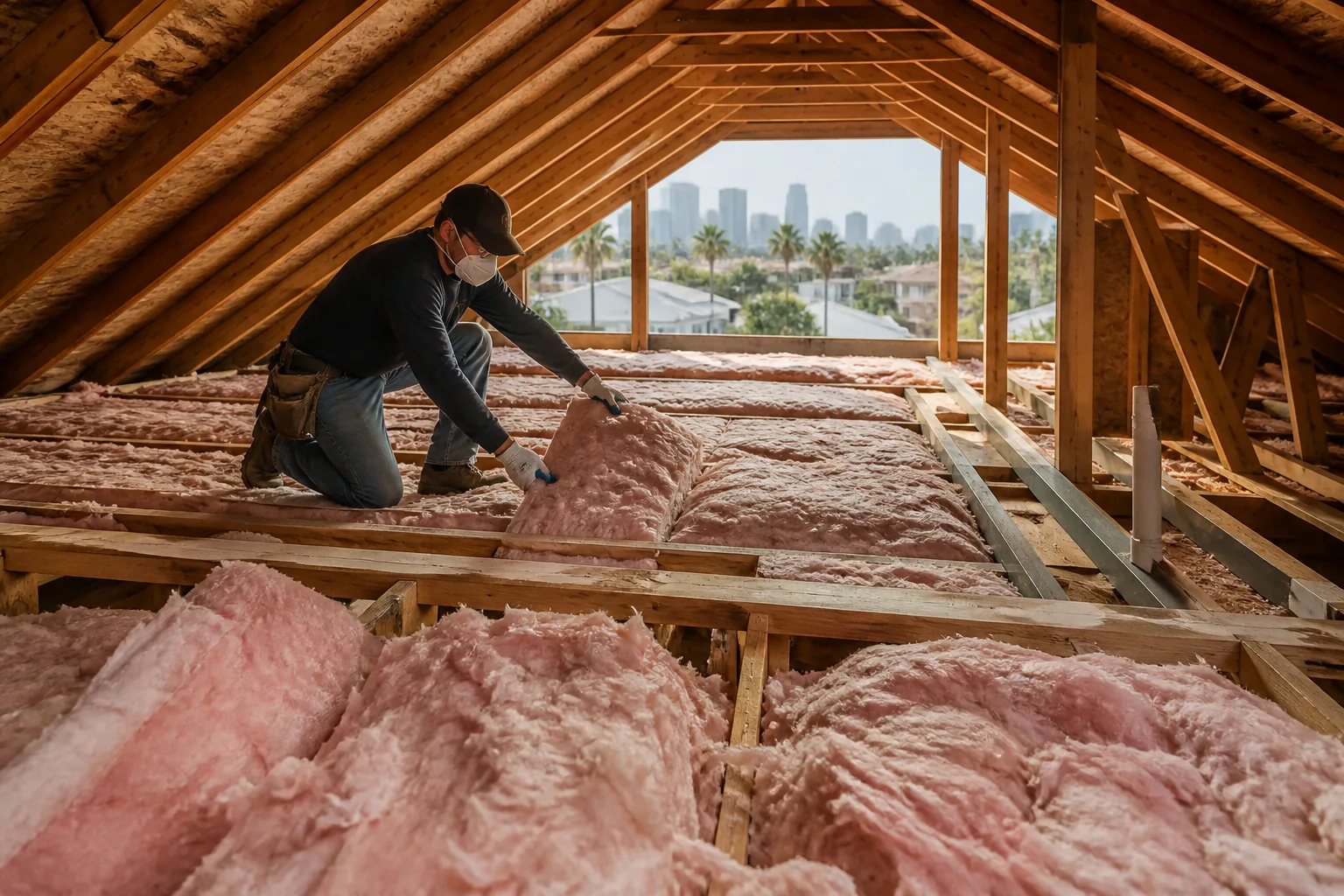
Johns Manville Attic Insulation in Los Angeles: A Homeowner’s Guide
Most Los Angeles homeowners can’t name the insulation in their attic, and that’s not an accident. Johns Manville is one of the biggest insulation manufacturers in the country, a Berkshire Hathaway company with over 160 years in building materials, yet it’s almost never sold directly to homeowners. It goes through contractors. So if a contractor quoted you Johns Manville without explaining why they picked it over Owens Corning or GreenFiber, that’s not automatically a red flag. But you deserve to know what you’re getting, how it performs in an LA attic, and whether the installer actually put in what they charged for. If you’d rather skip the research and talk to someone who installs this stuff daily, call us at (325) 240-5411.
Key Takeaways
- Johns Manville attic insulation is sold almost exclusively through contractors, not big-box stores, which means most LA homeowners only encounter it after someone else chose it for them.
- JM’s Spider blown-in fiberglass is a bonded system that resists settling better than standard loose-fill, a real advantage in hot LA attics where some insulation compacts over time.
- Fiberglass R-value drops at the 130°F+ attic temperatures common in Los Angeles summers, so the installed depth and coverage chart matter more than the label on the bag.
- You can verify a JM installation yourself: count the bags, check the coverage chart printed on the bag, and confirm the settled depth with a ruler.
- A written guarantee from the installer, not the manufacturer, is what protects you if the job was shorted.
What Is Johns Manville Attic Insulation, and Why Does It Almost Never Show Up at Home Depot?
Johns Manville makes three main products for attics: fiberglass batts, blown-in loose-fill fiberglass, and a hybrid system called Spider, which is blown-in fiberglass with a bonding agent that makes the fibers cling together. All three carry the JM name, but they behave differently once they’re in your attic, especially in Los Angeles, where summer attic temperatures regularly exceed 130°F.
The reason you won’t find JM’s premium blown-in products on a retail shelf is that they’re designed for contractor installation with specific equipment and training. A contractor buys JM through supply houses, gets access to JM’s technical support, and in many cases gets certified on the proper installation methods. That’s a double-edged sword for homeowners. On one hand, it means the people installing it should know the product better than a general handyman grabbing whatever’s in stock at a big-box store. On the other hand, it means you have less ability to comparison-shop the material itself, since you can’t just pull up a retail price online. That’s why the installer you pick matters at least as much as the brand. We install Johns Manville alongside Knauf, Rockwool, CertainTeed, and five other major brands at Woolsey Attic Insulation home, and we recommend JM specifically when the home’s attic geometry and ventilation profile call for a blown-in system that holds loft over time.
Spider vs. Standard Loose-Fill: Why LA Attic Heat Makes This Matter
Standard blown-in fiberglass is loose. It’s chopped glass fibers that get pneumatically blown across your attic floor to a specified depth. That depth is what gives you your R-value, and over years, that depth can settle, especially if the attic gets walked on for storage or servicing. Los Angeles attics have an extra challenge: heat. High temperatures accelerate settling in loose-fill because the material expands and contracts with temperature swings, gradually compacting.
Johns Manville’s Spider system works differently. The fibers are blown in through the same type of equipment, but they’re coated with a bonding agent that makes the fibers stick to each other on contact, creating a semi-rigid, web-like blanket. Once cured, a Spider installation holds its shape better than standard loose-fill, even when hot air moves through the attic. We’ve seen ten-year-old attics in the San Fernando Valley where standard loose-fill lost two full R-values to settling, while Spider maintains closer to its original spec. That’s not marketing language; it’s what we measure when we do attic assessments across Los Angeles neighborhoods from Woodland Hills to Eagle Rock.
The tradeoff is installation discipline. Spider has to be installed by someone who understands the curing process and won’t over-fluff or under-blow it. If you’re comparing quotes, ask the contractor specifically whether they’re quoting Spider or standard JM loose-fill. They’re not interchangeable, and the price should reflect that.
Formaldehyde-Free Binder: What It Means for an LA House
Johns Manville’s fiberglass insulation, including Spider and their loose-fill, uses a formaldehyde-free binder. The older formulations in the industry used formaldehyde as a binding agent, and while the cured product released only trace amounts, the concern wasn’t imaginary, especially for attics connected to living space.
Here’s why this matters more in Los Angeles than it does in, say, Seattle. In a hot climate, attic air doesn’t stay in the attic. As your attic heats up, air pressure differences push attic air through recessed lights, top plates, and the gaps around the attic hatch, pulling whatever is up there into your living space. If your insulation off-gassed anything, even minimally, you’d be breathing that air every day during summer. A formaldehyde-free binder eliminates that variable. It’s not that other brands still use formaldehyde, many don’t, but JM made it a documented standard across their fiberglass line, and for a Los Angeles homeowner with allergies or a sensitivity to indoor air quality, that’s a checkbox worth having.
That said, the binder is only part of the air quality story. If your attic has old fiberglass batts from the 1990s, rodent activity, or decades of dust, new insulation won’t fix those issues by itself. The right move is usually to assess what’s already there before blowing new material on top. If you’re in Los Angeles and want an honest read on your attic, our team at Woolsey does Attic Insulation in Los Angeles assessments that tell you exactly what you have now and what adding JM or another brand would actually accomplish.
R-Value at 130°F: What the Label Doesn’t Tell You
Every bag of JM insulation has an R-value printed on it, usually R-30 or R-38 for blown-in attic applications. That number is tested at a standard temperature, usually around 75°F. Your attic in Los Angeles in August is not 75°F. It’s 130°F or higher.
Fiberglass insulation loses some of its thermal resistance as temperatures rise. The loss isn’t catastrophic, but it’s real. At 130°F, a fiberglass batt or blown-in blanket might perform at 85 to 92 percent of its labeled R-value depending on the specific product and density. What that means practically: if you install R-38 and your attic regularly hits 130°F, you’re getting something closer to R-33 to R-35 in real-world conditions. That’s not a reason to avoid fiberglass. It’s a reason to install the right R-value for your climate zone and not just the minimum that building code allows.
Los Angeles sits in climate zones 2 and 3 depending on how close you are to the coast versus inland. The code minimum for attics in these zones is lower than what a homeowner trying to cut a summer AC bill actually needs. If you’re in Van Nuys or Reseda where August temps reliably top 100°F outside, we typically recommend going beyond the minimum so that even with heat-related degradation, you’re still above the performance threshold where your AC stops working so hard. That’s the kind of conversation we have with every homeowner before recommending a specific product, and it’s one reason we carry multiple brands instead of just whatever’s on the truck. Right material for the house, not the other way around.
How to Verify a Johns Manville Installation Was Done to Spec
Here’s something most guides won’t tell you: you can check whether your contractor actually installed what they charged for, and you don’t need special tools. Every JM blown-in product bag has a coverage chart printed on it. The chart tells the installer how many bags are required to hit a given R-value at a given attic square footage. If your attic is 1,200 square feet and the spec calls for 28 bags of JM loose-fill to hit R-38, then 28 bags is what should go into your attic. Not 22. Not “we’ll see how it looks.”
Here’s the verification checklist for a JM attic job:
- Count the bags. Ask the contractor to leave the empty bags on site. A legitimate installer has no problem doing this. Count them against the coverage chart for your attic’s square footage and target R-value.
- Check the settled depth. After installation, measure the depth of the insulation in at least five spots across the attic. JM’s chart lists settled depth for each R-value. If the chart says 12.5 inches for R-38 and you’re measuring 9 inches, it was shorted.
- Look for the coverage card. Many JM installers leave a card in the attic near the hatch showing the date, product used, square footage covered, and R-value installed. If your installer didn’t leave one, ask why.
- Confirm it’s the right product. If you were quoted Spider, the finished result should look like a cohesive blanket, not loose fluffy piles. If you were quoted standard loose-fill, it should be evenly distributed with no bare spots around vents or edges.
We pulled one out of an attic in Westchester last year where the previous contractor had quoted JM Spider, billed for Spider, and then blown in a cheaper off-brand loose-fill at half the spec depth. The homeowner had no idea until the AC bill stayed high and we went up there to look. The bags were long gone. The documentation from the installer was a one-page invoice that said “insulation installed.” Nothing else. That’s why we put the exact product, the exact R-value, and the exact bag count on every invoice, and why you should insist on the same from whoever does your job. When you hire us, you get a written price before work starts and a written guarantee after, including a free return visit if something isn’t right within 365 days. That’s the 365-Day Done Right Promise, and it’s part of the Kingswell Guarantee on every job we do.
Contractor-Channel Products: Better QC, Less Leverage, and How a Written Guarantee Closes the Gap
Johns Manville sells through contractors, not retail. That has real consequences, both good and bad, for a Los Angeles homeowner.
On the good side: contractor-channel products tend to have tighter manufacturing tolerances and better technical support, because the manufacturer’s reputation lives or dies with professional installers. If a contractor repeatedly botches a JM install, JM stops selling to them. That’s an incentive structure you don’t get with a retail bag off a shelf. The material itself is more likely to perform as specified when it leaves the plant.
On the bad side: you, the homeowner, have no direct relationship with Johns Manville. You can’t call JM customer service and ask them to come fix a bad install. JM’s warranty covers product defects, not installation errors. If the installer did a poor job, your recourse is with the installer. That’s fine if the installer stands behind their work. It’s a problem if the installer disappears after the invoice is paid.
This is the quiet truth of the insulation business in Los Angeles: the brand on the bag matters less than the name on the invoice. A written guarantee from the installer, one that says specifically what was installed, what R-value was installed, and what happens if it fails, is worth more than any manufacturer warranty you’ll never successfully claim. Ours says it plainly: if it’s not right within 365 days, we come back and fix it at no charge. In writing. We don’t ask you to call the manufacturer. We don’t send you to a warranty department. You call us, a live person answers, day or night, and we schedule the return visit.
How Much Does Johns Manville Attic Insulation Cost in Los Angeles?
Most attic insulation jobs in Los Angeles run between $1,500 and $4,500 for a typical 1,200 to 2,000 square foot home, depending on the existing insulation, the target R-value, the product chosen, and whether air sealing is part of the job. Johns Manville blown-in fiberglass typically lands in the $1.80 to $2.75 per square foot range installed. JM Spider runs higher, often $2.50 to $3.50 per square foot, because the installation process is more involved and the material cost is higher. These are real numbers from jobs across Los Angeles, not national averages.
Here’s a more detailed breakdown:
- JM Loose-Fill Fiberglass (R-30): roughly $1.80 to $2.25 per square foot installed
- JM Loose-Fill Fiberglass (R-38): roughly $2.00 to $2.75 per square foot installed
- JM Spider Blown-In (R-30 to R-38): roughly $2.50 to $3.50 per square foot installed
- Air sealing (recommended alongside any attic insulation): $500 to $1,500 depending on attic size and access
- Existing insulation removal (if needed): $1 to $2 per square foot
The price you should care about is the written one. Not the verbal ballpark, not the “we’ll see once we get up there” number, but a line-item price in writing before anyone climbs into your attic. That’s how we’ve done it since 2002 as part of the Kingswell family of independently owned and operated insulation companies. Glenn’s been running this shop the whole time, and the rule has never changed: say the price, show up in the window, leave it cleaner than you found it, put the guarantee in writing, come back if it fails. That’s the Kingswell Way, and it applies whether we’re installing Johns Manville, Rockwool, CertainTeed, or any of the other brands we carry.
If you’re comparing Johns Manville against Spray Foam Insulation in Los Angeles, that’s a separate conversation. Spray foam is a two-part liquid that expands on contact and seals gaps airtight, and it behaves very differently from fiberglass in an LA attic. It’s also typically double the cost. For most older Los Angeles homes with existing batts or minimal insulation, blown-in JM fiberglass plus air sealing is the more economical upgrade path. But the right answer depends on your house, your AC usage, and whether anyone in the home has moisture or asthma concerns. That’s a conversation we have honestly, with numbers on the table, before any contract gets signed.
When to Call a Pro
Attic insulation looks like a simple job. It’s not, and it’s one of the few genuinely risky DIY projects most homeowners under-estimate. You’re working on joists above a ceiling, often in 120°F+ heat for much of the year in Los Angeles, in a space with exposed nails, limited lighting, and, in many homes, older electrical wiring running through the very ceiling you’re standing above. Falls through drywall happen. Heat exhaustion happens. And a DIY insulation job that blocks your soffit vents can create moisture problems that cost far more than the insulation would have. If you’re not comfortable in the attic, don’t get comfortable with the idea. Call us at (325) 240-5411. A live person answers. We’ll walk you through what you have, what you need, and what it costs in writing before anyone puts a ladder up.
The Bottom Line
Johns Manville makes an honest product. The Spider system holds loft better than standard loose-fill in high-heat attics like the ones we have across Los Angeles. The formaldehyde-free binder is a real benefit if you care about indoor air quality. The R-value you actually get at 130°F depends on how much was installed and whether the installer followed the coverage chart, not just what the bag says. And since you can’t buy JM direct, the installer is your only point of accountability. Pick one who puts everything in writing. If you’re in Los Angeles and want a free estimate on Johns Manville or any attic insulation job, call (325) 240-5411. Written price before work starts. Written guarantee after. Every job, no exceptions.
Frequently Asked Questions
Yes, and it’s particularly well-suited to LA’s hot attic conditions when you use JM Spider blown-in fiberglass, which holds its loft better than standard loose-fill at the 130°F+ temperatures common in Los Angeles summers. JM also uses a formaldehyde-free binder across its fiberglass line, which reduces indoor air quality concerns in homes where attic air infiltrates living space. The real variable is installation depth and coverage.
JM blown-in fiberglass typically runs $1.80 to $2.75 per square foot installed in Los Angeles, and JM Spider runs $2.50 to $3.50 per square foot. A whole-attic job for a typical 1,500 square foot home generally lands between $3,000 and $4,500. Call (325) 240-5411 for an exact written quote, estimates are free.
No. Johns Manville’s blown-in attic insulation products are sold exclusively through contractor supply channels, not retail stores. If a contractor quotes you JM, ask which specific JM product they’re using, how many bags the job requires, and what settled depth they’re targeting. The coverage chart on the bag tells you everything.
Count the empty bags against the coverage chart printed on the JM bag, measure the settled depth in at least five spots across the attic, and look for a coverage card near the hatch. If the depth is short of spec or the bag count doesn’t match, the job was undersold. Call (325) 240-5411 if you want a second opinion on an existing install.
Written by Glenn Hartley, Owner at Woolsey Attic Insulation, serving Los Angeles since 2002.
Need Insulation Help?
Call Woolsey Attic Insulation - licensed & insured, here with fast after-hours help in Los Angeles.
(325) 240-5411