
Knauf Attic Insulation in Los Angeles: A Homeowner’s Guide
Knauf attic insulation in Los Angeles usually costs between $1.20 and $2.80 per square foot installed for blown-in fiberglass, with most single-story ranch homes in the Valley or South Bay landing between $1,800 and $4,200 total. Knauf is the largest insulation manufacturer most American homeowners have never heard of, and that anonymity means LA homeowners rarely push back on questions they should ask when a contractor specifies it. If you’d rather skip the research and just get a straight answer on what your attic needs, call us at (325) 240-5411 and we’ll walk you through it.
Here’s the thing about Knauf that surprises people: the company makes insulation for Lowe’s under the EcoStar label, and it supplies raw fiberglass to other brands you’d recognize on sight. There’s a reasonable chance you already have Knauf in your walls without knowing it. We’ve been installing attic insulation in Los Angeles since 2002, and we’ve pulled back enough attic hatches to know that most homeowners only learn what’s actually up there when something goes wrong. This guide unpacks the Knauf product line in plain language, tied to the specific conditions we deal with in LA attics every week.
Key Takeaways
- Knauf EcoStar blown-in fiberglass is the most common Knauf product specified for LA attics, and it delivers roughly R-2.6 to R-3.0 per inch depending on settled density.
- Meeting LA’s Title 24 code requirement of R-38 means roughly 13 to 15 inches of blown-in Knauf fiberglass, which translates to a specific number of bags per square foot you can verify yourself.
- Knauf’s fiberglass batts and blown-in products are formaldehyde-free, and that claim should appear printed on the bag label, not just in the contractor’s pitch.
- Brand specification matters less than contractor process. A written quote with labeled depth, bag count, and a guarantee protects you more than any logo on a bag.
Who Is Knauf, and Why Does It Matter for Your LA Attic?
Knauf Insulation is a German family-owned manufacturer that has quietly become one of the largest insulation producers in North America. The company runs plants in Indiana, Alabama, and California, and it supplies fiberglass insulation under its own name and through private labels like EcoStar, which you’ll see on shelves at Lowe’s. In Los Angeles, Knauf products show up regularly in attic insulation quotes because the company’s blown-in fiberglass line hits a specific sweet spot: it’s priced competitively against big-box brands and it carries the certifications that LA building inspectors look for.
The reason most LA homeowners haven’t heard of Knauf is that the company doesn’t spend heavily on consumer-facing advertising. Owens Corning has the pink panther. Knauf just shows up in contractor supply houses and on job sites. We mention this because it cuts both ways. A contractor who specifies Knauf isn’t necessarily cutting corners, but a homeowner who knows what Knauf product is being quoted and why has a real advantage at the quote stage. When we sit down with a homeowner in neighborhoods like Eagle Rock or Mar Vista, we walk through the material choice, not just the price.
Knauf’s relevance to Los Angeles specifically comes down to two things: its blown-in fiberglass is well suited to the open-truss attic configurations typical of LA’s post-war housing stock, and its formaldehyde-free binder claim matters in a city where attic temperatures regularly hit 130 degrees in August. Heat plus off-gassing is not a combination you want in a sealed-up attic space. For more on how attic insulation fits into the broader LA picture, see our guide to Attic Insulation in Los Angeles.
Knauf EcoStar Blown-In Fiberglass vs. Knauf Batts: Which Fits an LA Attic?
LA’s post-war housing stock, think the 1,200-square-foot stucco ranches in Lakewood or the tract homes in Westchester, typically has open truss or rafter-framed attics with plywood decking and a gable or ridge vent. That layout matters because it determines which insulation format makes sense. Here’s the practical breakdown:
- Knauf EcoStar blown-in fiberglass: This is the loosened fiberglass installed with a blowing machine, and it works best in attics with irregular joist spacing, cross-bracing, vent pipes, or old electrical runs. It fills cavities completely and performs well in the shallow sloped sections near the eaves where batts get compressed and lose R-value. For most LA attics with a pitched roof and open trusses, EcoStar blown-in is the more effective choice.
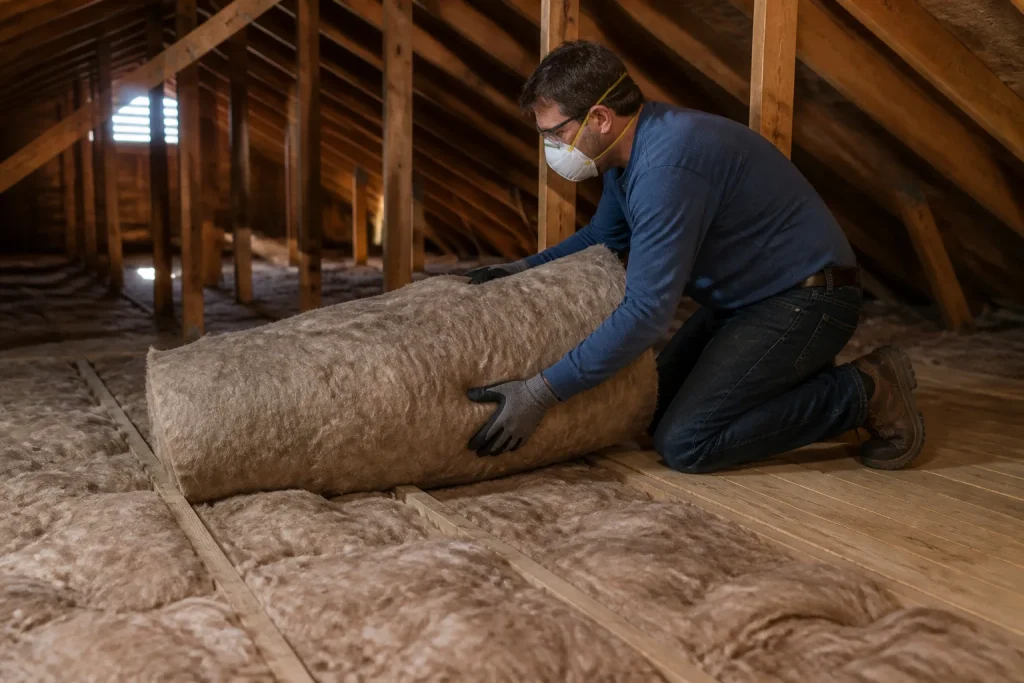
- Knauf batt insulation: Pre-cut fiberglass batts in Kraft-faced or unfaced rolls. Batts make sense in attics where the joist spacing is uniform and there are few obstructions, or in knee-wall sections and side attics where blown-in would slough off. We generally see batt jobs specified less often for full attic floors in LA because the labor to install them correctly around obstructions is higher, and air gaps at the seams are a real performance leak.
The cost spread matters too. EcoStar blown-in typically runs $1.20 to $2.20 per square foot installed in Los Angeles, while a Knauf batt job can range from $1.50 to $2.80 per square foot, depending on the R-value target and how much cutting and fitting the space demands. The batt route isn’t inherently worse, it just costs more to install properly, which pushes the total higher without delivering more R-value per dollar. For a deeper look at when spray foam might be the better call for your specific attic, see our breakdown of Spray Foam Insulation in Los Angeles.
Formaldehyde-Free: What the Knauf Label Actually Says
Knauf’s blown-in fiberglass and batt lines are manufactured with a formaldehyde-free binder, which is a meaningful claim in an attic context. Traditional fiberglass insulation used a formaldehyde-based resin to bind the fibers together, and in a hot attic, that resin can off-gas. Knauf switched to a plant-based binder, and the company states explicitly that its products are formaldehyde-free.
Here’s the practical part: the claim should appear on the bag label itself. When a contractor tells you the product is formaldehyde-free, ask to see the bag. EcoStar bags from Knauf carry the formaldehyde-free language on the printed label, and the certification is tied to a GREENGUARD or UL Environment mark you can look up. In our experience bidding jobs across Los Angeles from Pasadena to Torrance, legitimate insulation crews don’t mind showing you the bag. If a contractor can’t show you a bag and asks you to take their word for the material spec, that’s a red flag worth taking seriously.
Knauf’s formaldehyde-free claim matters more in Los Angeles than in cooler climates because attics here bake. A sealed-up attic in the San Fernando Valley can sit above 120 degrees for hours in July and August. That’s the environment where off-gassing accelerates, and it’s also the environment where old fiberglass batts, the ones with the yellow resin binder from a generation ago, degrade fastest. If your attic still has that older product, the comparison isn’t just about R-value, it’s about what that material is doing in the heat.
R-Value Per Inch: Knauf vs. Cellulose at LA Title 24 Depths
Los Angeles building code under Title 24 requires new insulation work in attics to hit R-38, and that requirement drives how much material you need, regardless of brand. Blown-in Knauf fiberglass delivers about R-2.6 to R-3.0 per inch at typical installed densities, depending on the specific product and how evenly it’s blown. To hit R-38, you’re looking at roughly 13 to 15 inches of settled depth.
Blown-in cellulose delivers a higher R-value per inch, around R-3.2 to R-3.7, which means you’d need fewer inches to hit R-38, typically 11 to 12 inches. So why would anyone choose Knauf fiberglass over cellulose in Los Angeles? Two practical reasons. First, fiberglass doesn’t settle as noticeably as cellulose over time, which means the R-value you pay for on day one is closer to what you actually have in year five. Cellulose can settle up to 20% and lose R-value, especially in the dry heat of LA summers when the material dries out and compacts. Second, Knauf fiberglass is lighter per R-value than cellulose, which matters in older LA attics where the ceiling joists weren’t sized for much dead load.
On cost-per-square-foot terms, blown-in Knauf fiberglass at R-38 typically runs $1.20 to $2.20 per square foot installed in Los Angeles, while cellulose at R-38 runs $1.40 to $2.50. The gap narrows when you account for the extra depth cellulose requires and the settling factor. Neither product is wrong, but you should know the tradeoff before you sign. We pulled a failed cellulose job out of a garage-conversion attic over in Culver City last month where the material had settled to half its original depth in under four years. The homeowner never knew because no one had come back to check.
The Bag-Count Method: How to Verify Your Knauf Job Was Installed to Labeled Depth
Insulation underselling is a real problem in Los Angeles, and it’s more common than most homeowners think. A crew quotes you R-38, blows in 9 inches, and calls it done. You can’t see the R-value with your eyes, and by the time the summer electric bill arrives, the crew is long gone. Here’s how you verify a Knauf blown-in job using the manufacturer’s own documentation.
Every Knauf EcoStar bag lists a coverage chart on the back. The chart tells you how many square feet a single bag will cover at a given depth and R-value. For example, a bag might cover 40 square feet at R-38 depth, or 60 square feet at R-30 depth. The math is simple:
- Measure your attic floor area in square feet. A 1,200-square-foot house typically has roughly 1,200 square feet of attic floor.
- Divide your square footage by the coverage-per-bag number at your target R-value. If you have 1,200 square feet and each bag covers 40 square feet at R-38, you need 30 bags.
- Ask the contractor to confirm the number of bags specified on your written quote.
- On install day, count the bags that come off the truck before the machine starts. Ask to see empty bags after the job.
That last step catches the most common cheat. A crew quoting 30 bags shows up with 22 and hopes you’re not watching. The bag-count method isn’t foolproof, crews can overblow one section and underblow another, but it verifies quantity, which is the hardest thing for a homeowner to check after the fact. The depth ruler check is the second verification: a simple yardstick pushed into the blown material in several spots should read 13 to 15 inches for R-38 Knauf fiberglass. If it doesn’t, the bag count was wrong or the distribution was uneven.
This is also where the quote itself matters. A written quote that specifies bag count, depth inches, and R-value target is a quote you can verify. A quote that says “attic insulation, R-38” and nothing else is a quote you can’t. That’s the difference between buying a result and buying hope. Learn more about how to read an attic insulation quote the right way on our Woolsey Attic Insulation home page.
Why Brand Specification Matters Less Than Contractor Process
Here’s the part of this guide that matters more than anything about Knauf specifically: the manufacturer’s name on the bag matters less than the process of the contractor who brings it. We install Knauf products, and we also work with CertainTeed and GreenFiber, because the right material depends on the attic, not on what’s stacked in the warehouse. A well-installed GreenFiber cellulose job will outperform a badly installed Knauf job every time. The brand is not the guarantee. The process is.
So what should you look for in a written quote, regardless of which manufacturer the crew brings to your Los Angeles job? Here’s our list:
- 1
Specific product name with manufacturer: “Knauf EcoStar blown-in fiberglass, R-38” is specific. “Premium attic insulation” is not.
- 2
Square footage and bag count or board footage: These numbers should be on the quote and should match your own measurements.
- 3
Depth inches and R-value target: Not one or the other. Both.
- 4
Prep work listed separately: Air sealing, baffle installation, and old insulation removal should be line items, not assumed.
- 5
A written guarantee with a specific term: Ours is 365 days, in writing, on every job. If the work fails within that window, we come back and fix it at no charge.
- 6
The price before work starts: In writing. No door-step adjustments, no “discovered conditions” upcharge calls.
In Los Angeles, the difference between a contractor who writes all of this down and one who doesn’t is usually the difference between a job done right and a job that becomes next summer’s problem. We’ve built our whole operation around the written-quote process because we’ve seen too many LA attics with half the material they should have and no recourse for the homeowner. The Kingswell Guarantee is our name for that process: a written price, a committed arrival window, a clean job site, a written guarantee, and a free return visit if anything fails within the guarantee period.
If you’re comparing quotes and want a second set of eyes on the numbers before you sign anything, call us at (325) 240-5411. We’ll walk through what’s on the quote and tell you honestly whether it holds up. No charge, no obligation.
When to Call a Pro
Some attic work is genuinely worth doing yourself, and some is not. Replacing a missing piece of R-19 batt over a bare spot is within most homeowners’ reach. But blowing fiberglass to R-38 depth across a full attic floor requires equipment, calibration, and a respirator, and doing it wrong leaves you with uneven coverage, blocked soffit vents, or a fiberglass cloud in your living space. We’ve cleaned up plenty of DIY blow-in jobs in Los Angeles attics where the homeowner rented a machine, skipped the baffles, and ended up paying professional rates twice: once for the rental and once for us to fix it.
Call a pro when the job involves full-attic depth work, when your attic has vermiculite or other old insulation that needs assessment, or when you’re reading a quote you can’t verify. And if you hire us, you get background-checked, uniformed technicians, a live person on the phone 24/7, and the written guarantee that every job includes. Related services: see our Attic Insulation in Los Angeles and Spray Foam Insulation in Los Angeles pages for more on what we install and how each material performs in LA attics.
The Bottom Line
Knauf is a legitimate, well-made insulation brand with a formaldehyde-free fiberglass line that fits the open-truss attics common across Los Angeles. Its EcoStar blown-in product delivers competitive R-value per dollar and is easy to verify with the bag-count method if you know how to read the coverage chart. The real takeaway, though, is that no manufacturer’s brand name replaces a written quote with specific depth, bag count, and guarantee terms. In a city where attic temperatures punish bad decisions quietly for years, the paper trail is the product.
Wool was the first insulation. Woolsey keeps the idea in the name, and we’ve been at this in Los Angeles since 2002. If you’re in Los Angeles and need help sorting out your attic insulation options, Woolsey Attic Insulation offers free estimates with a written price before any work starts. Call (325) 240-5411 and a real person will answer, day or night.
Frequently Asked Questions
Knauf blown-in fiberglass attic insulation in Los Angeles typically runs between $1.20 and $2.80 per square foot installed, with most full-attic jobs landing between $1,800 and $4,200 depending on square footage and existing insulation conditions. The exact price depends on depth, access difficulty, and prep work like air sealing or old insulation removal. For an exact written quote for your attic, call (325) 240-5411 and we’ll walk you through the numbers.
Knauf and Owens Corning both produce formaldehyde-free fiberglass insulation with similar R-value per inch ratings, and neither is meaningfully “better” in most residential attic applications. The material specs are close enough that installation quality matters more than which of the two brands goes in. We install both brands and choose based on what fits the specific attic, not on brand loyalty.
Knauf blown-in fiberglass requires roughly 13 to 15 inches of settled depth to achieve R-38, which is the Title 24 requirement for attic insulation work in Los Angeles. Cellulose would require fewer inches to hit R-38, but Knauf fiberglass holds its depth better over time in dry LA conditions. Your contractor should specify the exact target inches in writing before work begins.
You can install Knauf batts yourself for small repairs, but full-attic blown-in work to R-38 is best left to a professional crew with the right equipment and training. DIY blow-in jobs in Los Angeles attics frequently result in uneven coverage, blocked soffit vents, and fiberglass dust in the living space. If you’re weighing DIY against hiring out, call (325) 240-5411 and we’ll give you an honest read on what your attic actually needs.
Written by Glenn Hartley, Owner at Woolsey Attic Insulation, serving Los Angeles since 2002.
Need Insulation Help?
Call Woolsey Attic Insulation - licensed & insured, here with fast after-hours help in Los Angeles.
(325) 240-5411