
Preparing Your Home’s Insulation for Winter in Los Angeles
Preparing your home’s insulation for winter in Los Angeles means checking your attic depth before the first cold stretch hits, sealing the air leaks that let heated air escape, and knowing what your insulation’s R-value actually is today, not what it was when it was installed. Most LA homes built before 1990 have settled, compressed attic insulation that’s underperforming by 30 to 50 percent. If you’d rather not crawl up there yourself, call (325) 240-5411 and we’ll do the whole inspection free.
Here’s the thing about Los Angeles winters that surprises most homeowners: a 45°F January night costs you more in wasted heat than a Chicago freeze costs a properly insulated home. Not because LA is colder. It isn’t. It’s because your furnace was sized assuming the insulation was doing its job, and in most Los Angeles attics, it hasn’t been doing its job for a long time. We pulled a batt out of an attic in Sherman Oaks last December that had compressed from R-30 to what measured out around R-14. The homeowner’s gas bill that month was $240. The attic fix was less than a third of that, one time.
Why LA’s Mild Winters Fool Homeowners Into Losing Money
The percentage of heat lost through an under-insulated attic is the same at 45°F as it is at 20°F. Heat doesn’t care how cold it is outside. It moves toward cold at the same rate, driven by the temperature difference between your living space and your attic. If your attic insulation has settled to half its rated R-value, roughly the same share of your furnace’s output leaks through the ceiling as it would in Minnesota. The difference is that a Minneapolis homeowner notices because the house feels drafty and the furnace runs constantly. In Los Angeles, the furnace cycles on for an hour in the morning, an hour at night, and you never feel cold enough to think something’s wrong. The gas bill tells a different story.
We see this pattern every winter across Los Angeles neighborhoods. Homes in the Valley, the Westside, South LA, the foothills, it doesn’t matter. An attic with R-19 fiberglass batts that were installed in 1985 is now functionally R-10 or worse. The furnace runs longer to compensate. You pay for the heat twice: once to produce it, once to lose it through the ceiling.
The October Attic Check Every LA Homeowner Should Do
Before the first cold stretch, there’s a simple inspection you can do yourself in about twenty minutes. It doesn’t require special tools or a contractor visit. Here’s what to look for:
- Measure your insulation depth. Take a ruler or tape measure into the attic and push it down through the insulation until it touches the drywall. Fiberglass batts should measure at least 11 inches for R-30, 14 to 15 inches for R-38. Blown-in fiberglass or cellulose should sit at roughly 13 to 15 inches for R-38. If you’re seeing 6 or 7 inches, your attic is under-insulated and has been for years.
- Look for compression. If the insulation is matted down, especially in the middle of the attic where people have walked or boxes have been stored, it’s lost most of its loft. Compressed fiberglass doesn’t insulate. The air pockets are what do the work, and once they’re flattened, the R-value drops fast.
- Check the eaves. In many LA homes, insulation gets shoved toward the edges and blocks the soffit vents that let the attic breathe. Blocked vents trap moisture, which degrades insulation even faster. Pull insulation back from the eaves so air can move.
- Look for gaps and bare spots. Settled insulation shifts. Gaps open up over top plates, around can lights, and near the attic hatch. A bare strip of drywall loses heat like an open window left cracked all winter.
If you get up there and you’re not sure what you’re looking at, that’s a fine reason to call us. We’ll tell you what you have, what it’s doing, and what it would cost to fix, with a written price before any work starts. That’s the Kingswell way we’ve operated since 2002.
How to Tell If Your Insulation Has Settled Below Its Effective R-Value
The label on your insulation says R-30 or R-38. That number assumes full loft, even coverage, no moisture, and proper installation. In a Los Angeles attic that’s been through twenty or thirty summers of heat and the occasional damp winter, none of those assumptions hold. Insulation settles. Fiberglass batts lose loft as the fibers relax and flatten. Blown-in insulation compresses under its own weight. Rodents and roof leaks take a toll. The result is that your attic insulation’s effective R-value, the number that actually matters, is far below what the bag said.
Here’s the ruler-and-coverage-chart method to estimate what you really have:
- Measure the depth in at least four spots: near the eaves, in the middle, near the attic hatch, and in a far corner. Jot down each number.
- Average those depths. If you have three readings of 8 inches and one of 5 inches, your average is about 7.25 inches. That variance alone tells you there’s settling and shifting.
- Multiply by the material’s R-value per inch. Fiberglass batts give you roughly 2.2 to 2.7 R per inch. Blown-in fiberglass runs about 2.2 to 2.5. Cellulose runs about 3.2 to 3.7. So 7.25 inches of fiberglass batt is effectively R-16 to R-19, not R-30.
- Compare against what your ceiling needs. For Los Angeles attics, the Department of Energy recommends R-30 to R-60. Most older LA homes sit between R-11 and R-19 right now.
That gap, between what you think you have and what you actually have, is what shows up on your January gas bill.
Air Sealing: The Step That Matters More Than Adding Insulation
Before you add insulation on top of old insulation in Los Angeles, seal the air leaks first. This is the step most homeowners skip and most contractors don’t mention, because it’s less visible than a fresh layer of fiberglass. But air sealing delivers more comfort per dollar than almost anything else you can do in an attic, especially in LA where the temperature swings moderate and the real problem is conditioned air escaping through gaps you can’t see from the living room.
The three most common air bypass points in Los Angeles homes are:
- Top plates. The horizontal boards at the top of your wall framing, where the wall meets the attic floor, are almost never sealed in homes built before 1990. There’s a gap there that runs the entire perimeter of your house. Heated air from every room rises into the walls and exits through that gap into the attic. Sealing it with foam or caulk stops the biggest single leak in most homes.
- Recessed lights. Older can lights are basically holes in your ceiling with a bulb in them. Unless they’re IC-rated and air-tight, they dump heated air into the attic all winter. Sealing them or replacing them with sealed fixtures is a straightforward fix that pays for itself in a season or two.
- The attic hatch. The access door or pull-down stair is frequently nothing more than a piece of plywood resting on trim. No gasket, no seal, no insulation. That’s a 2-foot-by-2-foot open hole in your ceiling envelope. Weatherstripping and an insulated cover are cheap and effective.
In our experience at Woolsey Attic Insulation, air sealing plus bringing the attic up to R-38 cuts heating costs in Los Angeles by 20 to 35 percent in the first winter. The sealing does more than the added insulation in most cases, because you’re stopping the leak rather than slowing it.
What a Pre-Winter Insulation Quote Should Include
If you decide to bring in a contractor before winter hits, the quote itself will tell you a lot about who you’re dealing with. A serious insulation quote in Los Angeles should include four things, in writing:
- Current R-value documentation. The contractor should measure and tell you what you have right now, in actual inches and estimated R-value. If they won’t show you the measurement, walk away.
- Proposed R-value. You should see the number they’re bringing you up to, and how they arrived at it. For most LA homes, R-38 is the practical target for fiberglass or blown-in. Spray foam jobs are different and should be explained clearly.
- Air sealing scope. The quote should itemize which bypass points they’ll seal and with what material. A quote that skips air sealing entirely is a quote from someone who doesn’t understand how heat loss actually works.
- A written price. Not an estimate range. Not a “we’ll see once we get up there.” A number, in writing, before any work starts. If the price depends on conditions revealed mid-job, that should be stated explicitly and bounded.
This is The Kingswell Way: say the price, show up in the committed window, leave the job site cleaner than you found it, put the guarantee in writing, and come back if it fails. Every Woolsey job includes a 365-day guarantee in writing. If it’s not done right, we come back and fix it at no charge. That’s not a slogan. It’s the terms on the paper you sign.
We work with Rockwool, CertainTeed, and Icynene, among others, because different Los Angeles homes call for different materials. A 1920s bungalow in Highland Park has different attic conditions than a 2005 tract home in Porter Ranch, and the material recommendation should fit the home, not whatever happens to be on the truck. We’ll explain the trade-offs in plain language, including spray foam insulation, which is a two-part liquid that expands on contact and seals gaps airtight. It’s not right for every attic, and we’ll tell you when it isn’t.
When to Call a Pro
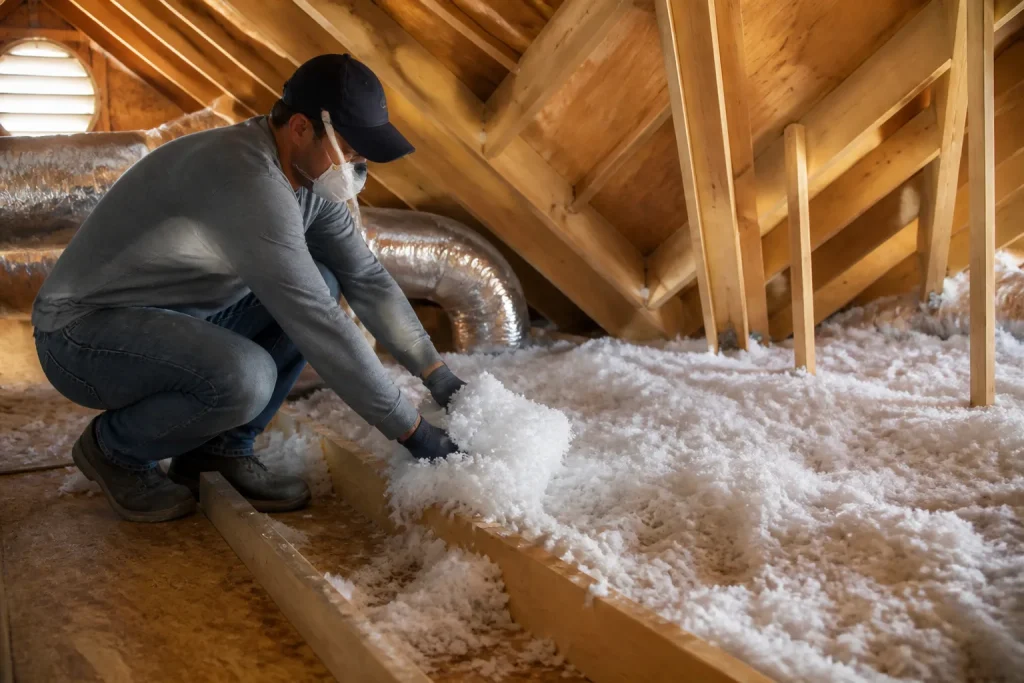
You can do the ruler check and the visual inspection yourself. You should. But if you find compressed insulation, gaps, or depth below about 10 inches, that’s the point to call someone who does this every day. Adding insulation or sealing air leaks properly requires working in a hot, cramped, dusty attic, often around fiberglass and old wiring. A trained technician has the right respirator, the right knee boards, and the right judgment about what not to touch.
There’s also a safety element worth naming plainly. Attics contain hazards that aren’t obvious from the hatch: exposed nails, live electrical, and in older Los Angeles homes, vermiculite that may need testing before anything gets disturbed. If you’re not confident, don’t push through it. Call us at (325) 240-5411 and we’ll send a background-checked, uniformed technician to take a look. You’ll know exactly who’s walking into your home.
Related services in Los Angeles: Attic Insulation in Los Angeles and Spray Foam Insulation in Los Angeles. You can also learn more about how we work at the Woolsey Attic Insulation home page.
The Bottom Line
Los Angeles winters are mild enough to hide an insulation problem for years, and that’s precisely why the problem persists. Your attic loses the same percentage of heat at 45°F as it would at 20°F, but you never feel it, so you never check. The fix starts with a ruler and twenty minutes in your attic in October. If the numbers don’t add up to at least R-30, you’re paying your gas company for heat you’re not keeping.
If you’re in Los Angeles and need help, Woolsey Attic Insulation offers free estimates. Call (325) 240-5411. A live person answers 24 hours a day, 7 days a week. You’ll get a written price before any work starts, a committed arrival window, and a 365-day guarantee in writing on every job. Wool was the first insulation. Woolsey keeps the idea in the name.
Frequently Asked Questions
Most attic insulation jobs in Los Angeles run between $1,800 and $4,500 depending on attic size, current insulation depth, and whether air sealing is included. We give you the exact written number before any work starts, not an estimate range. Call (325) 240-5411 for a free quote.
Measure the depth. If fiberglass batts are less than 11 inches deep or blown-in insulation is less than 13 inches, your attic is under-insulated. Also look for compression, gaps, and moisture stains. Any of those means the insulation isn’t performing at its rated R-value.
Yes. Air sealing the top plates, recessed lights, and attic hatch stops heated air from escaping before insulation even comes into play. In most LA homes we see, air sealing delivers bigger comfort and cost improvements than adding insulation alone.
In most cases, yes. We schedule a free inspection quickly, deliver the written price, and can typically complete the installation within days of your approval. Call (325) 240-5411 and a live person will get you on the schedule.
Written by Glenn Hartley, Owner at Woolsey Attic Insulation, serving Los Angeles since 2002.
Need Insulation Help?
Call Woolsey Attic Insulation - licensed & insured, here with fast after-hours help in Los Angeles.
(325) 240-5411