
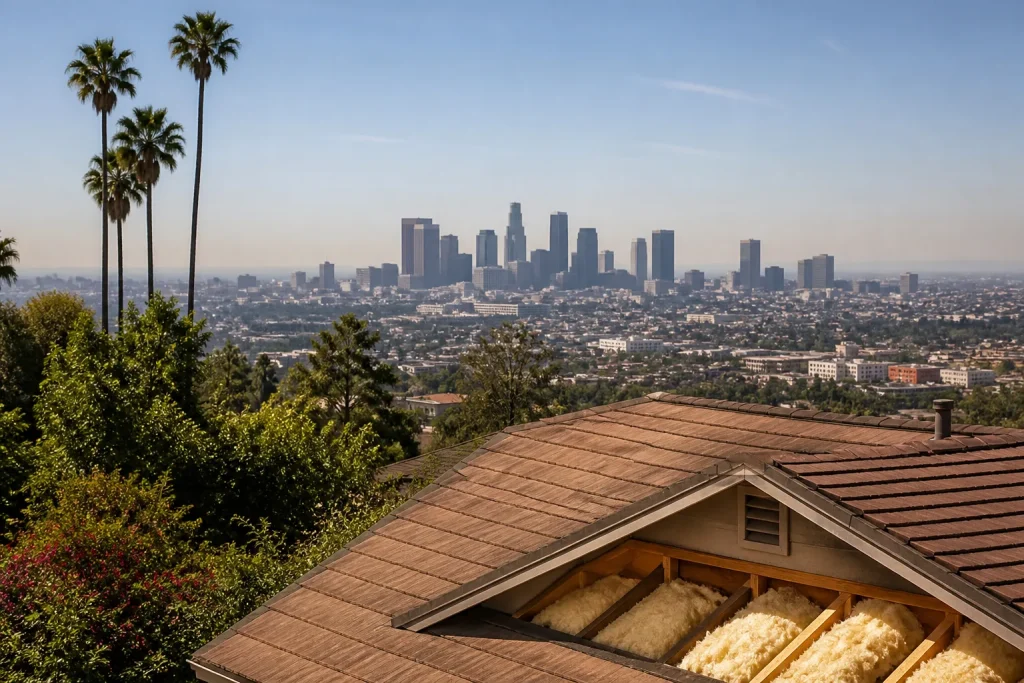
How Los Angeles Weather Affects Your Insulation
Los Angeles weather doesn’t destroy insulation the way a Minnesota winter does. It does something sneakier: it wears insulation down through relentless thermal cycling, intense UV exposure in ventilated attics, and months of accumulated heat that never really lets the material recover. The result isn’t a sudden failure. It’s a slow loss of R-value that shows up on your cooling bill years before an inspector ever flags it.
If you’d rather not spend your weekend in a 140-degree attic thinking about this, call us at (325) 240-5411 and we’ll take a look for you.
The Attic Temperature Reality in Los Angeles
Let’s put numbers on what your attic actually does during a typical Los Angeles summer. In the San Fernando Valley, attic temperatures routinely hit 150°F to 160°F by 2 p.m. in July and August. At dawn, that same attic might read 65°F. That’s a 90-degree swing every single day, for roughly five months straight.
Closer to the coast, say Santa Monica or Mar Vista, the peaks are lower, often 120°F to 130°F, but the marine layer adds something the Valley doesn’t deal with: morning humidity that sits in the attic until the sun burns it off. What you get is a daily cycle of heat expansion, moisture exposure, and contraction, repeated about 150 times each summer.
Cold-climate attics deal with one big seasonal shift, from warm to frozen and back. Your Los Angeles attic deals with a daily stress test for nearly half the year. Materials don’t fail dramatically under those conditions. They settle, degrade, and lose effectiveness a little at a time.
What the Daily Swing Does to Loose-Fill Insulation
Blown-in fiberglass and blown-in cellulose both respond to thermal cycling, but not the same way. Fiberglass, which is essentially spun glass fibers, tends to compress under its own weight faster when heat softens the binders that give it loft. Cellulose holds its height better initially but absorbs moisture more readily, and when it cycles between damp mornings and 150-degree afternoons, it can mat down in patches, creating thin spots you can’t see from the attic hatch.
Here’s what that looks like over time in a typical Los Angeles home:
- Year 1-5: Insulation looks fine. R-value holds close to the original specification. Energy bills are about what you’d expect.
- Year 5-10: The first compression appears, usually near the eaves and any high-traffic areas. Blown-in fiberglass can lose 15-20% of its loft. Your air conditioner starts running longer cycles without any obvious reason.
- Year 10-15: Settlement is visible. R-value may be down 30% or more in the worst spots. Cooling costs climb measurably, and rooms over the garage or on the top floor feel noticeably warmer than the rest of the house.
The maddening part is that none of this trips an alarm. Your attic doesn’t leak, your roof doesn’t show damage, and a quick glance at the insulation tells you nothing. The degradation is invisible unless you know what to measure.
The Marine Layer Problem: Coastal Los Angeles Is a Different Climate
Within five miles of the ocean, the insulation equation changes completely. Homes in Playa del Rey, Westchester, or San Pedro deal with morning fog that pushes relative humidity in the attic above 70% for hours at a time. Then the afternoon sun cooks that moist air to 120°F or more.
That’s the scenario where open-cell vs. closed-cell spray foam stops being a preference and becomes a physics decision. Open-cell spray foam is vapor-permeable, which means it lets moisture pass through. In a Ventura County canyon or the Antelope Valley, that’s fine, and sometimes desirable. Within a few miles of the Pacific, an open-cell application against the roof deck can absorb that daily moisture pulse, and over several years, that shows up as reduced adhesion and, in the worst cases, a musty smell that no air freshener fixes.
Closed-cell spray foam, by contrast, is a vapor barrier in its own right. It’s denser, typically around 2.0 pounds of material per cubic foot, and it doesn’t absorb the morning fog the same way. It costs more up front, sometimes 40-50% more than open-cell, but for coastal Los Angeles homes it’s often the difference between an installation that holds up for fifteen years and one that needs attention in seven.
We install spray foam insulation in Los Angeles in both open-cell and closed-cell configurations, and we’ll tell you straight up which one fits your specific street, not just your zip code. A home in Playa Vista and a home in Tarzana need different materials.
Santa Ana Winds and the Fire-Ember Question
When Santa Ana winds blow in from the desert, Los Angeles humidity can drop into single digits. Vegetation dries out. And your attic, if it has exposed spray foam, becomes something you should think about seriously.
Spray foam insulation is combustible. It’s not a secret and it’s not a defect; it’s just a material property. Exposed open-cell or closed-cell foam in an attic space needs an ignition barrier, usually a layer of intumescent coating or a thermal barrier like drywall, to meet code in most California jurisdictions. That requirement gets talked about like a paperwork technicality, but in Los Angeles the reason is brutally practical: embers from a wildfire or a neighboring house fire can travel hundreds of yards, land in a vented attic, and smolder or ignite on exposed foam.
This is not theoretical. The 2017 Creek Fire near Sylmar and the 2018 Woolsey Fire both sent embers into residential neighborhoods miles from the fire line. Homeowners with exposed foam in vented attics were, in some cases, relying on coatings that had degraded under years of daily thermal cycling, meaning the protection they thought they had wasn’t as robust as the day it was applied.
We’ve pulled degraded foam out of attics in Encino and Tarzana where the homeowner had no idea the ignition barrier had thinned. That’s not a scare story; it’s a reason to check. If you’ve got spray foam that’s more than five years old in a vented attic in Los Angeles, take a look or have someone take a look.
The ‘Mild Weather Excuse’ Trap
Los Angeles homeowners delay insulation upgrades for the most understandable reason in the world: it doesn’t feel urgent. Nobody calls an insulation company in January because their laundry room pipes froze. Nobody tapes plastic over the windows because the Santa Anas are howling in from the Palmdale side.
But there’s a cost to that reasoning, and it’s countable.
Take a 1,800-square-foot ranch in Granada Hills with original R-19 fiberglass batts, then 20 years old and settled to maybe R-11 or R-12 in the worst spots. In July and August, that attic is 150°F every afternoon. HVAC systems in that house run nearly continuously from 11 a.m. to 7 p.m. The cooling load difference between an R-12 attic and an R-38 attic in that climate can be $80 to $120 per month during peak summer. Over five months of hot season, that’s $400 to $600 per year. Over five years, you’ve paid for the insulation upgrade twice over, and you still have the hot house.
The mild weather excuse doesn’t survive first contact with a September electric bill.
And here’s the part that compounds: Los Angeles County’s climate is warming. Nights are warmer than they were in 1990, the marine layer burns off earlier, and heat waves arrive sooner in the year. The assumptions that made R-19 “adequate” in a 1965 home in the Valley are outdated. You don’t need a crisis to justify better insulation; you just need to look at what your attic is actually doing on a Tuesday in August.
When to Call a Pro
If any of these sound familiar, it’s worth a professional look: your top-floor rooms run 7-10°F warmer than the rest of the house in summer; your AC cycles on and off more than three times an hour during hot afternoons; you can see daylight through the attic floorboards where insulation has settled below the joist tops; or your attic smells musty in the morning, especially after foggy nights. These are all signs that the Los Angeles climate has been working on your insulation long enough to matter.
For readers who want to dig deeper into how we approach the work, you can also check out our attic insulation services in Los Angeles or start with the Woolsey Attic Insulation home page for how The Kingswell Way runs every job, from written price to cleanup to the 365-day guarantee.
The Bottom Line
Los Angeles weather is not mild to your attic. It’s a daily stress test of heat, moisture, and UV that settles loose-fill, tests foam adhesion, and degrades fire barriers in ways that don’t announce themselves until the bill or the ember arrives. The good news is that the right material, properly installed, handles this climate just fine. It’s the old, settled, or misapplied insulation that fails, and it fails quietly.
If you’re in Los Angeles and suspect your attic is underperforming, Woolsey Attic Insulation offers free estimates. We’ll give you a written price before any work starts, every time. Call (325) 240-5411. A real person answers, 24/7.
We pulled one out of a garage over in Woodland Hills last month where the homeowner had lived there since 2011 and had never seen his attic. The blown-in had settled to four inches at the eaves, which in this climate was doing almost nothing. He called us because his power bill hit $700 in August. That’s the thing about the Los Angeles climate: it doesn’t send you a letter. It just sends you the bill.
Frequently Asked Questions
Los Angeles-style daily thermal cycling, with attic temperatures swinging 60 to 90 degrees between dawn and afternoon for five months a year, compresses blown-in fiberglass, mats down cellulose, and degrades foam adhesion faster than the gradual seasonal changes seen in colder climates. The result is lost R-value and higher cooling costs, often years before any visible damage appears.
Yes. Homes within five miles of the coast in areas like Playa del Rey or San Pedro deal with morning marine layer humidity exceeding 70% in the attic, followed by afternoon heat. That cycle makes open-cell spray foam a poor fit for coastal attic applications in many cases, while closed-cell foam’s vapor-barrier properties handle the moisture cycle better. Inland Valley homes face less humidity but higher peak attic temperatures, so the material choice shifts accordingly.
In a typical LA attic, blown-in fiberglass can lose 15-25% of its R-value by year 10 due to settlement and binder breakdown under repeated heat cycles. Cellulose can lose 10-20% where it mats down from moisture exposure. Many homes in the San Fernando Valley we inspect at the 15-year mark are running at half their original rated R-value without the homeowner ever having looked in the attic.
Yes. Santa Ana conditions drop humidity to single digits and create the fire-ember risk that makes ignition barriers over exposed spray foam a practical safety concern in Los Angeles, not just a code requirement. Degraded thermal barriers on older foam can leave the material exposed to embers traveling from fires miles away.
Visual checks can catch major settlement, thin spots near the eaves, and moisture staining. But R-value loss under repeated Los Angeles thermal cycling often happens without obvious visual signs, especially early on. A trained eye with an infrared reading will show you what your insulation is actually doing.
Woolsey Attic Insulation handles attic and spray foam insulation across Los Angeles. We’re independently owned and operated, work with eight leading materials brands including Owens Corning, Rockwool, and GreenFiber, and every job runs under The Kingswell Guarantee. A written price before any work begins, a committed arrival window, a clean job site, and a written guarantee included. Call (325) 240-5411 for a free estimate. Estimates are free, and a live person answers the phone.
Written by Glenn Hartley, Owner at Woolsey Attic Insulation, serving Los Angeles since 2002.
Need Insulation Help?
Call Woolsey Attic Insulation - licensed & insured, here with fast after-hours help in Los Angeles.
(325) 240-5411