
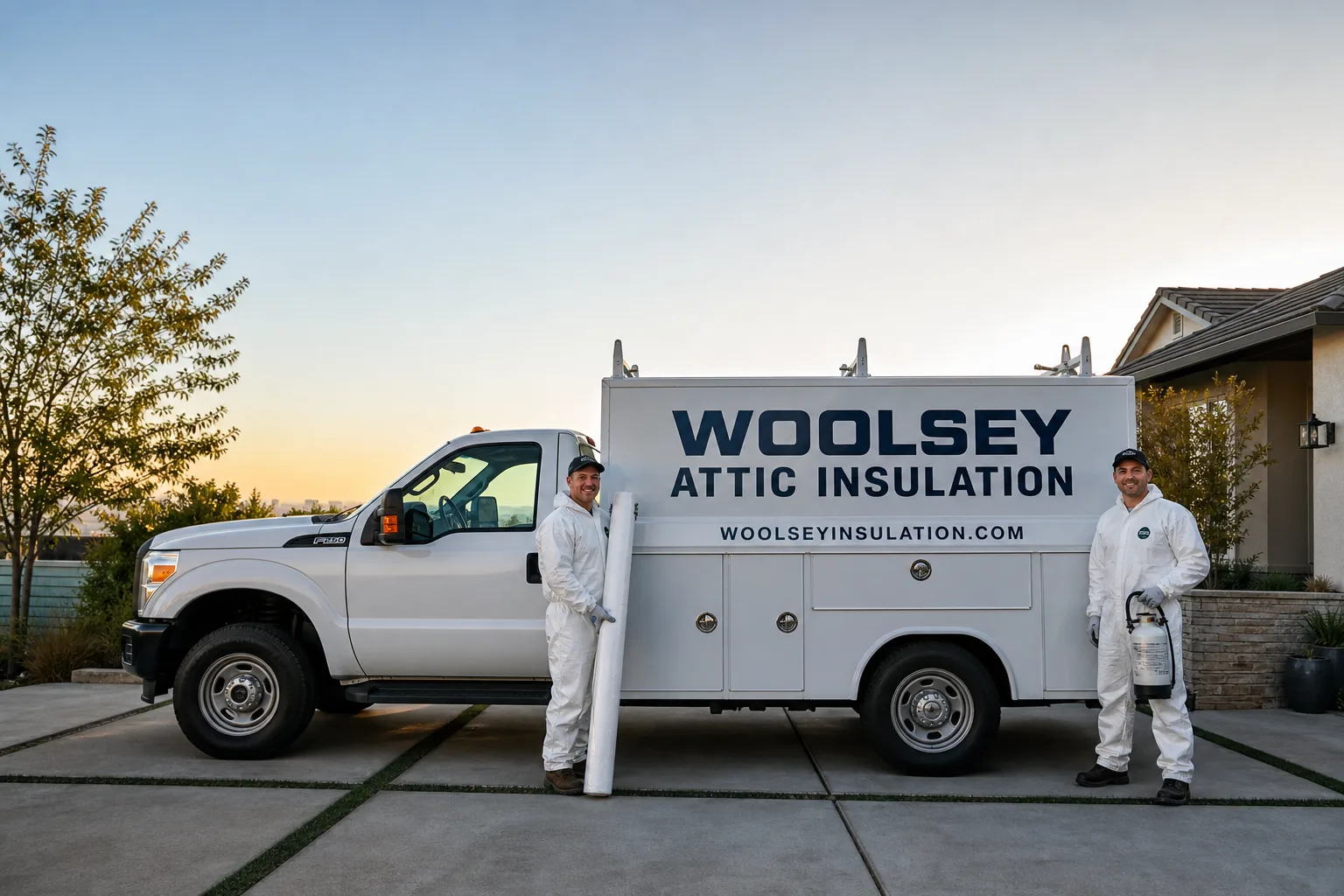
Fast, Reliable Attic Insulation Across Calabasas
Most attic insulation jobs in Calabasas run between $1,800 and $6,500 depending on square footage, existing insulation depth, and whether we’re doing a top-up or a full removal and replacement. That’s a real range, and you’ll get an exact written number before any work begins. We serve Calabasas neighborhoods from The Oaks to Mulholland corridor gated communities, and we know the fire-code requirements here better than an out-of-area crew ever could. Call (325) 240-5411 and a live person answers, any hour.
Why does that local knowledge matter? Because every attic in Calabasas sits inside California’s Very High Fire Hazard Severity Zone. That changes what materials you can use, how assemblies must be built, and what your permit reviewer will accept. We’ll walk you through it in plain language.
Why Woolsey Attic Insulation Is Calabasas’s Preferred Attic Insulation Company
Calabasas homeowners deal with a specific set of conditions: heat that regularly pushes past 105°F in summer, Santa Ana wind events that swing temperatures hard in fall, and attic spaces framed around vaulted ceilings and tile roofs that don’t give easy access. Our crews have worked those attics for years. We know the difference between a 1980s Calabasas Park home with original R-19 batts and a 2022 Woolsey Fire rebuild held to the current energy code.
We run background-checked, uniformed technicians on every job, so when a crew pulls up to your home on Mulholland Highway or Parkway Calabasas, you know exactly who’s walking through the door. We give you a written price before we touch anything. And every job carries our 365-Day Done Right Promise: if something isn’t right within a year, we come back and fix it at no charge. In writing.
Our Attic Insulation team handles blown-in cellulose, fiberglass batts, spray foam, and top-ups. Scheduling is coordinated from our Los Angeles office, and crews serve Calabasas locally. Call (325) 240-5411 for a straight answer and a free estimate.
Insulation Contractors in Calabasas
Insulation Contractors in Calabasas do more than blow material into a space and leave. The job here means reading your attic’s current condition, checking what the VHFHSZ rules require for your specific assembly, sealing air leaks, and installing the right material at the right R-value. A typical Calabasas project runs $1,800 to $6,500, with top-ups on the lower end and full removals with air sealing on the higher end. You’ll get the exact number in writing before we start.
Code-Driven Material Choices
Because Calabasas falls entirely within the Very High Fire Hazard Severity Zone, your insulation choice isn’t just about comfort. Ignition-resistant construction requirements apply. Borate-treated blown cellulose and closed-cell foam in specific assemblies are common here precisely because they satisfy the fire-rated standards while hitting Title 24 energy targets. A crew that doesn’t know Calabasas code might spec the wrong product and fail inspection.
Air Sealing Before Insulation
In canyon-facing Calabasas homes, wind-driven infiltration from Santa Ana events pushes hot or cold air through unsealed top plates and recessed can fixtures. We seal those penetrations before adding insulation. Otherwise you’re paying to heat or cool air that moves straight through your attic floor.
Attic Ventilation in Calabasas
Attic Ventilation in Calabasas is the difference between a roof assembly that bakes itself into premature failure and one that sheds the valley’s relentless heat. Calabasas attics can hit 140°F in August without proper airflow. Ventilation work typically runs $600 to $1,800 depending on whether we’re adding baffles, balancing intake and exhaust, or correcting a previous contractor’s mistake. It’s often the first thing we fix before insulation goes in.
Baffles and Intake Correction
Many 1980s and 1990s Calabasas homes were built with minimal or blocked soffit vents. When insulation gets blown in without baffles, it covers the intake and chokes the airflow entirely. We install baffles before every blow-in, then verify the ridge or box vents are actually moving air. Without that step, your new insulation traps heat instead of releasing it.
Cathedral Ceiling Ventilation
In homes with large cathedral ceiling sections and no accessible attic cavity, ventilation has to be designed differently. Open-cell spray foam applied to the underside of the roof deck converts that space to conditioned area, which changes the ventilation math completely. We’ve done this in The Oaks at Calabasas and throughout the Las Virgenes corridor, and it’s one of the more common fixes for upstairs heat problems in this city.
Trusted Brands We Service in Calabasas
We install and service insulation from Johns Manville, Knauf, Rockwool, and CertainTeed, among others. Why does that matter? Because your home’s assembly, exposure, and fire-zone obligations should determine the material, not whatever happens to be on the truck. A 1990s Calabasas home with cathedral ceilings and canyon wind exposure needs a different product than a flat-ceiling rancher in a protected cul-de-sac. We stock what Calabasas jobs actually require.
Common Attic Insulation Problems We See in Calabasas Homes
- Original R-19 batts from the 1980s and 1990s. Calabasas’s planned communities were built to old energy standards that no longer meet current Title 24 zone requirements. Those vaulted-ceiling rooms become heat traps by early afternoon.
- Cathedral ceilings with no accessible attic cavity. Builders in The Oaks and similar developments often framed large ceiling sections without any attic access above them, so the hottest rooms in the house have zero added insulation. Contractors skip them because they’re hard to reach. We don’t.
- Wind-washed insulation from Santa Ana events. Canyon-exposed roof assemblies in Calabasas get hit hard by wind that pushes through unsealed top plates and recessed lights, effectively eroding the insulation’s performance even when R-value looks sufficient on paper.
- Post-Woolsey Fire rebuild gaps. Full rebuilds along the Las Virgenes corridor are held to 2022 energy code, but surviving homes of the same era often still have original insulation. The gap between the two is enormous, and many owners don’t realize it until the first heat wave.
Pricing for Attic Insulation in Calabasas, CA
Here are honest numbers for the Calabasas market. A basic top-up to bring an existing attic from R-19 to R-38 typically runs $1,800 to $3,200. Full removal of old batts, air sealing, and new blown-in cellulose runs $4,000 to $6,500 on a 2,500 to 3,500 square foot home. Cathedral ceiling spray foam work on a single room starts around $2,500. Attic ventilation correction runs $600 to $1,800. Every quote is written, upfront, and unchanged when the crew arrives. Call (325) 240-5411 for a free estimate.
We Also Serve Cities Near Calabasas
Our crews cover Calabasas and the surrounding communities, including Topanga, Agoura Hills, Oak Park, and Westlake Village. If you’re just over the ridgeline, we’re still your local crew. Learn more about our work throughout the region on our Attic Insulation in Calabasas page.
Serving Calabasas, CA - Our Local Coverage Area
We’re based in the Calabasas area and know this community well. Use the map below to see our service coverage - if you’re nearby, we can almost certainly help.
FAQs About Attic Insulation in Calabasas
Yes. Every attic insulation job in Calabasas sits inside California’s Very High Fire Hazard Severity Zone, so material and assembly choices must satisfy ignition-resistant construction standards layered on top of Title 24 energy compliance. That means borate-treated blown cellulose or closed-cell foam in specific assemblies is a permit-driven decision here, not a performance upgrade.
Yes, we can, and we do it regularly in The Oaks at Calabasas and similar 1990s-built communities. The standard approach is applying open-cell spray foam to the underside of the roof deck, which converts the assembly to conditioned space and meets both energy code and VHFHSZ fire-rated requirements. Call (325) 240-5411 for an exact quote on your ceiling.
Most 1980s Calabasas homes were built with R-19 or less in the attic, and current Title 24 zone requirements call for R-38 minimum in vented attics, and often higher depending on the assembly. That’s roughly a doubling of insulation depth, which is why so many homes in Calabasas Park and Mulholland corridor developments run hot upstairs. We’ll measure and give you a written number.
In most Calabasas homes, that upstairs heat comes from a combination of original R-19 batts, unsealed air penetrations, and cathedral ceiling sections with no insulation above them. The attic becomes a heat reservoir, and the conditioned air below it can’t keep up. We were called to a 1990s home in The Oaks where the upstairs bonus room hit 96°F mid-afternoon with the AC running continuously. After we applied open-cell spray foam to the roof deck and dense-packed borate-treated cellulose to R-38 in the flat attic, the room held within 2 to 3 degrees of the thermostat setpoint during the next heat wave.
Yes, and the difference is significant. Rebuilds permitted after the 2018 Woolsey Fire are held to the 2022 energy code and current VHFHSZ ignition-resistant assembly requirements. Older surviving homes from the 1980s and 1990s often still carry their original R-19 or lower insulation. If you bought a surviving home, you may be dealing with a much lower standard than your neighbors in newer rebuilds. We’ll tell you exactly where your attic stands. Call (325) 240-5411 for a free assessment.
Written by Glenn Hartley, Owner at Woolsey Attic Insulation, serving Calabasas.