
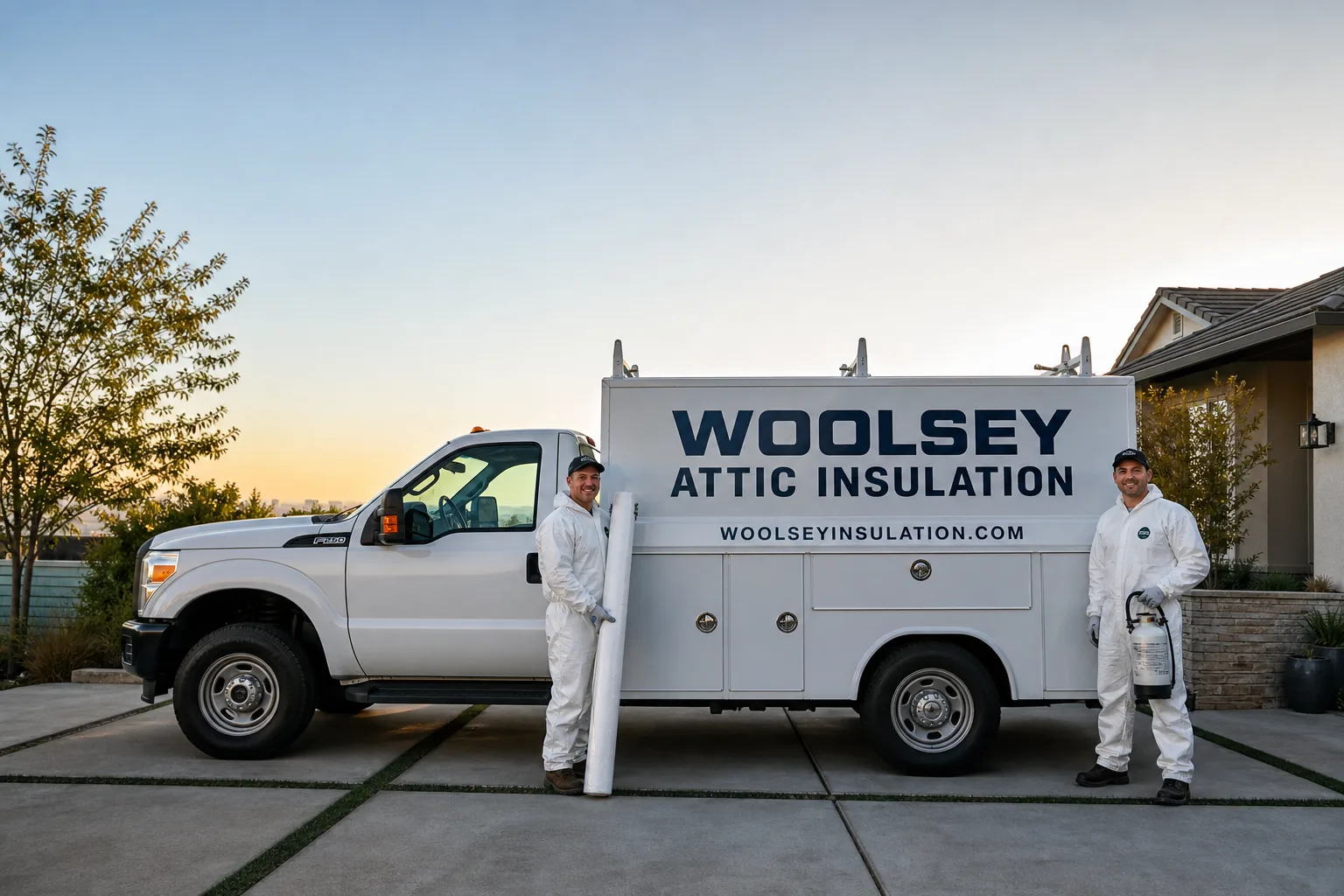
Fast, Reliable Attic Insulation Across Rohnert Park
Attic insulation in Rohnert Park is not a one-size-fits-all job. Most of the city’s homes were built between 1958 and the mid-1970s, before California’s Title 24 energy code took effect, which means original fiberglass batts are now decades past their useful life and wall cavities sit empty. Woolsey Attic Insulation covers every numbered section in Rohnert Park, from the ranch homes near Crane Creek to the newer builds east of Petaluma Hill Road. Call (325) 240-5411 and a live person answers, day or night.
What makes Rohnert Park different is the Petaluma Gap. Cool Pacific air funnels through the coastal hills and hits this city harder than Santa Rosa or Sebastopol. That persistent wind doesn’t just chill the outside of a house. It pushes through attic vents, across the insulation, and into the wall cavities below. We account for that in every quote we write.
Why Woolsey Attic Insulation Is Rohnert Park’s Preferred Attic Insulation Company
Homeowners here have called us after other contractors gave them a low verbal estimate and a much higher number at the door. That doesn’t happen with us. Before any work starts, a Woolsey technician walks the attic, measures the existing depth, checks the baffles and top plates, and hands you a written price. That number doesn’t change. It’s the Kingswell Guarantee, and it’s been part of every Woolsey job since 2002, when the company was founded under the Kingswell family of independently owned and operated insulation companies.
We show up in the window we commit to. Our technicians are background-checked and uniformed, so the person in your driveway is exactly who we said would arrive. When the job is done, we leave the site cleaner than we found it and hand you a written warranty: 365 days, in writing, on every repair and installation. If something isn’t right within a year, we return and fix it at no charge. Glenn Hartley leads our crews, and he holds every job to the same standard he’d want in his own attic.
Attic insulation is all we do. We don’t install windows, we don’t replace HVAC systems, and we won’t try to sell you a roof. That focus is why our Attic Insulation team can diagnose a wind-washed attic in a Section 4 ranch in minutes, because we’ve seen hundreds of them.
Attic Insulation Removal in Rohnert Park
Attic Insulation Removal in Rohnert Park usually starts with what we find under the old fiberglass: batts that look intact from the hatch but have been pushed flat and piled against the gable vents by decades of Petaluma Gap wind. In the original numbered sections, the single-story ranch footprints and shallow roof pitches mean that wind enters through soffit vents and scours the attic floor. The insulation doesn’t disappear. It relocates. Bare spots open up over bedrooms and hallways while corners bury under drifted material. When that happens, a top-off just adds new insulation on top of compromised old material. The right fix is removal, air-sealing, and a fresh start.
A full removal and re-insulation in a typical Rohnert Park ranch runs between $2,200 and $4,800, depending on attic size and access. Smaller jobs where we only remove a portion and patch the affected area can come in lower. You get the exact written number before we touch anything.
Wind-Washed Batts and the Petaluma Gap Effect
Sustained winds through the Petaluma Gap accelerate what insulation pros call wind-washing: moving air strips the fine fibers from fiberglass batts and compresses them. In Rohnert Park, this is worse than in eastern Sonoma Valley communities because the wind arrives faster and more consistently. Our crews see batts in Section 4 and Section 5 attics that have lost half their original loft. They look okay at a glance. They’re not.
Moisture, Fog, and Matting
Marine fog is a regular visitor here, and under-ventilated attics trap that moisture. Damp fiberglass mats down and stops insulating. When we remove old insulation and find damp spots or visible mold on the attic floor, we address the ventilation issue before installing anything new. Our Rohnert Park crews stock baffles and vent prep materials on the truck so we can fix airflow in the same visit.
Blown In Insulation in Rohnert Park
Blown In Insulation in Rohnert Park is the standard recommendation for attics and walls in the numbered sections. Blown-in fiberglass or cellulose settles into every corner, around every truss, and over every top plate in a way batts can’t match, especially when wind pressure is pushing air through the attic. For wall cavities, blown-in dense-pack fills the empty stud bays that every pre-1978 Rohnert Park tract home was built with.
For an attic-only blow-in, most Rohnert Park homes run between $1,800 and $3,600. A full wall dense-pack retrofit for a typical three-bedroom ranch runs $5,000 to $9,500, because it requires drilling access holes through drywall or siding, filling each cavity, and patching afterward. We give one written price that covers all of it.
Dense-Pack Wall Retrofit for Numbered-Section Homes
Because the tract homes in Sections 1 through 6 were built to nearly identical floor plans, we can quote dense-pack wall retrofits block-wide without testing every single cavity. That uniformity doesn’t exist in Santa Rosa or Sonoma, where remodels and custom builds make each house its own puzzle. In Rohnert Park, we know the stud spacing, the cavity depth, and the window framing before we ever climb into the attic. That’s why we can offer a one-trip visit: we map the layout from the plan, and the plan matches the house.
Air-Sealing Before the Blow-In
No blown-in insulation performs well if air is still moving through the top plates and around light fixtures. In a 1962 Section 4 ranch, our tech climbed into the attic and found the original fiberglass batts had been pushed flat by the Petaluma Gap draft and piled against the gable vent. We pulled the failed batts, air-sealed every top plate and electrical penetration, and blew in Owens Corning fiberglass to a uniform depth, then dense-packed the exterior walls from inside. The homeowner said the hall thermostat held steady for the first time during a windy week. We finished the attic and wall assembly in one trip because the tract footprint let us map the cavity layout before we arrived.
Trusted Brands We Service in Rohnert Park
We don’t sell whatever happens to be on the truck. Woolsey works with eight leading insulation brands, including Owens Corning, Johns Manville, Knauf, and Rockwool, so the material recommendation fits the house and the exposure. A wind-scoured crawlspace-facing attic with persistent fog gets one product. A dry attic over a well-sealed living room gets another. We stock the most common Rohnert Park-spec materials locally, which means shorter lead times and fewer return trips when a job runs long or a homeowner asks for an upgrade mid-project. Glenn Hartley’s crews are trained on every brand we carry, and the warranty doesn’t change because the material did.
Common Attic Insulation Problems We See in Rohnert Park Homes
- Wind-washed batts piled against gable vents. Sustained Petaluma Gap winds push loose fiberglass across the attic floor, leaving bare spots over living areas while material drifts into corners. A quick peek from the hatch misses it because the batts near the access point look untouched.
- Hollow pre-Title 24 wall cavities acting as chimneys. In the numbered sections, empty stud bays connect the attic to the living space. Warm air rises through the top plates into the attic, defeating new insulation within a season unless the walls are dense-packed or the top plates air-sealed first.
- Fog-driven moisture matting insulation flat. Marine fog and wind-driven moisture from the Petaluma Gap work into under-ventilated attics. Fiberglass and cellulose both absorb that damp, compress, and lose R-value. Removal becomes necessary when a top-off would trap that moisture underneath.
- Degraded original batts in slab-on-grade ranches. The late-1950s and early-1960s homes across Rohnert Park were built with minimal attic insulation and none in the walls. Sixty years of settling, dust, and wind exposure have reduced whatever was there to a thin, ineffective layer.
Pricing for Attic Insulation in Rohnert Park, CA
You won’t get a useful attic insulation quote over the phone without numbers. Here are the honest ranges for Rohnert Park: attic inspection and air-sealing alone typically runs $600 to $1,400. Attic blow-in to current R-38 or R-49 standards runs $1,800 to $3,600 for most ranchers here. Full attic removal of failed insulation plus new blown-in runs $2,200 to $4,800. Wall dense-pack retrofits for a standard three-bedroom tract ranch run $5,000 to $9,500. We don’t give verbal ballparks that shift when the tech arrives. A Woolsey estimate is a written price, delivered before any work starts, and it doesn’t move. Call (325) 240-5411 and we’ll schedule a walkthrough. The estimate is free.
We Also Serve Cities Near Rohnert Park
Our crews work across central Sonoma County. We cover Attic Insulation in Rohnert Park plus the surrounding communities: Cotati, Petaluma, Santa Rosa, and Sebastopol. If you’re just outside the city limits, call and ask. We’ll tell you straight whether we can get a crew to you, and when.
Serving Rohnert Park, CA - Our Local Coverage Area
We’re based in the Rohnert Park area and know this community well. Use the map below to see our service coverage - if you’re nearby, we can almost certainly help.
FAQs About Attic Insulation in Rohnert Park
The wind moved it. Sustained Petaluma Gap winds push loose fiberglass batts across the attic floor until they pile against gable vents or roof transitions. Your attic isn’t empty. It’s redistributed. The fix is removal, air-sealing, and a new blown-in layer that resists wind-washing. Call (325) 240-5411 and we’ll confirm what’s happening before you spend a dollar.
Yes. Dense-pack wall retrofits are done by drilling small access holes through the drywall or siding, filling each stud bay with blown-in insulation, and patching the holes. You don’t tear out drywall. Because Rohnert Park’s numbered sections used nearly identical floor plans, we can quote this work accurately and finish it in one visit. Many of our dense-pack jobs in Sections 1 through 6 take a single day.
We work with eight leading brands, including Owens Corning, Johns Manville, Knauf, and Rockwool. The recommendation depends on your attic’s exposure to Petaluma Gap wind, moisture, and how you use the space. We don’t push one brand for every house. You’ll see the material specified in your written quote before any work begins.
For the tract homes built between the late 1950s and early 1970s, yes, the wall cavities are typically empty. California’s Title 24 energy code took effect in 1978, and these homes predate it. The walls are hollow stud bays. An attic-only insulation job leaves those walls as heat-loss chimneys. Dense-packing them is the only way to make the home perform as a sealed system.
Because the housing stock is uniform. The numbered sections were built as planned communities with nearly identical floor plans, stud spacing, and cavity depths. Our crews know the layout before they arrive. In Santa Rosa or Sonoma, remodels and custom construction make each house different enough that we often need a second visit. In Rohnert Park, the plan matches the house, so we can bring the right materials, the right equipment, and the right crew the first time. Call (325) 240-5411 for an exact quote, delivered in writing, before any work starts.
Written by Glenn Hartley, Owner at Woolsey Attic Insulation, serving Rohnert Park homeowners with attic and spray foam insulation. Wool was the first insulation. Woolsey keeps the idea in the name.