
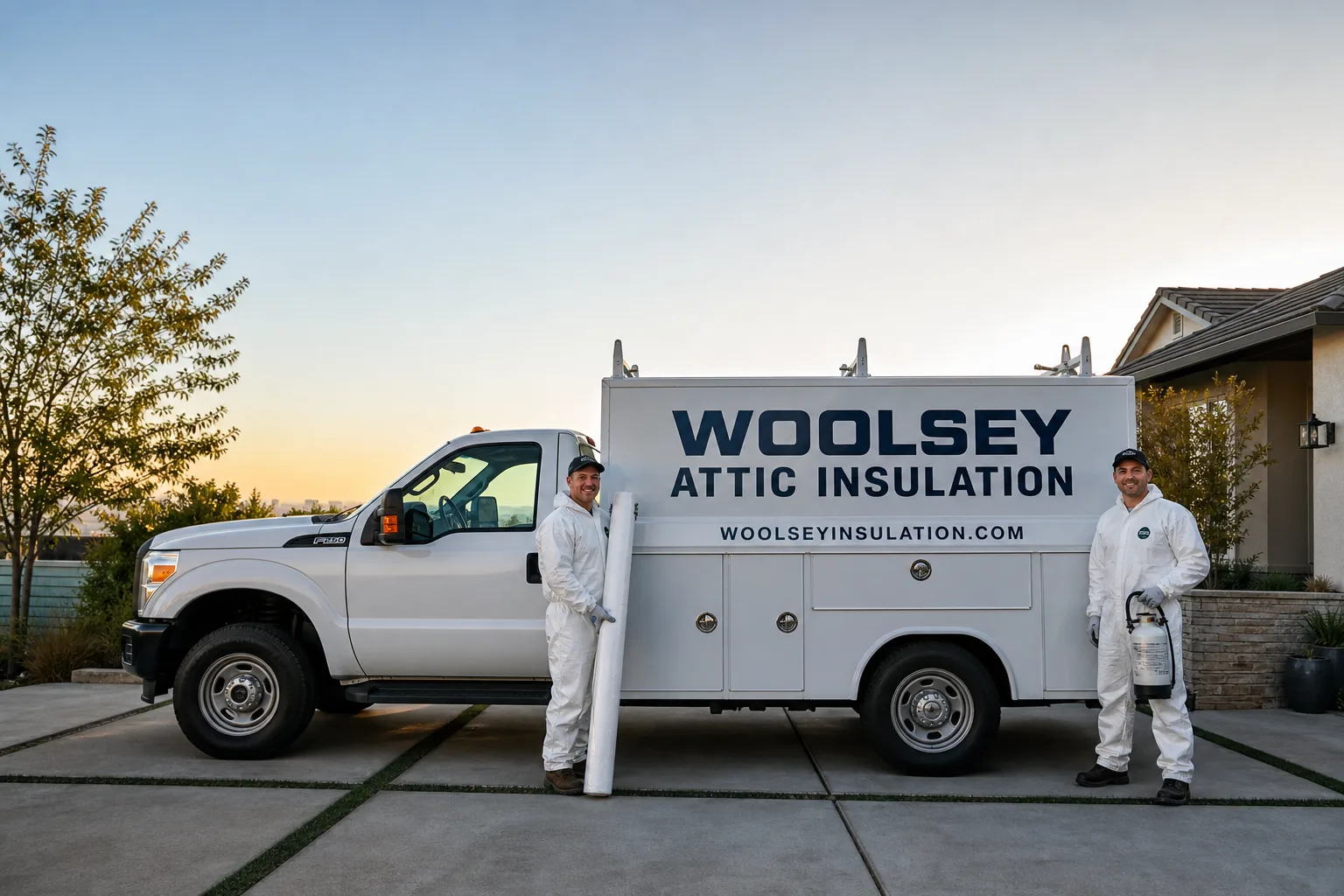
Fast, Reliable Attic Insulation Across Vincent
Attic insulation in Vincent has to work harder than almost anywhere else in Los Angeles County. Summer attic temperatures push past 150°F while winter nights drop below freezing, and the wind that funnels through the SR-14 corridor finds every gap in your ceiling. We’re Woolsey Attic Insulation, and we’ve been correcting problem attics in Vincent long enough to know that R-value alone won’t fix a drafty home here. Our crews respond to Vincent calls fast, we quote written prices before any work starts, and you can reach a live person at (325) 240-5411 any hour of the day. Whether you need a full Attic Insulation replacement or a targeted top-up, we’ll treat your attic like it’s our own.
Why Woolsey Attic Insulation Is Vincent’s Preferred Attic Insulation Company
Vincent homeowners don’t have much patience for contractors who show up late, change the price at the door, or disappear after the job. Around here, people talk. Our reputation across Vincent is built on doing exactly what we say we’ll do, and putting it in writing. Every job starts with a written price before any work begins. Every job ends with a written guarantee, and a free return visit if anything isn’t right within 365 days. That’s not a pitch; it’s how we’ve operated since Glenn Hartley built Woolsey into the Kingswell family of independently owned insulation specialists.
Our technicians arrive in uniform, background-checked, and on a committed arrival window, not a “sometime between eight and noon” shrug. When you call, a live person answers. Not a voicemail maze. Not a call-back tomorrow. Seven days a week, 24 hours a day. For older homes in Vincent with degraded batt insulation or missing baffles, that reliability matters. You’re not getting a subcontractor who’s never worked in the high desert. You’re getting a crew that understands wind-driven air infiltration and knows which materials actually hold up under this thermal swing.
Attic Ventilation in Vincent
Attic Ventilation in Vincent is the difference between an attic that breathes and one that cooks. When your attic hits 150°F in July, that heat has to go somewhere. Without proper airflow, it radiates down into your living space and pushes your cooling system well beyond its design load. Intake vents at the eaves and exhaust vents near the ridge create a natural convection current that pulls hot air out and draws cooler air in. In Vincent’s older ranch homes and manufactured housing, we frequently find the original vents blocked by dust, insulation, or decades of deferred maintenance. Sometimes the venting was never adequate to begin with.
Static Ventilation
Static vents – box vents, ridge vents, and soffit vents – rely entirely on natural airflow. They have no moving parts, which means nothing to break. In Vincent, the persistent Antelope Valley wind actually helps these systems work, but only if the intake and exhaust are balanced. Too many exhaust vents and not enough intake creates negative pressure that pulls conditioned air from your living space up through ceiling penetrations. We see this on older homes where someone added ridge vents without adding soffit vents.
Powered and Solar Ventilation
Powered attic fans move far more air than static vents and can drop attic temperatures dramatically on triple-digit days. Solar-powered models run free after installation and work best when the sun is strongest, which aligns perfectly with Vincent’s worst heat. We install both types and walk you through which makes sense for your roof profile and attic volume before we quote anything.
Radiant Barrier in Vincent
Radiant Barrier in Vincent addresses the problem no amount of blown-in fiberglass can solve: the sun baking your roof deck and radiating heat down into the attic. A radiant barrier is a reflective foil that stapled to the underside of your rafters reflects thermal radiation back toward the roof, keeping your attic and your living space measurably cooler. In a climate where summer attics routinely exceed 150°F, this isn’t a luxury add-on. It’s the difference between an attic that’s merely hot and one that’s actively cooking everything below it.
Foil Decking Installations
On homes where the roof deck is accessible, we apply radiant barrier foil directly to the underside of the decking. This reflects up to 97% of radiant heat before it ever enters the attic space. For Vincent’s older homes with open truss construction, this installation is straightforward and can drop attic temperatures by 20 to 30 degrees on peak summer days.
Existing Attic Retrofit
If you already have attic insulation in place, adding a radiant barrier is one of the most cost-effective retrofits available. The barrier works independently of your insulation’s R-value and doesn’t interfere with batts or blown-in material. For Vincent homeowners whose attic insulation is in decent shape but whose summer cooling bills are still astronomical, we often recommend starting here. Radiant barrier installation for a typical Vincent attic runs $1,400 to $3,800 depending on square footage and roof geometry.
Trusted Brands We Service in Vincent
We work with eight insulation manufacturers so the material recommendation matches your home, not whatever happens to be on our truck. On Vincent jobs, we regularly install Owens Corning loose-fill for its consistent blown-in depth and thermal performance, Knauf batts for their dimensional stability in older framing bays, and Rockwool where fire resistance matters most. These are materials we trust in the high desert’s thermal extremes. We carry local stock for the attic insulation systems used across Vincent and can typically source specialty products within 24 hours when a job calls for something specific.
Common Attic Insulation Problems We See in Vincent Homes
- Wind-driven air infiltration through unsealed top plates and penetrations. The SR-14 corridor wind pushes conditioned air out through unsealed gaps all winter long. Insulation can’t do its job when the air it’s supposed to trap is bleeding through the ceiling plane at every wiring penetration and top plate seam.
- Degraded or absent original insulation in pre-Title 24 homes. Many of Vincent’s ranch homes and manufactured housing went up before energy codes got serious. We routinely find 2 to 4 inches of compressed, dusty fiberglass where code today calls for R-38 to R-60.
- Heat-compressed batts in triple-digit attics. Sustained 150°F attic temperatures cause older batts to collapse and pull away from joists. Once fiberglass loses its loft, its R-value drops sharply, and it stops filling the cavity it was designed to fill.
- Dust-choked baffles and blocked ventilation. The fine dust that blows through Vincent’s semi-rural lots accumulates inside attic vent channels. When baffles plug, airflow stops, and the whole ventilation system fails silently.
Pricing for Attic Insulation in Vincent, CA
Most attic insulation jobs in Vincent run between $1,800 and $5,500 depending on square footage, access, and the condition of existing material. A straightforward blown-in top-up over existing batts typically runs $1,800 to $3,200 for a 1,200-square-foot attic. Full replacement including removal of degraded material, air sealing, and new blown-in insulation to R-38 runs $3,500 to $5,500. Radiant barrier adds $1,400 to $3,800. Attic ventilation installation runs $400 to $1,200 for static vents and $1,200 to $3,500 for powered or solar units. Every Woolsey quote is written before work starts and includes the 365-Day Done Right Promise in writing. Call (325) 240-5411 for an exact quote on your attic, free of charge.
We Also Serve Cities Near Vincent
Woolsey Attic Insulation crews work throughout the Antelope Valley and beyond. Along with Vincent, we provide attic insulation services in Attic Insulation in Vincent‘s neighboring communities including Los Angeles, San Diego, San Jose, and San Francisco. If you’re in a nearby city with the same high-desert temperature swings, we can usually schedule within the week.
Serving Vincent, CA - Our Local Coverage Area
We’re based in the Vincent area and know this community well. Use the map below to see our service coverage - if you’re nearby, we can almost certainly help.
FAQs About Attic Insulation in Vincent
Because wind-driven air infiltration through unsealed top plates and ceiling penetrations bleeds conditioned air out of your home regardless of how much insulation sits on top. We were called to a ranch-style home off the SR-14 corridor where the owner reported the house couldn’t hold heat on below-freezing winter nights despite a recent insulation top-off. Our tech found the original top plates and wiring penetrations wide open, with GreenFiber batts discolored from years of wind-driven dust infiltration. After air sealing with spray foam and blowing in Owens Corning loose-fill to a uniform depth, the home finally held temperature through the night. If your attic was topped off without air sealing, call (325) 240-5411 for an inspection.
Most Vincent homes benefit from both, but the order matters. If your attic has less than R-30 of insulation, we address that first because it delivers the fastest comfort gain. A radiant barrier only attacks radiant heat from the roof deck, so it does nothing for the heat that already transferred into the attic air. We typically recommend air sealing first, insulation to code second, and radiant barrier third as a summer-specific performance upgrade. Radiant barrier in Vincent runs $1,400 to $3,800 for a typical attic, and the written quote will show exactly what you’re paying for.
They mean your insulation has to work in both directions, not just keep heat out. In the coastal basin, attics mostly need to block outgoing heat. In Vincent, your attic also needs to trap heat inside during winter, and loose-fill fiberglass or cellulose performs well for that when installed at proper depth and paired with air sealing. The freeze-thaw swing also causes older batts to contract and expand, which degrades them faster than steady-state climates. We recommend materials with dimensional stability – Knauf and Rockwool batts hold their loft through these swings better than bargain fiberglass.
Yes, and it’s usually the single highest-impact upgrade you can make. Pre-Title 24 homes in Vincent were often built with R-19 or less in the attic, and much of that has compressed or blown away over the decades. Bringing the attic to R-38 or R-49 in a semi-rural ranch home can cut heating and cooling costs by 20 to 30 percent, and the comfort difference is immediate. We’ve done this on homes throughout Vincent’s larger lots and agricultural properties, and the written guarantee covers the work for a full year.
In our experience across Vincent, blown-in fiberglass from Owens Corning handles the thermal swing best when properly air-sealed, because it fills ceiling bays completely and doesn’t sag over time. Knauf batts are a strong choice for homes where the framing is irregular or where you’ll be in the attic frequently. Rockwool batts add fire resistance, which matters in semi-rural areas where wildfire defensible space is a concern. We stock all three locally for Vincent jobs, and your written quote will specify the exact material, depth, and R-value before we start.
Ready to fix your attic? Call Woolsey Attic Insulation at (325) 240-5411 for a free, written estimate. We serve all of Vincent with scheduled appointments and emergency-response availability, and a live person answers every call.
Written by Glenn Hartley, Owner at Woolsey Attic Insulation, serving Vincent under the Kingswell Guarantee. Every job in writing, every promise kept for 365 days.