
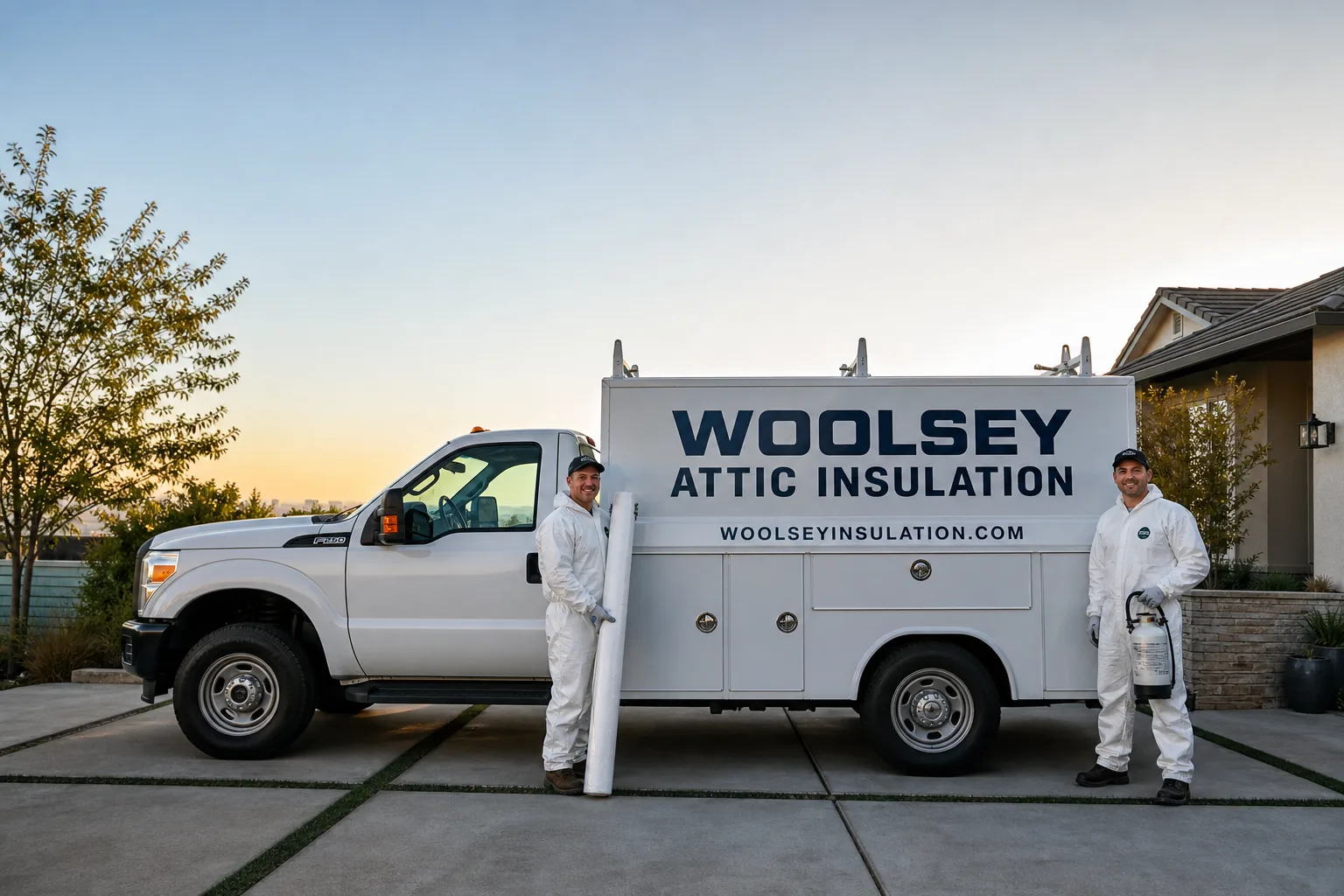
Fast, Reliable Attic Insulation Across Contra Costa Centre
Most attic insulation jobs in Contra Costa Centre run between $1,400 and $3,800, depending on attic size, what’s already up there, and whether old material needs to come out first. You get the exact written number before any work starts. If your Contra Costa Centre home was built in the 1960s or 70s and the upstairs won’t cool below 80 in August, you’re not imagining it and you’re not alone. Woolsey Attic Insulation has been inside enough attics near the Pleasant Hill/Contra Costa Centre BART station to know precisely what’s up there: settled fiberglass, rodent damage, zero air sealing, and a hatch that leaks like a window left open. Call (325) 240-5411 and we’ll schedule an inspection that tells you exactly where you stand.
Why Woolsey Attic Insulation Is Contra Costa Centre’s Preferred Attic Insulation Company
Contra Costa Centre homeowners don’t call Woolsey because they saw a billboard. They call because a neighbor in the tract homes east of Treat Boulevard used us, got a written price before work began, and actually had a crew show up inside the promised window. That shouldn’t be remarkable but if you’ve been through a contractor who changed the number at the door, you know it is.
Every Woolsey job in Contra Costa Centre runs on The Kingswell Way, and that means four things happen in order. We say the price up front, in writing. We show up in a committed arrival window, not a four-day “sometime next week” spread. We leave the job site cleaner than we found it. And we put a written guarantee on the work with a free return visit if anything fails within 365 days. Glenn Hartley, who leads Woolsey, built the company in 2002 around a simple idea: the insulation trade doesn’t need more salespeople. It needs more accountability.
Our technicians are background-checked and uniformed, so you know exactly who’s walking through your door. A live person answers our phone 24 hours a day, 7 days a week. No voicemail maze. No “we’ll call you back in 24 to 48 business hours.” When a Contra Costa Centre attic hits 140°F and a homeowner needs an answer, they get one.
We also understand this specific zip code’s housing stock. We don’t just install Attic Insulation; we look at how your specific 1960s tract home was built, where air is leaking, and what the Diablo Valley heat does year after year. That local knowledge changes the recommendation, and it’s why this page exists rather than a generic one.
Attic Mold Removal in Contra Costa Centre
Attic Mold Removal in Contra Costa Centre means something specific here: the inland Diablo Valley heat bakes moisture out of unvented or poorly vented attics, then cool nights drive it back into porous framing, creating exactly the warm, damp, stagnant conditions mold needs. In Contra Costa Centre’s post-war tract homes, we most often find mold growth on the underside of roof sheathing near blocked soffit vents and around bathroom exhaust fans that vent into the attic instead of through the roof. Homeowners typically call us after seeing dark staining on the attic side of the sheathing or smelling mustiness in an upstairs hallway. Attic mold removal in Contra Costa Centre generally runs $1,200 to $2,600, depending on the affected square footage and whether we need to remove insulation to reach it.
What the job involves here
We start by identifying why moisture is trapped in the first place, because treating mold without fixing airflow is a temporary fix. In Contra Costa Centre homes, that usually means clearing blocked soffit vents, adding baffles, and redirecting bathroom exhaust fans to terminate outside. Then we remove contaminated insulation, treat the affected framing and sheathing, and leave the attic dry and ready for new material.
When a Contra Costa Centre homeowner should act
Don’t wait for mold to spread. If you can smell it from the hallway, it’s already established. Call (325) 240-5411 for an inspection and a written plan with a real price. We’ll tell you honestly whether the mold is active, dormant, or something else entirely.
Attic Insulation Removal in Contra Costa Centre
Attic Insulation Removal in Contra Costa Centre is often the necessary first step when old fiberglass batts have settled to 3 or 4 inches, been torn up by rodents, or been soaked by a past roof leak. In many 1960s Contra Costa Centre homes, the original insulation delivers roughly R-8 to R-11 today, far below the R-38 the same attic space can hold with modern material. We remove the degraded material, vacuum out dust and debris, and give you a clean deck to work from. Attic insulation removal in Contra Costa Centre typically costs $800 to $1,800, depending on attic accessibility and how much material is up there.
When removal beats layering over old insulation
You don’t always need to remove what’s there. But in Contra Costa Centre’s older tract homes, the original batts are often too far gone to salvage. If there’s rodent activity, we always recommend removal first. You can’t air-seal effectively through compressed, contaminated fiberglass, and air sealing is where the real energy savings come from.
Prepping for a clean install
After removal, we have a clear view of the top plates, can lights, and plumbing penetrations that leak conditioned air into the attic. That’s the moment we air-seal before new insulation goes in. Skipping this step is the single most common reason a Contra Costa Centre homeowner adds insulation and still sees no improvement on their August cooling bill.
Trusted Brands We Service in Contra Costa Centre
We work with eight leading manufacturers: Owens Corning, Johns Manville, Knauf, Rockwool, CertainTeed, Icynene, Demilec, and GreenFiber. That range matters because the right material for a 1965 Contra Costa Centre tract home with a ventilated attic is not necessarily the right material for a modern condo near the BART station. We stock the products Contra Costa Centre homeowners actually need, which means less waiting on special orders. When you call (325) 240-5411, we’ll tell you what we recommend and why, not just what happens to be on the truck.
Common Attic Insulation Problems We See in Contra Costa Centre Homes
- Settled and compressed fiberglass batts. The original insulation in pre-1978 Contra Costa Centre tract homes has compressed to 3 – 4 inches, delivering R-8 to R-11 in attics that routinely bake past 140°F in summer. That’s why these homes can’t hold a setpoint in August no matter how hard the AC runs.
- Unsealed top plates and can lights. Conditioned air leaks straight through unsealed penetrations into the attic, so even after adding insulation, the house still runs hot and the system short-cycles. In Contra Costa Centre homes from this era, the leak area is often the equivalent of a window left open year-round.
- Dried-out attic hatch gaskets. Inland Diablo Valley heat shrinks and cracks old hatch weatherstripping, turning the hatch into a permanent open door for 140°F attic air to pour into the hallway below. This one’s easy to miss and expensive to ignore.
- Rodent tunnels and nests in the insulation. Pest activity in older Contra Costa Centre garages and attics compacts batts into tunnels and nests, creating uninsulated voids exactly where the ceiling is hottest. We find this in a large share of local attics, and it’s one more reason removal often beats layering.
And here’s the local hinge none of the national write-ups mention: the same inland Diablo Valley heat that destroys your attic insulation also destroys your garage hardware. Because the marine layer that keeps Oakland and San Francisco mild rarely reaches Contra Costa Centre, summer heat bakes older garages and their door springs, hinges, rollers, and chains years faster than in coastal Alameda County. We see failed torsion springs and corroded tracks in Contra Costa Centre garages at rates that would surprise a Lafayette homeowner. If your garage door is struggling and your attic is hot, there’s a decent chance the same heat is behind both. We handle insulation, but we’ll always tell you what we see.
Pricing for Attic Insulation in Contra Costa Centre, CA
A typical attic insulation job in Contra Costa Centre runs $1,400 to $3,800. Blown-in fiberglass for a standard 1,200-square-foot attic usually lands between $1,700 and $2,600. Attic insulation removal adds $800 to $1,800. If you’re adding spray foam to a knee wall or rim joist area, you’re looking at $1.75 to $3.25 per board foot, depending on whether you want open-cell or closed-cell. These are real numbers from our Contra Costa Centre jobs, not internet estimates. The exact written price comes after we inspect your attic, measure what’s there, and show you what we recommend. Call (325) 240-5411 for a free estimate. You’ll have the number before any work begins. That’s The Kingswell Way.
We Also Serve Cities Near Contra Costa Centre
Woolsey crews cover Contra Costa Centre and the surrounding Bay Area communities. Homeowners in Los Angeles, San Diego, San Jose, and San Francisco rely on the same written-price, written-guarantee approach. Learn more about our work across the region on our Attic Insulation in Contra Costa Centre hub page, or call (325) 240-5411 to talk with a live person about your attic.
Serving Contra Costa Centre, CA - Our Local Coverage Area
We’re based in the Contra Costa Centre area and know this community well. Use the map below to see our service coverage - if you’re nearby, we can almost certainly help.
FAQs About Attic Insulation in Contra Costa Centre
If it’s original, your attic likely has 3 to 4 inches of settled fiberglass delivering roughly R-8 to R-11, far below the R-38 the same space can hold today. Most Contra Costa Centre homes from the 1960s and early 1970s were built under codes that required only a fraction of what current energy standards call for. We can confirm in one visit. Call (325) 240-5411 and we’ll measure it for free.
It’s the inland Diablo Valley heat, not salt air. Contra Costa Centre consistently runs 20 to 30°F hotter than Oakland and San Francisco on summer afternoons, and that sustained heat bakes the lubricants out of springs, hinges, and rollers while thermal cycling stresses every metal part in the door system. Older tract homes with uninsulated garages amplify the effect. We don’t repair garage doors, but we see the same heat attacking attic insulation, and it’s the single biggest local factor in how we spec materials here.
Not always, but you should if the existing material is compressed, rodent-damaged, water-stained, or moldy. In Contra Costa Centre homes from the post-war tract era, that describes a large share of attics we inspect. If the old batts are clean and reasonably intact, we can blow new insulation right over them. The decision comes down to what we find. We’ll show you photos and give you a straight recommendation.
Yes, and it’s the highest-ROI step you can take. Attic insulation plus air sealing typically cuts cooling costs 15 to 30% in Contra Costa Centre homes even when walls remain uninsulated, because heat rises and the attic is your biggest thermal leak. Most 1960s and 1970s tract homes here have no wall cavity insulation, but the attic carries the largest share of the load. Start there, then decide whether wall retrofits make sense later.
Yes. Pre-1978 commercial office buildings clustered near the Contra Costa Centre BART station frequently have no meaningful roof or wall insulation at all, because they were built before California’s Title 24 energy code existed. We core-sample and assess these buildings for retrofit insulation, and it’s a more common job here than in surrounding residential-only communities like Lafayette or Moraga. Call (325) 240-5411 and ask for a commercial assessment.
If your Contra Costa Centre attic is hot, under-insulated, or showing signs of mold or rodent damage, call Woolsey at (325) 240-5411. You’ll talk to a live person, get a straight answer, and receive a written price before any work starts. That’s the promise we’ve kept since 2002, and it’s why your neighbors here keep our number.
Written by Glenn Hartley, Owner at Woolsey Attic Insulation, serving Contra Costa Centre homeowners with written-price, written-guarantee work since 2002.