
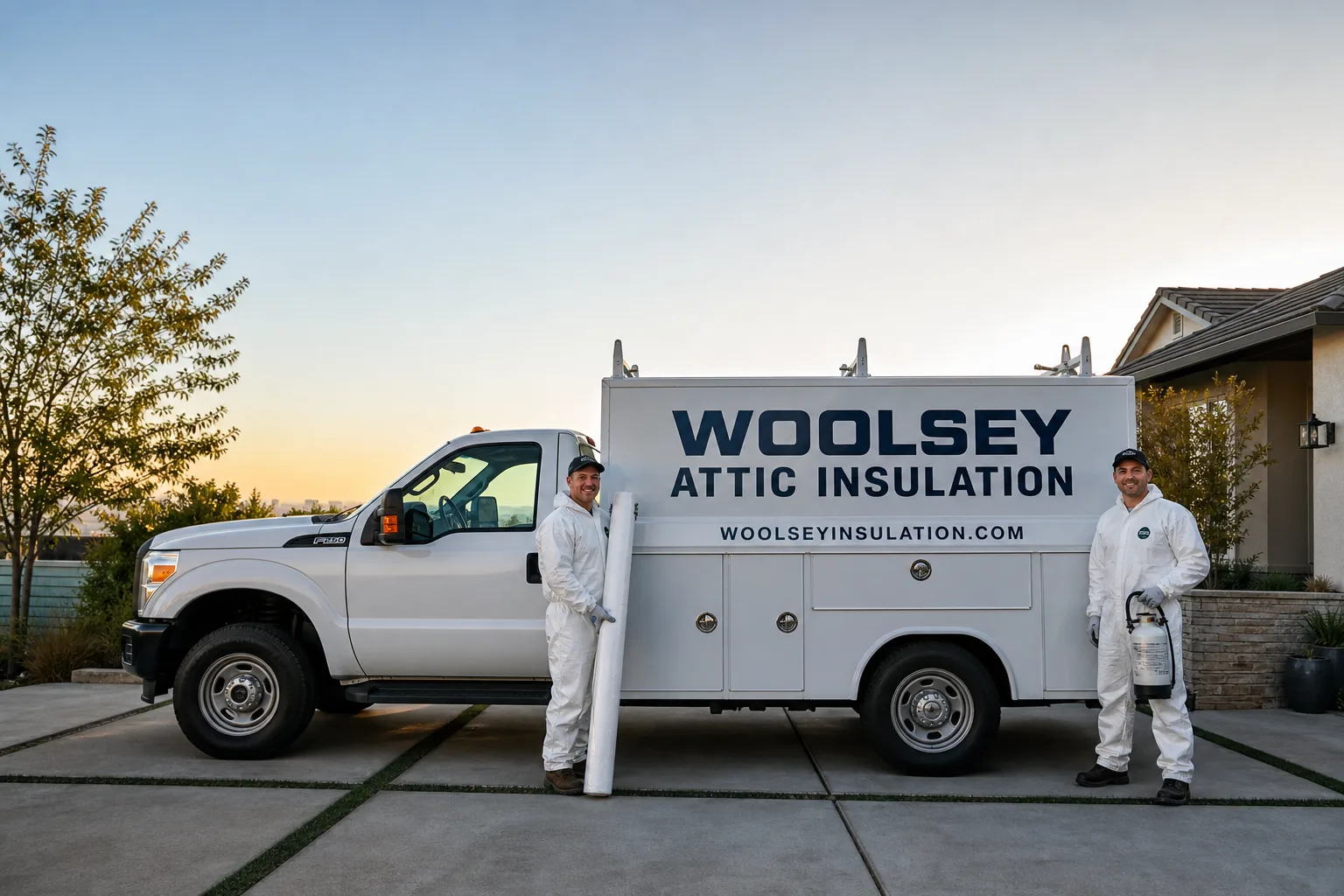
Fast, Reliable Attic Insulation Across Fillmore
Most attic insulation jobs in Fillmore run between $1,800 and $4,200, depending on attic size, existing insulation condition, and whether air-sealing is included. We give you the exact written number before any work starts. If your Fillmore home was built before the 1980s, there’s a strong chance your attic is under-insulated for this valley’s heat, and we can tell you precisely what’s up there and what it would take to fix it. Call (325) 240-5411 and a live person answers, any hour.
We’re Woolsey Attic Insulation, part of the Kingswell family of independently owned and operated insulation companies. Glenn Hartley leads our crews, and we’ve spent years working in Fillmore homes along Central Avenue, up into the Sespe foothills, and through the older blocks near Sespe Street and Mountain View Street. We know this town’s housing stock and we know what this valley’s heat does to an under-insulated attic.
Why Woolsey Attic Insulation Is Fillmore’s Preferred Attic Insulation Company
Fillmore homeowners keep calling us back, and we think it comes down to three things. First, we answer the phone. Not a machine, not a call-back number. A live person, 24 hours a day, seven days a week. When your attic is baking at 140°F in July and your AC won’t shut off, you don’t want to leave a voicemail.
Second, we put the price in writing before a single crew member steps through your door. Not an estimate that shifts at the last minute. A written number, delivered ahead of the work, every single job. That’s the Kingswell Guarantee, and it’s been the way we operate since 2002.
Third, our technicians are background-checked and uniformed, so the person walking into your Fillmore home is someone we’d trust in our own. And every job includes our 365-Day Done Right Promise: if it’s not right within a year, we come back and make it right at no charge. In writing.
Attic Mold Removal in Fillmore
Attic Mold Removal in Fillmore is a job we handle regularly, because this valley’s cool winter mornings and hot afternoons create condensation cycles inside poorly vented attics, especially in older homes near the Santa Clara River where humidity lingers. Mold takes hold in dark, warm attic cavities, and once it spreads into the insulation itself, the only real fix is removal and replacement. Most mold-affected attic insulation removal jobs in Fillmore run $2,200 to $4,800, depending on square footage and how far the mold has traveled through the insulation layer.
When Removal Beats Treatment
If the mold is only on the roof sheathing, treatment can work. But once it grows into blown-in fiberglass or cellulose, chemical sprays can’t reach the spores buried inside the material. In a Fillmore home with a 30°F day-to-night temperature swing, that trapped moisture keeps the mold alive. We remove the contaminated insulation, treat the surfaces, and prepare the attic for fresh material with proper baffles and ventilation. The written price covers all of it, and the guarantee is in writing for 365 days.
Ventilation Prep Before New Insulation
Mold often returns when the attic can’t breathe. Before we install anything new, we check your existing vents, ridge cap, and soffit baffles. In older Fillmore homes, especially 1920s-to-1960s bungalows, soffit vents are often painted over or blocked by decades of debris. We clear them and install baffles where needed, so the next insulation job doesn’t inherit the same moisture problem.
Attic Insulation Removal in Fillmore
Attic Insulation Removal in Fillmore usually means one of three things: the insulation is water-damaged, it’s been contaminated by rodents, or it’s simply collapsed and heat-degraded after decades of valley summers. We pull out the old material, bag it, and haul it away, then prep the attic for new insulation. Removal-only jobs in Fillmore typically run $1,200 to $2,800, and the full removal-plus-replacement package generally lands between $2,800 and $5,500 depending on attic size and access.
Signs Your Insulation Has Failed
In Fillmore homes built before the 1980s, it’s common to find original fiberglass batts compressed to half their rated R-value, dust-caked and rodent-nested. You’ll feel it as rooms that won’t cool in summer or hold heat in winter, and you may smell it as a stale, musty odor near the attic hatch. If your insulation is more than 25 years old and has never been replaced, it’s likely past its useful life.
Why Removal Comes Before Air-Sealing
You can’t properly air-seal an attic with old insulation still sitting in the way. We remove the old material, then inspect top plates, electrical penetrations, and plumbing chases for gaps that leak conditioned air into the attic. In Fillmore’s citrus-era bungalows, those gaps are often the single biggest source of heat gain, and sealing them before installing new insulation is the difference between a retrofit that works and one that just looks good from the hatch.
Trusted Brands We Service in Fillmore
We install and service attic insulation only, and we work with eight leading material brands so the recommendation fits your Fillmore home, not whatever’s loaded on the truck that day. That includes Owens Corning fiberglass, Johns Manville batt insulation, Knauf blown-in products, and Rockwool for homes that need extra fire resistance or sound control in the attic floor. Whether your project needs R-38 blown-in coverage in a 1,100-square-foot bungalow attic or Rockwool batts in a 1970s Sylmar-rebuild addition, we’ll quote the right material for the job and hand you the written price before anything starts.
Common Attic Insulation Problems We See in Fillmore Homes
- Coastal-spec R-values under valley heat. Homes permitted under a general Ventura County assumption often carry R-11 to R-19 insulation, which is a coastal spec. In a Fillmore attic hitting 140°F in August, that’s like running an ice chest with a beach towel for a lid. We routinely find R-19 installed in homes that need R-38 minimum for this microclimate.
- Citrus-era construction with zero cavity fill. The older bungalows near downtown Fillmore were built with redwood-framed walls and plaster-and-stucco exteriors, with no wall cavity insulation at all. Attic heat radiates through those empty cavities straight into living space, and a retrofit that doesn’t air-seal first just traps the problem inside.
- Post-1971 Sylmar rebuilds that predate Title 24. Homes rebuilt after the Sylmar earthquake or added onto in the mid-1970s often have compressed fiberglass or original insulation that’s been rodent-contaminated for decades. The paper backing deteriorates, the R-value collapses, and the thermal performance is gone before the first 100°F day arrives.
- Big day-to-night temperature swings stressing the material. Fillmore regularly sees 30°F differences between afternoon highs and overnight lows. Insulation has to handle aggressive heat gain during the day and meaningful heat retention at night, a dual demand that repeatedly expands and contracts the fibers and accelerates degradation.
Pricing for Attic Insulation in Fillmore, CA
For a typical Fillmore single-family home, new blown-in attic insulation to R-38 runs between $2,800 and $4,800, including removal of old, degraded material. Top-up jobs, where we add fresh material over existing insulation that’s still in decent shape, run $1,200 to $2,400. Batt insulation replacement lands in the $3,000 to $5,000 range depending on square footage and whether we’re working in a low-clearance 1940s attic or a more accessible 1970s build. Mold remediation and removal adds $1,500 to $3,000 on average. Fillmore’s older housing stock means most jobs need removal and replacement rather than a simple top-up, and our written price accounts for that reality before we start. Call (325) 240-5411 for an exact written quote. Estimates are free, and nobody changes the number at the door.
We Also Serve Cities Near Fillmore
Our crews cover Fillmore and the surrounding valley communities, so if you’re in Moorpark, Santa Paula, Simi Valley, or Camarillo, the same Attic Insulation team can reach you quickly. Scheduling and dispatch are coordinated from our Los Angeles office, but the crews working your attic live and operate locally in the valley.
Serving Fillmore, CA - Our Local Coverage Area
We’re based in the Fillmore area and know this community well. Use the map below to see our service coverage - if you’re nearby, we can almost certainly help.
FAQs About Attic Insulation in Fillmore
Because Fillmore sits deep in the inland Santa Clara River Valley, where summer highs top 100°F while Ventura and Oxnard, just 20-25 miles southwest, stay 15-20°F cooler thanks to marine influence. The valley geography blocks that coastal air, so your attic is absorbing a thermal load that a Ventura attic never sees. If your insulation was installed to a general Ventura County spec, it’s failing under conditions it was never designed for. Call (325) 240-5411 and we’ll inspect what’s actually up there.
Most don’t. Homes built in the 1920s through the 1950s for citrus and agricultural workers often have zero cavity fill in the walls and only whatever scrap insulation was added decades later in the attic. We regularly find original R-11 batts compressed to half their rated value, dust-caked and heat-degraded. The insulation you have is likely costing you more in AC runtime than replacing it would cost. Our crew recently worked a 1940s citrus-worker bungalow near the historic downtown blocks with exactly this condition, and after removal, air-sealing, and a fresh Owens Corning R-38 install, the homeowners told us their afternoon AC load finally stopped running past sunset.
Almost certainly not. The post-earthquake rebuilds and mid-1970s tract additions in Fillmore predate California’s Title 24 energy standards, which means original insulation installed at R-11 or R-19 was common, and decades of compression, rodent activity, and heat cycling have reduced its performance further. Current code for this climate zone calls for R-38 or better in attics. If your home hasn’t had attic insulation replaced since it was built, it’s a retrofit candidate. We’ll give you a written quote for what a valley-spec replacement costs, no obligation.
Fillmore commonly sees 30°F differences between afternoon highs and overnight lows, which means the insulation has to resist aggressive heat gain during the day while also holding in heat on cold winter nights. That dual demand favors higher R-values and materials that don’t collapse under repeated thermal cycling. Blown-in fiberglass and certain batts handle this better than old, compressed material, and air-sealing matters even more because the temperature differential between your conditioned space and the attic is so large. We’ll explain exactly what your attic needs, with the trade terms in plain language, before you commit to anything.
If the existing insulation is wet, moldy, rodent-contaminated, or compressed, removal is the right call, and those conditions describe a large share of Fillmore homes built before 1980. If the material is dry, intact, and reasonably close to its original depth, a top-up can work and costs less. The only way to know for sure is an attic inspection, which we do at no charge as part of every written estimate. Call (325) 240-5411 and a real person will schedule it.
Why Correct Valley-Spec Insulation Matters in Fillmore
Here’s what makes Fillmore different from the coastal cities 25 miles away. Homes here are permitted and insulated under a general Ventura County assumption that treats the whole county as one climate zone. But the Santa Clara River Valley blocks marine air and creates an inland-desert microclimate where summer highs routinely exceed 100°F while coastal Ventura and Oxnard stay 15-20°F cooler. The result: many Fillmore homes carry coastal-spec insulation, typically R-11 to R-19, in an environment that demands R-38 or higher. The insulation’s effectiveness collapses exactly when the attic hits 140°F and you need it most.
Then there’s the housing stock itself. Fillmore’s older blocks are full of citrus-era bungalows with redwood-framed walls, plaster and stucco exteriors, and zero cavity fill. Nothing in those wall cavities stops attic heat from radiating down into living space. The post-1971 Sylmar rebuilds added square footage but largely predate Title 24, so their attics are often insulated with compressed, rodent-contaminated material that lost its thermal performance years ago. A correct valley-spec retrofit means removal, air-sealing top plates and penetrations, installing proper baffles, and blowing in fresh material at R-38 or better. That’s the job we do in Fillmore every week.
Contact Woolsey Attic Insulation in Fillmore
If your Fillmore attic is under-insulated, moldy, or still carrying coastal-spec material from decades past, we’ll inspect it and give you a written price before anything starts. The Kingswell Guarantee covers every job: a written price, a committed arrival window, a clean job site, a written guarantee, and a free return visit if the work fails within 365 days. Call (325) 240-5411 now and a live person answers. No voicemail maze, no door-step surprises, just an honest number and a crew that shows up.
Written by Glenn Hartley, Owner at Woolsey Attic Insulation, serving Fillmore with valley-spec attic insulation and air-sealing since 2002.