
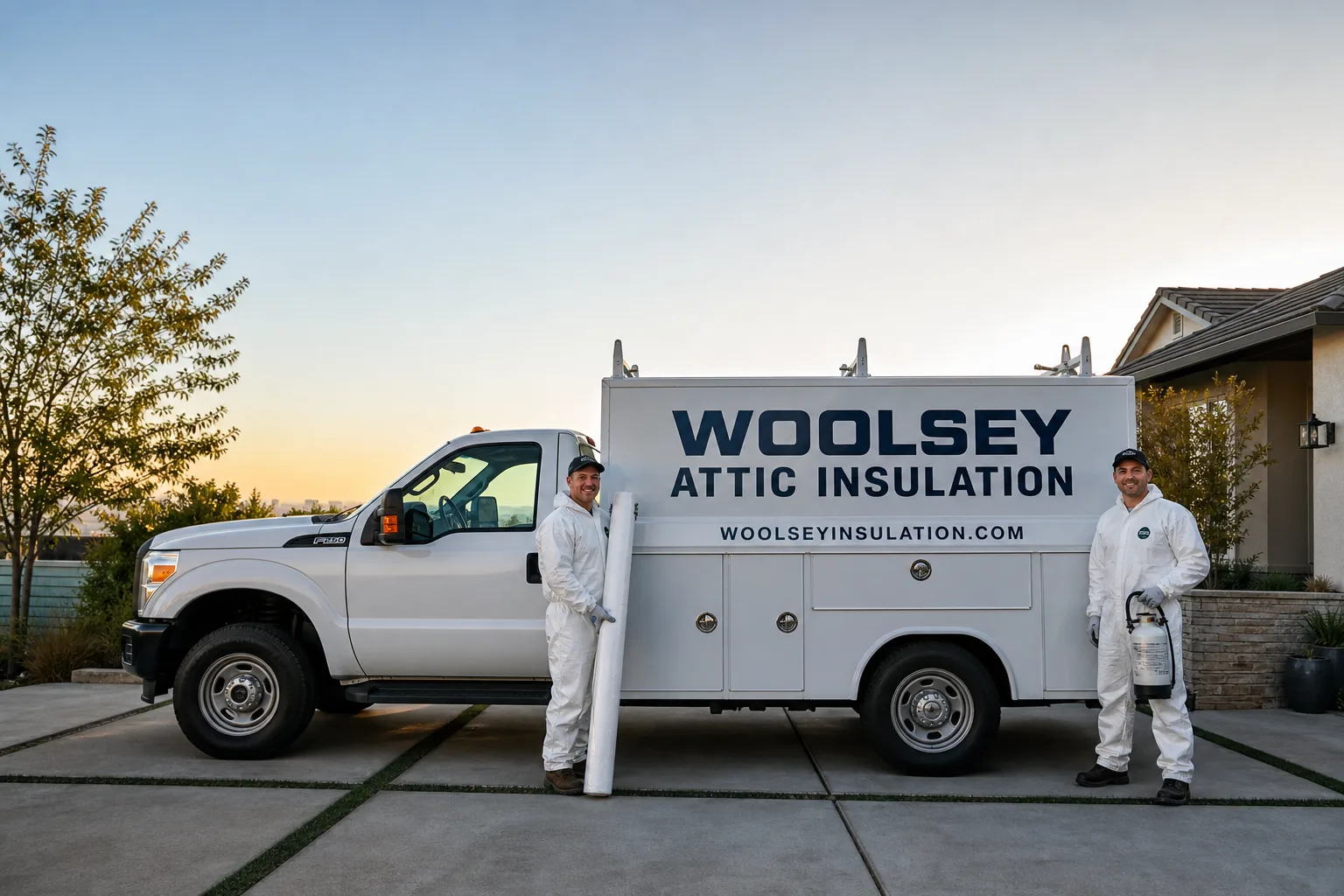
Fast, Reliable Attic Insulation Across Lake Arrowhead
Most attic insulation jobs in Lake Arrowhead run between $1,800 and $4,600, depending on attic size and how much of the original 1950s-to-1970s material needs to come out first. We give you the exact written number before any work starts, so there’s no door-step surprise. Woolsey Attic Insulation has spent more than two decades working in mountain communities like Lake Arrowhead, where the houses are different from what you find downhill. Cold attics, compressed rock wool, rodent-tunneled batts, and ice dams at the eave are standard calls for us up here. If your cabin or chalet won’t hold heat through a mountain winter, call (325) 240-5411 and we’ll walk you through what’s actually going on up there.
Key Takeaways:
- Lake Arrowhead sits in Title 24 Climate Zone 16, California’s coldest energy tier – your attic needs R-49, not the R-30 that works fine down in San Bernardino
- Most pre-1980 Lake Arrowhead cabins have original insulation compressed to R-7 or worse
- We work with Owens Corning, GreenFiber, Johns Manville, and Knauf – the material fits the home, not the truck
- The Kingswell Guarantee: a written price, a real arrival window, a clean job site, and a written 365-day promise on every job
Why Woolsey Attic Insulation Is Lake Arrowhead’s Preferred Attic Insulation Company
We don’t just work in the mountains. We understand them. Lake Arrowhead is a specific kind of environment: high altitude, hard freeze-thaw cycles, and a housing stock built for weekend ski trips and summer escapes, not year-round living. Post-pandemic, that has changed fast. More people are converting their seasonal cabins into primary residences, and the first thing they notice is the cold. Glenn Hartley leads our Lake Arrowhead work, and he’s built the team around one principle: explain the problem honestly, price it in writing, and stand behind the result for a full year.
Every Woolsey technician who enters your home in Lake Arrowhead is background-checked and uniformed. You know exactly who’s walking through the door. The phone is answered by a live person 24 hours a day, seven days a week – no voicemail maze, no call-back window. And every job, from a simple blown-in top-up to a full attic rebuild with baffles and air sealing, includes the 365-Day Done Right Promise: if the work isn’t right within 365 days, we come back and fix it at no charge.
We also understand what Lake Arrowhead homeowners have been through with other contractors. Changed prices at the door. Missed arrival windows. Callbacks that go nowhere. The Kingswell Way is our answer: say the price, show up in the window, leave it cleaner than you found it, put the guarantee in writing, and come back if it fails.
Attic Ventilation in Lake Arrowhead
Attic Ventilation in Lake Arrowhead is not optional – it’s the difference between a dry attic and one that grows ice dams, condensation, and mold during hard mountain freezes. Proper ventilation lets the attic breathe so moisture from stack-effect airflow doesn’t condense on the underside of a cold roof deck. In a Zone 16 climate like Lake Arrowhead, where nighttime temperatures drop below freezing for weeks at a stretch, a poorly ventilated attic becomes a moisture trap. Most of the homes we see in Lake Arrowhead were built with ridge vents and maybe a couple of gable vents, but no soffit intake, and no baffles. The airflow path was never completed. That imbalance is the single most common ventilation problem we fix.
Soffit Baffles and Intake Air
Most mid-century Lake Arrowhead cabins have zero baffles at the soffits. Insulation was either shoved into the eave and blocked the airflow entirely, or the cavities were left open so wind blew straight through the attic. Baffles – rigid channels that hold the insulation back from the roofline – restore a clean path for outside air to enter at the soffit and exit at the ridge. It’s simple physics, but cutting corners here causes real damage. In Lake Arrowhead, we see homeowners replace their roof sheathing after a decade of ice damming because the attic was insulated to R-49 without first fixing the airflow.
Powered Attic Ventilation Options
Some Lake Arrowhead homes have poor ridge-line access or very low-slope roofs that don’t move air naturally. In those cases, a powered attic ventilator paired with proper intake baffles can make a measurable difference in moisture control and summer heat buildup. We recommend powered venting selectively – only when natural ventilation can’t do the job. The fix isn’t to throw a fan at the problem. It’s to diagnose where the airflow is actually blocked and fix that first. In most Lake Arrowhead homes, that means baffles, not motors.
A typical attic ventilation job in Lake Arrowhead runs $650 to $1,700 depending on the linear feet of soffit and how many rafter bays need baffles. We give you the exact number in writing before any work starts.
Radiant Barrier in Lake Arrowhead
Radiant Barrier in Lake Arrowhead works differently than most people expect. Unlike in the valleys below, where the main job of a radiant barrier is to reflect away brutal summer sun, up here the material does double duty. In summer, a radiant barrier stapled to the underside of the rafters blocks radiant heat transfer from the roof deck into the living space. In winter, that same barrier reflects radiant heat back into the home, reducing the amount of heat lost upward through the roof. It’s a thin, foil-faced sheet that’s inexpensive and surprisingly effective in both seasons.
Installing Radiant Barrier in Cold Climates
There’s a persistent myth that radiant barriers don’t make sense in cold climates. That’s wrong. Radiant barriers work in any climate where there’s a meaningful temperature difference between the roof deck and the attic floor. In Lake Arrowhead, that difference is extreme. The real rule is that a radiant barrier must be installed with proper ventilation – the barrier itself must not trap moisture. That’s why we almost never install a radiant barrier without first checking the soffit intake and ensuring the attic ventilation is balanced.
Radiant Barrier and Snow Country
Lake Arrowhead gets measurable snowfall, and snow sitting on a roof changes the roof deck temperature dramatically. Without a radiant barrier, snow melt at the roof peak refreezes at the cold eave, and the cycle repeats until you have an ice dam. A radiant barrier doesn’t solve ice damming on its own – that’s primarily an air-sealing and ventilation problem – but it does reduce heat loss into the attic, which is part of why snow melts unevenly at the ridge. In homes where we install both an air seal and a radiant barrier, homeowners report noticeably less ice along the eaves the following winter.
A radiant barrier installation in Lake Arrowhead typically runs $1,000 to $2,700, depending on attic square footage and whether baffles are installed at the same time. Every quote is a written price before work begins. Call (325) 240-5411 and we’ll inspect the attic and tell you exactly what makes sense for your home.
Trusted Brands We Service in Lake Arrowhead
We install and service Owens Corning, Johns Manville, Knauf, and GreenFiber insulation. We don’t have a truck full of whatever the distributor had a deal on this month. The material recommendation fits the home. For Lake Arrowhead’s Zone 16 attic requirements, we most often spec Owens Corning blown-in fiberglass at R-49 because it delivers the densest, most consistent coverage in irregular rafter bays. GreenFiber cellulose is a strong choice for air sealing when the home has old can lights and top-plate leaks. Johns Manville and Knauf batts serve well in smaller cabin retrofits. We carry local inventory for all four brands, so we don’t have to order and wait when a Lake Arrowhead job needs material sooner.
Common Attic Insulation Problems We See in Lake Arrowhead Homes
- Compressed R-7 rock wool in 1950s-1970s cabins. The original batts in these A-frames and chalets were never more than R-11 on day one – and after sixty years of freeze-thaw cycling, rodent tunneling, and gravity, they’re down to R-7 or lower. That’s roughly one-seventh of what Lake Arrowhead’s climate actually calls for.
- Stack-effect air leaks through top plates and can lights. Seasonal-retreat construction was never sealed. Warm air rises through the walls and bypasses the attic insulation entirely, carrying moisture with it. That moisture condenses on the cold roof deck and freezes. We see the resulting ice damming at Lake Arrowhead eaves all winter.
- Open downhill crawl walls in slope-built cabins. Many Lake Arrowhead homes are built on slopes, and their downhill crawl space wall is completely open to mountain wind. That means the floor loses heat faster than the attic, and attic-only upgrades underdeliver until the crawl wall is sealed. This is a Lake Arrowhead problem – flatland contractors almost never see it.
- Post-fire rebuilds with incomplete attic insulation. Homes rebuilt after the 2003 Old Fire or 2007 Slide Fire were built to stricter California WUI and Title 24 standards, so their walls and attic floors are generally better – but we still see attic hatches left uninsulated, baffle gaps, and bad installs. A newer build doesn’t automatically mean a properly insulated attic.
Pricing for Attic Insulation in Lake Arrowhead, CA
Here are the real numbers for the Lake Arrowhead market. A blown-in attic top-up on a home that already has some insulation – just bringing it from R-19 to R-49 – typically runs $1,200 to $2,400. A full attic insulation replacement, which means removing the old compressed batts, air-sealing the top plates and can lights, installing baffles, and blowing in R-49, typically runs $2,800 to $4,600 depending on attic square footage and access difficulty. A radiant barrier install runs $1,000 to $2,700. Ventilation work, including baffles and intake correction, runs $650 to $1,700. Every single quote is a written price delivered before any work starts, and every job includes the written 365-Day Done Right Promise. Call (325) 240-5411 and we’ll give you the exact number for your home.
We Also Serve Cities Near Lake Arrowhead
Our crews work throughout the San Bernardino Mountains and the surrounding foothills. If you live in Crestline, Running Springs, Highland, or San Bernardino, we bring the same Attic Insulation expertise and the same written pricing promise. For more on what sets our approach apart across the mountain communities, see our Lake Arrowhead coverage page.
Serving Lake Arrowhead, CA - Our Local Coverage Area
We’re based in the Lake Arrowhead area and know this community well. Use the map below to see our service coverage - if you’re nearby, we can almost certainly help.
FAQs About Attic Insulation in Lake Arrowhead
California Title 24 Climate Zone 16 calls for R-49 ceiling insulation in Lake Arrowhead homes. That’s the highest attic insulation requirement in the state, and it’s the same requirement you’d find in a cold-climate mountain town in Colorado. For context, San Bernardino – just 30 miles downhill – sits in Zone 10 and only requires R-30. If your Lake Arrowhead home was built before the early 2000s, it’s almost certainly nowhere near R-49. Call (325) 240-5411 and we’ll measure your current R-value and give you a written price to bridge the gap.
You can, but you shouldn’t. First, the existing rock wool in these 1960s Lake Arrowhead cabins is usually compressed to R-7 or worse and full of rodent tunnels. Second, the rafter bays weren’t designed for more material, so without baffles at the soffits you’d block the only airflow the attic has and create a condensation trap. The right sequence is: remove the old material, air-seal the top plates and can lights, install baffles, and then blow in R-49. It’s more work, but it’s the only way the insulation actually performs in Lake Arrowhead’s winter. Call (325) 240-5411 for a free inspection and a written plan.
In Lake Arrowhead, this usually means your home is slope-built and losing heat through the floor. When a cabin is built into the hillside, the downhill crawl space wall is often completely open to mountain wind. That means heat loss is driven from below, even after the attic is brought to R-49. We see this all the time – a homeowner pays for a comprehensive attic job, and the house is warmer but still not warm. The fix is to seal and insulate the crawl space floor and the open downhill wall. That’s not an attic job, but it’s the difference between an attic upgrade that works and one that underdelivers. Call (325) 240-5411 and we’ll tell you which category your home falls into.
Some do, yes. Homes rebuilt in Lake Arrowhead after the 2003 Old Fire or the 2007 Slide Fire were constructed to stricter California WUI and Title 24 code, which means their walls and attic floors start in a much better place than a 1960s original cabin. What we still see in these newer builds are incomplete details: attic hatches left uninsulated, gaps at the eave where baffles were omitted, or blown-in coverage that settled unevenly. It’s rarely a full replacement on these homes, but a targeted correction can make a real difference. We’ll inspect it honestly and tell you if the attic is already doing its job. Call (325) 240-5411 – estimates are free.
Yes – in Lake Arrowhead, a radiant barrier works in both directions. In summer it reflects heat from the roof deck away from the living space, and in winter it reflects radiant heat back into the home instead of letting it escape upward through the roof. That second effect is the one most people don’t realize applies here, but it does. The key is installation: a radiant barrier needs proper ventilation above it, or it becomes a moisture trap during cold weather. We typically install it in combination with baffles or a ventilation correction. Expect to pay $1,000 to $2,700 for a typical Lake Arrowhead attic. Call (325) 240-5411 for an exact written quote.
Written by Glenn Hartley, Owner at Woolsey Attic Insulation, serving Lake Arrowhead and the San Bernardino Mountains.
For a free attic inspection and a written quote with no door-step surprises, call Woolsey Attic Insulation at (325) 240-5411. A real person answers, 24/7.