
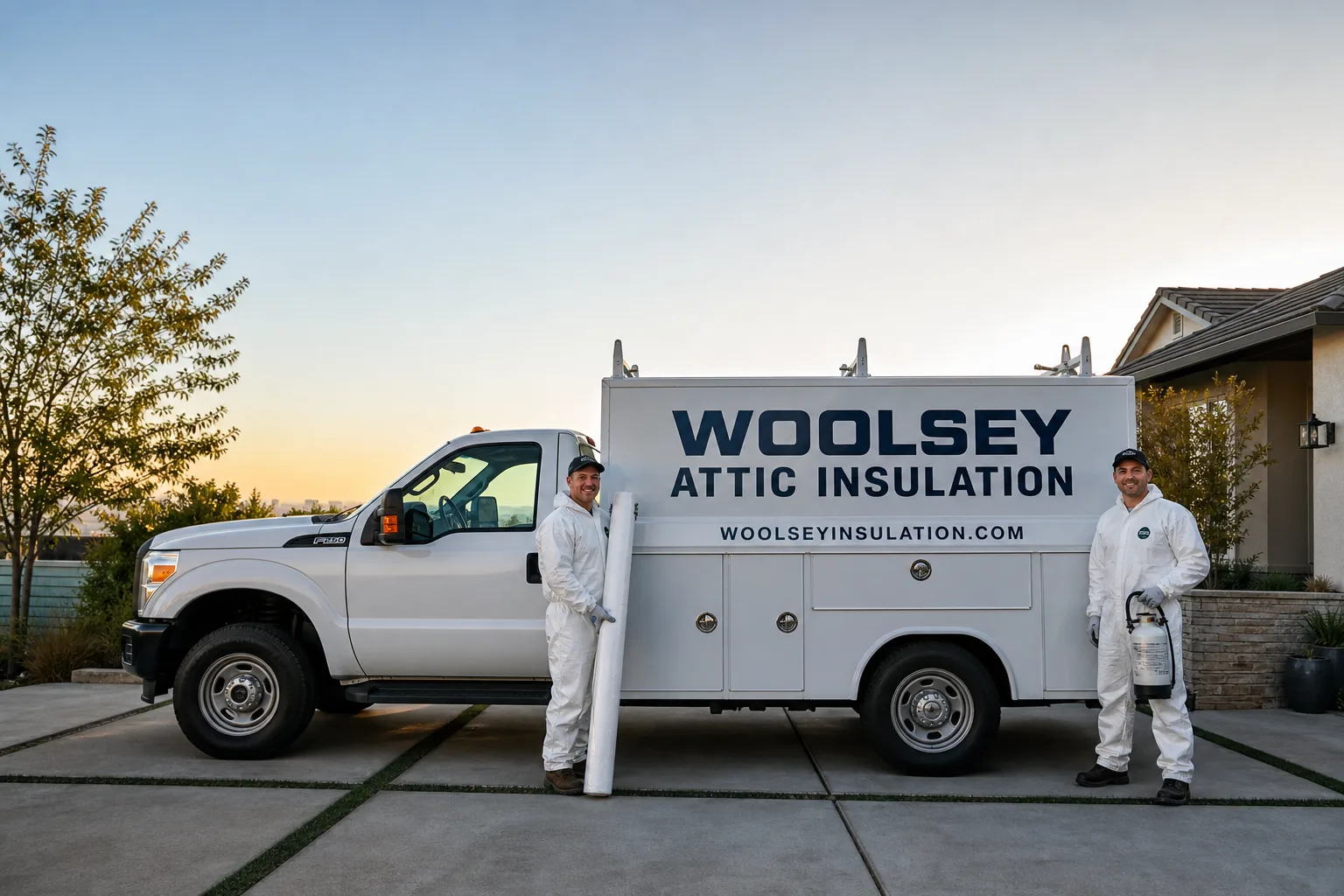
Fast, Reliable Attic Insulation Across Moreno Valley
If your Moreno Valley home was built between 1985 and 2000, your attic is almost certainly under-insulated for what this valley actually does in summer. Original R-19 blown-in fiberglass installed to then-minimum Title 24 code has compressed over 25 to 30 years, and we routinely measure effective R-values between R-11 and R-14 in the Alessandro Boulevard and Sunnymead Ranch tracts. That means your attic is working against you every afternoon from June through September, when roof deck temperatures climb past 150°F and your air conditioner fights heat that shouldn’t be there in the first place. Woolsey Attic Insulation serves Moreno Valley directly, with background-checked crews who know these 1990s stucco tracts block by block. Call (325) 240-5411 and we’ll give you a written price before any work starts.
Why Woolsey Attic Insulation Is Moreno Valley’s Preferred Attic Insulation Company
Moreno Valley homeowners have been let down before. A contractor quotes one number over the phone, then changes it at the door. A crew shows up three hours late, or not at all. A repair fails six weeks later and nobody answers the callback. We built Woolsey around fixing exactly that. Every job carries a written price delivered before work begins, a committed arrival window, and a written guarantee included on every installation. If something isn’t right within 365 days, we come back and fix it at no charge. That’s the Kingswell Guarantee, and it’s in writing on every Moreno Valley job.
Our Attic Insulation crews work in Moreno Valley weekly, and dispatch coordinates from our Inland Empire office in Riverside-San Bernardino, so scheduling doesn’t depend on a crew driving in from somewhere distant. You call, a live person answers, and we schedule a real window. We show up in uniform, with verified identity, and we leave the job site cleaner than we found it. Moreno Valley homeowners call us because they want the opposite of the contractor they dealt with last time.
Attic Ventilation in Moreno Valley
Attic ventilation in Moreno Valley is not optional, because the San Jacinto Valley heat load turns a poorly vented attic into an oven that cooks your insulation, your ductwork, and your cooling bill at the same time. A properly vented attic moves hot air out through ridge or static vents while pulling cooler air in through soffit vents, and that airflow is what keeps attic temperatures from climbing even higher than the 150°F we already see here. Without it, even R-38 insulation struggles to do its job, because the heat radiates down through the ceiling assembly all afternoon and evening.
Vented Tracts With Ductwork In Unconditioned Space
Most Moreno Valley homes from the late 1980s and 1990s run HVAC ductwork through the attic, which means every degree of attic heat adds heat gain to the air moving through those ducts before it ever reaches a register. We check baffles, clear blocked soffit vents, and verify that ridge or static venting matches the attic’s square footage. A typical attic ventilation correction in Moreno Valley runs $400 to $900, depending on vent count and whether baffles need replacement.
When Airflow Stops Working
Blown-in insulation that’s drifted into eaves blocks the very soffit vents that supply intake air, and that’s a failure we see constantly in Moreno Valley tracts where original insulation was never topped up. Without intake, exhaust vents have nothing to pull. We clear the eaves, install baffles where they’re missing, and restore the airflow path before adding insulation.
Radiant Barrier in Moreno Valley
A radiant barrier in Moreno Valley is one of the highest-return upgrades for a stucco tract home that sits in full sun all afternoon, because it reflects radiant heat back out before it can radiate down into the living space. Unlike insulation, which slows conductive heat transfer, a radiant barrier addresses the actual mechanism that makes San Jacinto Valley attics so brutal: the roof deck absorbing solar energy and re-radiating it downward at 150°F or more. We staple a foil-faced barrier to the underside of the roof rafters, leaving an air gap that lets it do its job.
What A Radiant Barrier Does For Your Cooling Load
In late-1990s Moreno Valley tracts without radiant barrier, attic surface temperatures routinely spike 20 to 30 degrees above outdoor air. Adding the barrier knocks that radiant load down measurably, and homeowners notice it most in late afternoon, when the house used to keep warming after the sun peaked. Radiant barrier installation in Moreno Valley typically runs $1,200 to $2,400 for a standard 1,500 to 2,200 square foot single-story home.
Pairing Radiant Barrier With Insulation
Radiant barrier doesn’t replace insulation; it changes the environment the insulation works in. We pair the two on most Moreno Valley retrofits, blowing insulation to R-38 or higher and then installing the barrier, because doing one without the other leaves half the problem untouched.
Trusted Brands We Service in Moreno Valley
We work with eight leading insulation manufacturers, and on Moreno Valley jobs we lean heavily on Owens Corning fiberglass, Johns Manville blown-in, and GreenFiber cellulose depending on what each attic actually needs. The material recommendation fits the home, not whatever happens to be on the truck. Because our crews stock these brands for Moreno Valley routes, we don’t have to special-order or substitute mid-job, which means your install doesn’t stall waiting on material.
Common Attic Insulation Problems We See in Moreno Valley Homes
- Compressed original blown-in: In 1985 to 2000 Moreno Valley tracts, original R-19 fiberglass has settled to half its rated depth or less. We measure R-11 to R-14 effective values constantly in the Alessandro Boulevard and Sunnymead Ranch areas, where sun exposure is longest.
- Duct heat gain in vented attics: Because nearly every Moreno Valley tract home runs ductwork through unconditioned attic space, under-insulated attics create a double energy loss. Your insulation is thin and your ducts are absorbing heat before air reaches the registers.
- Wind-drifted loose fill: Santa Ana and San Gorgonio Pass wind events push blown-in insulation into ridges and corners, leaving thin spots over living areas. Winter’s sharp overnight temperature drops then expose exactly where coverage drifted, and you feel it as cold rooms and uneven temperatures.
- Blocked soffit vents: Years of blown-in drift and unmaintained baffles choke off attic intake airflow in Moreno Valley homes. Exhaust vents pull nothing, attic heat builds further, and cooling costs climb accordingly.
Pricing for Attic Insulation in Moreno Valley, CA
Most Moreno Valley attic insulation retrofits run between $1,800 and $4,200 for a standard single-story tract home, depending on square footage, current R-value, and whether air sealing or ventilation work is included. A straightforward top-up to bring compressed R-12 back to R-38 typically lands between $1,500 and $2,600. Full replacement of failed insulation, including removal, air sealing, and new blown-in material, runs $2,800 to $4,200. We give you the exact written number before any work starts, and that number doesn’t change at the door. Call (325) 240-5411 for a free estimate, and we’ll walk the attic with you if you want to see the condition yourself.
We Also Serve Cities Near Moreno Valley
Our crews cover Moreno Valley and the surrounding inland communities, including Perris, Nuevo, Colton, and Riverside. If your home sits in one of these areas and you’re dealing with the same 1990s tract insulation issues we see across the San Jacinto Valley, call us and we’ll schedule a walkthrough. Same written price, same guarantee, same live person answering the phone.
Serving Moreno Valley, CA - Our Local Coverage Area
We’re based in the Moreno Valley area and know this community well. Use the map below to see our service coverage - if you’re nearby, we can almost certainly help.
FAQs About Attic Insulation in Moreno Valley
Your house was built to Title 24 minimums from the 1980s and 1990s, which meant R-19 attic insulation, and that material has since compressed to roughly half its rated depth. What was R-19 is now effectively R-11 to R-14, and Moreno Valley attic temperatures that regularly exceed 150°F demand far more than that. Current recommendations for this climate zone run R-38 to R-49, so most 1990s tract homes here are operating at less than half of what they should have. Call (325) 240-5411 and we’ll measure what’s actually in your attic and give you a written price for bringing it current.
For Moreno Valley’s inland San Jacinto Valley climate, we recommend R-38 minimum in vented attics, with R-49 preferable when we’re already up there and the budget allows. That’s the level where the insulation actually resists the 150°F attic temperatures these homes experience each summer rather than just slowing them slightly. The exact depth depends on material, but expect roughly 13 to 16 inches of blown-in fiberglass or cellulose. Call (325) 240-5411 for a free estimate; the exact number is in writing before work starts.
Yes. In Moreno Valley tract homes, ductwork runs through unconditioned attic space, so every degree of attic heat adds heat gain to the air moving through those ducts. Even with R-38 blown to full depth, ducts sitting in a 150°F attic absorb heat before conditioned air reaches your registers. That’s why we address duct heat gain as part of the same retrofit, whether through air sealing, radiant barrier, or correcting attic ventilation, rather than treating insulation as the only variable. Call (325) 240-5411 and we’ll walk through what your attic actually needs.
In Moreno Valley, yes, in most cases. A radiant barrier addresses the radiant load from your roof deck, which insulation doesn’t stop, and the San Jacinto Valley sun makes that load significant. Insulation slows conductive heat transfer; radiant barrier reflects heat before it radiates downward. For a 1990s stucco tract home in full sun, pairing blown-in R-38 with a foil-faced radiant barrier gives you measurably lower attic temperatures and better late-afternoon comfort than insulation alone. Call (325) 240-5411 for a written quote on both.
Within 25 to 30 years, which means almost every home in the Alessandro Boulevard tracts built between 1985 and 2000 is already there. We consistently measure original R-19 blown-in fiberglass compressed to R-11 to R-14 in those attics, and the longest sun-exposed homes are typically the worst. The compression happens steadily, but the loss is silent: the house slowly gets harder to cool, bills drift upward, and rooms start feeling uneven. If your home is in that age range, call (325) 240-5411 and we’ll tell you what’s actually in your attic before we ever quote a number.
Written by Glenn Hartley, Owner at Woolsey Attic Insulation, serving Moreno Valley and the surrounding San Jacinto Valley communities.