
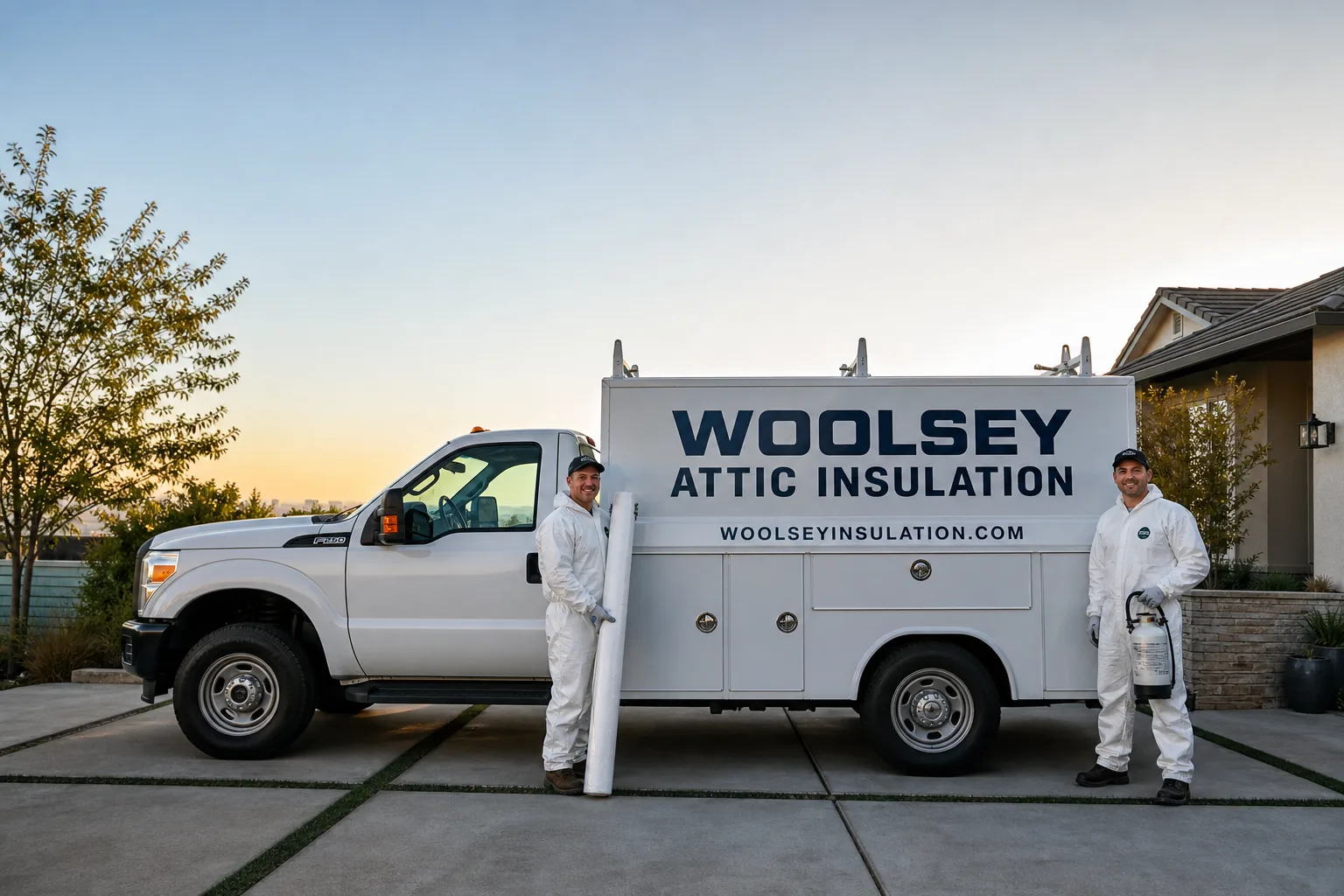
Fast, Reliable Attic Insulation Across Quartz Hill
Attic insulation in Quartz Hill usually runs between $1,800 and $4,600 for a full attic on a standard ranch or tract home, with the exact number written down before any work starts. Quartz Hill sits in California’s Title 24 Climate Zone 14, the high desert, which means your attic gets hammered by 155°F summer heat and genuine hard freezes in winter. That’s a nearly 85-degree seasonal swing, and most homes built here between the late 1960s and early 1990s came with insulation speced for mild coastal weather, not Antelope Valley extremes. Our crews serve Quartz Hill every week, we know these attics and what’s failing in them, and we answer the phone with a live person around the clock. Call (325) 240-5411 and you’ll get a straight answer, not a voicemail.
Why Woolsey Attic Insulation Is Quartz Hill’s Preferred Attic Insulation Company
Woolsey Attic Insulation is led by Glenn Hartley, and we’ve been focused on attic and spray foam insulation since 2002, part of the Kingswell family of independently owned and operated insulation companies. That focus matters in Quartz Hill because the local housing stock has a specific set of problems: 2×4 framing holding original R-11 wall batts, attics with compressed 1970s fiberglass, and rim joists that leak like sieves when the Antelope Valley wind picks up. We show up in a committed arrival window, background-checked and uniformed, and the price we quote before the first crew member arrives is the price on the final invoice. Every job carries the 365-Day Done Right Promise: if it isn’t right within 365 days, we’re back to fix it at no charge, in writing.
The Kingswell Way runs on a simple sequence: say the price, show up in the window, leave it cleaner than you found it, put the guarantee in writing, and come back if it fails. Quartz Hill homeowners tell us that’s the part they were missing with previous contractors. We work with eight leading insulation brands, Owens Corning, Johns Manville, Knauf, Rockwool, CertainTeed, Icynene, Demilec, and GreenFiber, and we recommend the material that fits your attic, not whichever roll happens to be on the truck. For most Quartz Hill homes, that means blown-in fiberglass paired with a radiant barrier, a combination we’ll get into below.
Attic Ventilation in Quartz Hill
Attic ventilation in Quartz Hill is the first thing we check on nearly every call, because an unvented attic here regularly hits 155°F to 160°F in July and August, and that heat doesn’t just sit politely in the attic. It radiates down into your living space during the hottest part of the day and pushes your cooling system to run longer and harder. Proper ventilation moves that superheated air out and pulls cooler outside air in, which lowers attic temperature, slows shingle aging from the underside, and reduces the load on whatever insulation you have up there. Most Quartz Hill homes from the 1960s through 1990s were built with minimal ridge and soffit venting, often just a couple of static gable vents that don’t move enough air for a Zone 14 attic.
What a Ventilation Assessment Covers
We measure the existing intake and exhaust area in your attic and calculate the net free vent area against the size of your roof footprint. The goal is a balanced system: intake low at the soffits, exhaust high at the ridge or through powered vents. If you have recessed lights, plumbing chases, or a whole-house fan opening into the attic, we document those because they’re bypass points that let conditioned air escape and outside air infiltrate.
Ventilation Retrofits on Older Quartz Hill Homes
Adding soffit vents to a 1970s ranch with continuous vinyl soffit is straightforward and typically costs $400 to $900 installed. Ridge vent additions run $1,000 to $1,800 depending on ridge length and accessibility. We don’t recommend powered attic ventilators in Quartz Hill unless the soffit intake area is adequate first: pulling air with a fan without enough intake simply depressurizes the attic and sucks conditioned air out of the house through every crack in the ceiling plane.
Radiant Barrier in Quartz Hill
Radiant barrier in Quartz Hill is the second half of the standard local prescription, and it’s the piece coastal LA attic jobs rarely need. A radiant barrier is a reflective material, typically aluminum foil bonded to kraft paper or oriented strand board, installed on the underside of the roof rafters. It reflects radiant heat from the sun back out of the attic before it can be absorbed by your insulation and radiated into the house. Up on the high desert plateau at roughly 2,400 to 2,700 feet of elevation, with intense Mojave solar radiation hitting unshaded roofs for ten-plus hours a day in summer, that reflective layer cuts attic temperatures by a measurable amount, often 20°F to 30°F on the hottest afternoons.
When a Radiant Barrier Makes Sense Here
If your Quartz Hill attic has asphalt shingles and full sun exposure, a radiant barrier is almost always worth adding alongside new insulation. If your roof is already heavily shaded by mature trees, the payback shrinks significantly, and we’ll tell you that honestly. Most installations run $1,200 to $2,600 for a standard Quartz Hill ranch footprint, and the material goes up over existing attic insulation without disturbing it.
Foil, Paint, and Sheet Options
We work with foil-faced sheet products because they hold up better in high-heat attics than radiant barrier paints, which lose reflectivity as dust accumulates. Dust is a real factor here: Quartz Hill’s persistent winds and the dry Mojave air push fine dust into attics that are not tightly sealed. A well-installed foil sheet sheds dust far better than a painted surface, and it’s more durable across the 40-plus-year lifespan of the attic.
One more note from the field. On a 1978 ranch-style home near 60th Street West and Avenue L-8, our crew found the original fiberglass batts compressed to about R-8 after decades of 160°F attic heat, with wind-driven dust and rodent trails through the insulation. We air-sealed the top plates and recessed lights, blew in Owens Corning blown-in fiberglass to bring the attic to Zone 14-recommended R-value, and added a radiant barrier on the roof underside to cut the summer radiant load. The homeowner reported the upstairs rooms held temperature far better through July, and the winter heating run-time dropped noticeably. That combination is the standard we recommend for most Quartz Hill homes, because the climate here demands it.
What Quartz Hill Attic Insulation Costs
Pricing for attic insulation in Quartz Hill starts with a simple fact: the numbers below are ranges, and your exact number is written down and handed to you before any work begins. For a typical 1,400 to 1,800 square foot ranch or tract home:
- Attic insulation top-up over existing insulation: $900 to $1,800, depending on current depth and access.
- Full blown-in attic insulation to Zone 14 recommended R-value (R-49 to R-60): $1,800 to $3,400.
- Attic batt insulation for open attics or accessible rim joists: $1,400 to $2,800.
- Attic insulation replacement including removal of old compressed or contaminated material: $2,600 to $4,600.
- Radiant barrier installed on the roof underside: $1,200 to $2,600.
- Attic baffles and ventilation prep (soffit baffles, air sealing, vent retrofits): $500 to $1,500 depending on scope.
What moves the number in Quartz Hill specifically: whether your attic has easy access via a pull-down ladder or a small hatch, how many recessed lights need air-sealed covers, and whether the old insulation is compressed, rodent-contaminated, or already at a decent depth. We don’t pad the price at the door, and we don’t quote one number on the phone and another in writing. Call (325) 240-5411 for a free estimate, and you’ll have the exact written number before you agree to anything.
Trusted Brands We Service in Quartz Hill
We install Owens Corning and Johns Manville blown-in fiberglass in Quartz Hill attics most often, and we also carry GreenFiber cellulose for homeowners who prefer a denser, recycled-content product. Knauf batts come into play for rim joist work and accessible wall cavities. What matters more than brand names is that we recommend the material for your specific attic and climate zone, and we stock enough locally coordinated inventory to keep Quartz Hill jobs moving without waiting on a distant warehouse. If you have a brand preference, tell us up front, and we’ll match the system to your roof geometry, ductwork layout, and existing insulation depth.
Common Attic Insulation Problems We See in Quartz Hill Homes
- Compressed fiberglass from sustained heat. Original 1970s and 80s batts in Quartz Hill attics lose R-value after decades of 155°F to 160°F summers. R-19 batts often measure at R-8 to R-10 by the time we pull a sample, because heat and dust have pressed the fibers flat and killed their loft.
- Wind-driven infiltration bypassing the insulation. Persistent Antelope Valley winds force dust and outside air through poorly sealed rim joists and top plates. The insulation can look intact from below, but air is moving through gaps behind it, so the house still bleeds heat in winter and takes on heat in summer.
- Bypasses around recessed lights, plumbing chases, and attic hatches. Batts laid over unsealed recessed lights and plumbing chases create hot and cold bypasses that short-circuit the insulation. In Quartz Hill’s seasonal swing, those bypasses matter year-round, not just in summer.
- No radiant barrier combined with low attic ventilation. Unshaded Quartz Hill attics hit 160°F in summer, and without a radiant barrier and adequate venting, that heat load radiates into the house and shortens the life of stored items and framing. Coastal LA homes rarely face this condition; here it’s the default.
We Also Serve Cities Near Quartz Hill
Our Attic Insulation crews coordinate from the Los Angeles office and dispatch across the Antelope Valley and beyond. If you’re reading this from Los Angeles, San Diego, San Jose, or San Francisco, we run the same Kingswell Guarantee on every job, with the same written price before work starts. The climate details change, but the process doesn’t. For specifics on your area, see our main Quartz Hill page or call the number below.
Serving Quartz Hill, CA - Our Local Coverage Area
We’re based in the Quartz Hill area and know this community well. Use the map below to see our service coverage - if you’re nearby, we can almost certainly help.
FAQs About Attic Insulation in Quartz Hill
Quartz Hill sits in Climate Zone 14, where summer attic temperatures regularly exceed 155°F and winter lows drop below 20°F, creating a near-85-degree seasonal swing that coastal LA attics don’t experience. Blown-in insulation alone slows conductive heat transfer, but it can’t stop radiant heat from the sun from baking the roof deck and radiating down into the attic. In Quartz Hill, the reflective layer of a radiant barrier is the standard companion to blown-in insulation, and together they address the two distinct heat paths that make these attics so punishing. Call (325) 240-5411 and ask Glenn or the team about the Zone 14 spec for your specific roof orientation.
Most 1980s Quartz Hill attics we inspect have original fiberglass batts that are compressed, dusty, and performing at roughly half their labeled R-value, so they’re doing something, but not nearly enough. After decades of 155°F to 160°F attic temperatures, fiberglass batts lose loft and settle into a thin, conductive mat. We pull a sample during every estimate, measure the depth and condition, and tell you exactly what’s up there before recommending a top-up or full replacement.
The persistent Antelope Valley winds push outside air through poorly sealed rim joists, top plates, and attic bypasses, so insulation that’s not paired with air sealing performs worse than its R-value suggests. Wind-driven air movement carries dust into the attic and forces conditioned air out of the house through every crack in the ceiling plane. We address that with air-sealing work alongside insulation installation in Quartz Hill homes, because insulation without air sealing is like a down jacket with the zipper open.
We install Owens Corning, Johns Manville, and GreenFiber most often in Quartz Hill, and we also work with Knauf batts for rim joist applications. The brand recommendation depends on your roof geometry, existing insulation type, and whether you’re topping up or replacing. We stock and coordinate materials for Quartz Hill jobs specifically, so turnaround is fast.
If your Quartz Hill attic still has original 1970s or 80s insulation, it should be checked now, and then every five years or after any significant roof or HVAC work. The combination of extreme attic heat and wind-driven dust degrades old fiberglass more aggressively here than in coastal LA, and compressed or contaminated insulation doesn’t recover. A check takes about an hour, and we’ll give you a written assessment with photos so you can see what we see.
Call (325) 240-5411 for a free attic insulation estimate in Quartz Hill. A real person answers, day or night. We’ll schedule a time in our committed arrival window, inspect your attic, and hand you a written price before any work starts. If you’ve been let down by a contractor before, this is the part that feels different. The Kingswell Guarantee covers every job, and it’s in writing.
Written by Glenn Hartley, Owner at Woolsey Attic Insulation, serving Quartz Hill since 2002.