
Fast, Reliable Attic Insulation Across Valley Center
Attic insulation in Valley Center runs between $1,400 and $4,800 for most homes, with blown-in fiberglass on a 1,500-square-foot ranch typically landing around $2,300 to $3,200. You get a written price before any work starts, not after. If your Valley Center home was built to coastal San Diego standards, or if you’re in a manufactured home with the original belly-wrap still underneath, your attic is almost certainly under-insulated for this climate. Call (325) 240-5411 and we’ll walk you through what’s actually going on up there.
We know Valley Center’s roads, its weather, and the way its homes were built. Cole Grade Road, Lilac Road, the ranches off Valley Center Road. Summer days over 100°F, winter nights below freezing. It’s a different animal than Escondido or the coast. Our Attic Insulation crews work here regularly, and we schedule around the heat, not through the middle of it when the attic hits 140°F.
Why Woolsey Attic Insulation Is Valley Center’s Preferred Attic Insulation Company
Glenn Hartley leads our Valley Center work, and he’s been inside more foothill attics than most crews will see in a career. The homes here tell a story: 1970s ranch builds with R-11 batt in 2×4 roof cavities, double-wides with sagging belly-wrap, custom avocado-property homes where nobody ever checked what’s above the drywall. We know what we’re going to find before we climb the ladder.
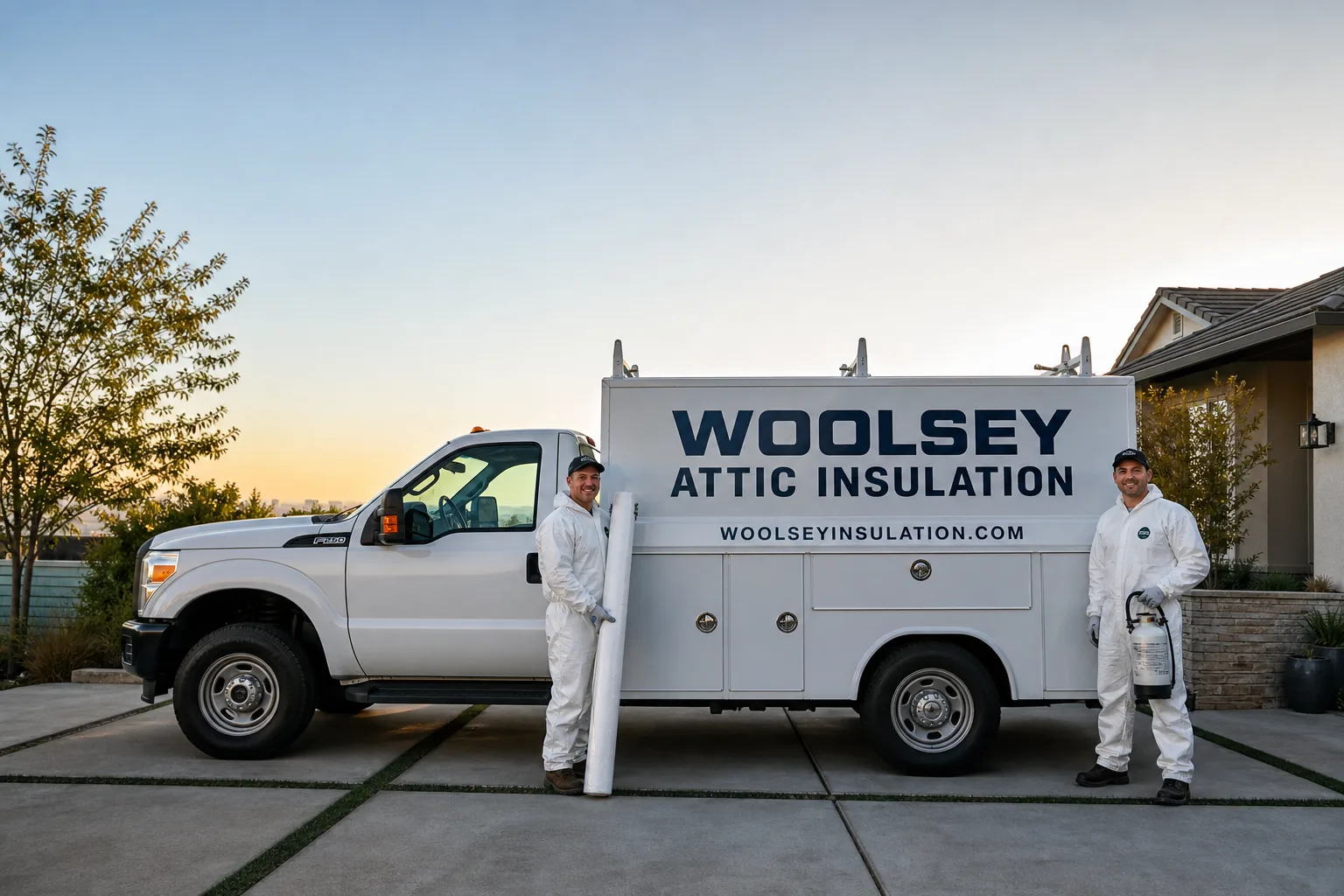
Every crew member who arrives at your door is background-checked and in uniform. That matters when you live on a quiet rural road and someone’s poking around your property. You know exactly who’s coming, and you’ll see a Kingswell vehicle in the driveway, not an unmarked truck.
Response time to Valley Center is same-day or next-day for most calls. If you’re roasting in July or freezing in December, call (325) 240-5411. A live person answers. Always. That’s not a slogan; it’s just how we run.
Attic Ventilation in Valley Center
Attic Ventilation in Valley Center isn’t a nice-to-have; it’s what keeps your insulation from becoming a heat sponge. A foothill attic on a 100°F July afternoon can hit 140°F to 150°F. If that heat can’t escape, it radiates down through your ceiling all night, and your AC never catches up. Most Valley Center attics we inspect have either inadequate venting for their roof pitch or ridge vents installed backwards or blocked by dust and nesting material.
A proper ventilation job here runs $600 to $1,500 depending on attic size, existing vent count, and whether we’re adding ridge venting, soffit vents, or both. We calculate the net free vent area your roof actually needs. Then we show you the math on paper before we cut anything.
Why Low-Pitch Ranch Roofs Suffer
Valley Center’s ranch homes were built low and wide. Low pitch means less natural chimney effect for rising hot air, so heat pools near the ridge line and pushes down into the living space. Adding the right intake and exhaust balance fixes that. It also protects your roof decking from condensation damage during those cold, damp winter mornings when the attic air can’t move.
What We Check Before Ventilating
We inspect the existing venting, look for blocked soffit channels, check for bath fan exhaust dumping into the attic, and measure the actual air flow. A vent job over an already-choked soffit does nothing. We fix the air path first, then the venting.
Radiant Barrier in Valley Center
Radiant Barrier in Valley Center works differently than anywhere on the coast. In a dry foothill climate with months of direct, high-angle sun on low-pitch roofs, a radiant barrier reflects a significant share of that radiant heat before it ever reaches your insulation. It’s installed under the roof decking, and in a Valley Center summer it can lower attic temperatures by 20°F to 30°F. That’s not a manufacturer’s claim; that’s what our crews measure with infrared thermometers after installation.
Radiant barrier installation in Valley Center runs $900 to $2,100 for a typical ranch or manufactured home, and it’s often the single highest-ROI attic upgrade here because the sun is relentless and the roof angles catch it all day. If you’re adding blown-in insulation anyway, installing both in one trip saves you money.
Manufactured Home Applications
Double-wides and manufactured homes along rural road corridors have thin roof assemblies that soak up heat fast. A radiant barrier stapled under the roof trusses, above the insulation, cuts the heat load dramatically. We’ve measured 25°F+ reductions in mid-afternoon attic temps on homes off Valley Center Road.
When Radiant Barrier Isn’t Enough
If your attic has R-11 batt or less, a radiant barrier alone won’t fix winter. It helps summer, but those 28°F winter mornings still push cold down through the ceiling. That’s why we usually pair radiant barrier with a top-up to at least R-38. Two directions, two problems, one solution.
Trusted Brands We Service in Valley Center
We work with eight leading insulation brands, so the recommendation fits your home rather than whatever’s on the truck. For Valley Center attics, that usually means Owens Corning blown-in fiberglass for R-value consistency, Johns Manville batt for tight cavity work, and Knauf for manufactured home top-ups where space is tight. We stock enough of these materials locally to turn around most Valley Center jobs in a single visit. No waiting two weeks on a special order from San Diego. If your attic needs it, it’s likely already on our truck when we pull up.
Common Attic Insulation Problems We See in Valley Center Homes
- R-11 batt in 2×4 roof cavities built for coastal mildness. Valley Center’s 70°F thermal swing crushes this. The batts compress, sag, and leave gaps at the top plates where conditioned air leaks into the attic all year.
- Original 1970s – 1980s fiberglass belly-wrap under manufactured homes. Along rural corridors like Lilac Road and Cole Grade Road, this wrap sags and falls away, leaving floors cold on winter nights and HVAC running nonstop. The real thermal hole is under your feet, not above your head.
- Batt facing and fasteners degraded by dust, heat, and pest intrusion. Rural Valley Center has rodents, birds, and dust that break the facing on old batts. Once the facing goes, the thermal boundary goes with it.
- Crushed and displaced insulation across low-pitch ranch trusses. Decades of 100°F attic cycling compress fiberglass in low-slope roofs. A 1,500-square-foot attic that was once R-30 might be performing at R-18.
Pricing for Attic Insulation in Valley Center, CA
Here’s what you can expect to pay in Valley Center right now. Blown-in attic insulation to R-38 on a 1,200 to 1,500 square foot ranch: $2,100 to $3,300. A top-up over existing insulation where you just need 4 to 6 extra inches: $900 to $1,800. Radiant barrier installation: $900 to $2,100. Attic ventilation upgrades: $600 to $1,500. Full removal and replacement of degraded or pest-damaged insulation: $2,800 to $5,500 depending on attic size and access. You’ll get an exact written number before any work begins, and it’s the number you’ll pay. Call (325) 240-5411 for a free estimate, and ask Glenn about combining radiant barrier with blown-in for the best summer and winter performance.
We Also Serve Cities Near Valley Center
Our Valley Center work regularly takes us through Attic Insulation in Valley Center and the surrounding foothill communities. If you’re in Escondido, San Marcos, Vista, or Fallbrook, the same background-checked crews and written-pricing promise apply. Call (325) 240-5411 and we’ll schedule a visit on a day we’re already in your area.
Serving Valley Center, CA - Our Local Coverage Area
We’re based in the Valley Center area and know this community well. Use the map below to see our service coverage - if you’re nearby, we can almost certainly help.
FAQs About Attic Insulation in Valley Center
Because Valley Center swings 70°F or more between summer and winter, while coastal San Diego only really battles heat gain. Your attic insulation has to resist heat coming down in July and heat escaping in December. Coastal attics can get away with moderate R-values and ventilation designed for one-direction heat flow. Valley Center needs insulation that performs in both directions, plus ventilation sized for a 140°F attic in summer and potential condensation in winter. We spec attics here to R-38 minimum, sometimes R-49 for larger homes, and we pair it with ventilation and often a radiant barrier. For an exact recommendation on your specific roof, call (325) 240-5411.
Almost certainly yes. Original belly-wrap from the 1970s and 1980s sags, tears, and falls away, which means your floor is basically exposed to outside air. On a 28°F winter night in Valley Center, that’s why the furnace never stops running. We inspect the belly-wrap from the crawl or undercarriage access, identify where the thermal boundary broke, and repair or replace it with faced batt secured properly. This is one of the most common and most overlooked manufactured-home insulation failures in Valley Center. Call (325) 240-5411 to have your undercarriage inspected.
Yes, in most cases a low-pitch roof in Valley Center catches direct sun for more hours per day than a steeper roof, and a radiant barrier under the decking reflects a big share of that radiant heat before it reaches your insulation. We typically measure 20°F to 30°F lower attic temperatures after installation on Valley Center ranches. That translates directly into cooler bedrooms in July and less strain on your AC. We also check whether your existing attic insulation needs a top-up at the same time, because a radiant barrier alone can’t fix winter heat loss. For a quote on your specific roof, call (325) 240-5411.
Every three to five years, or after any major pest intrusion, roof repair, or HVAC replacement. The dry heat and dust of Valley Center’s summers degrade batt facing faster than coastal humidity, and rural properties on Lilac Road, Cole Grade Road, and Valley Center Road see more rodent and bird activity than suburban neighborhoods. An inspection catches compressed insulation, displaced batts, or failed belly-wrap before your July electric bill tells you something’s wrong. We do free attic inspections as part of any estimate. Call (325) 240-5411 to schedule one.
Yes, and we do it regularly. Custom homes on avocado and horse properties in Valley Center often have unusual rooflines, cathedral ceilings, and attics with limited access. We use a mix of blown-in fiberglass for the open attic areas, batt for tight knee walls and skylight shafts, and spray foam where air sealing is critical. Every job gets the same written price and written guarantee. We’ll walk the attic with you before we quote so you see exactly what we see. Call (325) 240-5411 and ask for Glenn.
One more thing worth saying plainly: at a double-wide on the 14000 block of Valley Center Road, our crew found the original 1970s fiberglass belly-wrap sagging under the floor while the attic held only R-11 batt on a low-pitch roof. We pulled the collapsed batts, air-sealed the top plates and can lights, blew in Owens Corning fiberglass to R-38, and installed a radiant barrier to knock down the summer radiant load. The homeowner finally stopped running the HVAC 24/7 in July. That’s the kind of two-directional fix Valley Center homes need, and it’s what we do every week. Call (325) 240-5411 for your free estimate.
Written by Glenn Hartley, Owner at Woolsey Attic Insulation, serving Valley Center and surrounding foothill communities.