
Spring Insulation Checklist for Los Angeles Homes
Spring insulation prep in Los Angeles means checking your attic before it turns into an oven. By mid-June, attic temperatures here routinely hit 140°F or higher, which makes crawl-space work miserable for you and can affect how certain insulation materials cure. The short window for a comfortable inspection is roughly April through early May, and that is also when you’ll catch the rodent, moisture, and gap problems winter left behind. If you’d rather not spend your Saturday in a 100-degree crawl space, call (325) 240-5411 and we’ll handle the ladder work.
Why Spring Is the Right Time in Los Angeles
Attic temperatures in Los Angeles swing hard between seasons. A January attic might sit at 60°F in the morning. By July, that same space bakes at 150°F, and that heat radiates down through your ceiling into the living areas. The result is an air conditioner that runs longer, a house that never quite holds its cool, and a utility bill that climbs every month through October. Spring is the one time when attic conditions are still comfortable enough for a thorough inspection and, if needed, an installation that doesn’t fight the weather.
Spray foam insulation, for example, cures best when the substrate temperature is between about 60°F and 100°F. In a hot Los Angeles attic, most of the year sits outside that range. Blown-in insulation installs fine in higher heat, but the crew working in it does not. Anyone who has spent an hour in a 130-degree attic knows how quickly work quality drops when the air itself is punishing. The April-to-early-May window is also when rodents become easier to spot, because the cooler nights that drove them indoors are ending and the trails they leave are still fresh.
The Spring Attic Walkthrough: What to Look For
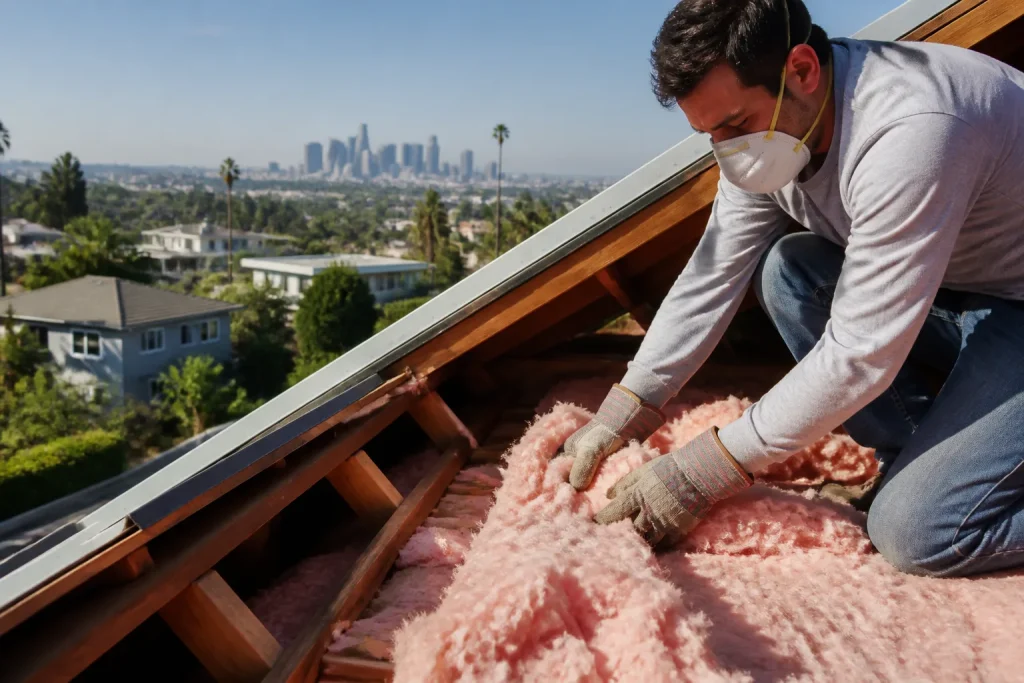
Before you ever call a contractor, there’s a basic spring inspection you can do yourself in about twenty minutes. You’ll need a flashlight, a dust mask, and a willingness to step carefully on joists only. Never walk on drywall. If you’d rather not climb up there at all, call (325) 240-5411 and we’ll do this full checklist for you as part of a free estimate.
Here’s what to check, in the order it matters:
- Look for dark streaks along the insulation. Those are often air leaks. Air moving through gaps in the ceiling below pulls dust with it, leaving gray or black trails that point directly to gaps in top plates, around can lights, or near the hatch.
- Sniff for a musty or ammonia smell. That ammonia-like odor is usually rodent urine. In Los Angeles, roof rats are a real issue in older neighborhoods with mature trees, and attics are their preferred highway. Contaminated insulation needs to be removed, not covered over.
- Measure your current insulation depth. Most Los Angeles homes built before 1980 have R-19 or less, which is roughly six inches of fiberglass batt. For our climate, the California Energy Commission recommends at least R-38 in attic floors, which is about 12 to 14 inches of blown-in material.
- Check the hatch. The attic access panel in a hallway ceiling is one of the most common thermal leaks in any Los Angeles home. If you can feel air moving around the edges when the house is closed up, that hatch is costing you cooled air all summer.
- Look at recessed lights from the attic side. Old can lights leak air like sieves. If you see gaps around them from above, those need sealing.
The Three Air Bypass Points That Matter Before Summer
When homeowners in Los Angeles call us about a hot upstairs bedroom or a living room that won’t hold its cool, we almost always find the problem is not the insulation depth. It’s air movement. Insulation slows heat transfer, but it does almost nothing to stop air leaking through holes. And air leaks are the fast lane for summer heat.
The three places we check on every spring call in Los Angeles are the attic hatch, the top plates, and recessed lights.
The attic hatch is a framed panel that sits in a hallway ceiling. Most builders put zero weatherstripping around it. That means the hot attic air pours down into the living space every afternoon and the cooled air you paid for rises up into the attic all day. Fixing it properly takes weatherstripping, a latch that pulls the panel tight, and often a layer of rigid foam board attached to the attic side of the panel. Cost is low. The comfort difference is immediate.
Top plates are the horizontal 2x4s running along the top of your walls, where the wall framing meets the attic floor. In most wood-framed Los Angeles homes, the gap where drywall meets the top plate is not sealed. From the attic, those gaps look like thin lines of light or dust. Seal them with fire-rated caulk or foam and you close off the primary pathway for hot air to enter the wall cavities and push into rooms.
Recessed lights are the hardest to address properly. Pre-2000 can lights are typically not air-tight and often not rated for insulation contact, which means insulation around them has to be held back, creating a direct chimney from the living space into the attic. The proper fix is to replace old cans with IC-rated, air-tight fixtures. Short of that, an approved cover box can be installed over the fixture from the attic side, sealed to the drywall, and then insulation can be placed over and around it. Never stack insulation directly against an older can light, that’s a fire risk.
Why Your Spring AC Tune-up Misses the Upstream Problem
Every spring in Los Angeles, HVAC companies offer tune-up specials. Coil cleaning, refrigerant check, filter change. Good service, worth doing. But a tune-up treats the air conditioner. It does not treat the attic, which is where the cooling load actually starts. If your attic is under-insulated or leaking air, the AC is fighting a battle it can’t win, no matter how well it’s serviced.
Here’s how that plays out. On a 90°F Los Angeles afternoon, your attic might hit 130°F. If the floor of your attic has only R-19 insulation and a handful of air leaks, the ceiling of your upstairs rooms becomes a low-level radiant heater pumping heat into the living space from above. The AC runs longer cycles to hold the same set point. The coil works harder. Energy use climbs. The unit ages faster. And none of that shows up in a spring tune-up report, because the tune-up only looks at the machine.
So our spring recommendation is this: schedule the HVAC service, yes. But do the attic walkthrough first, or have us do it. If the attic checks out, the tune-up is money well spent. If the attic needs work, you now know where the real energy problem is. When we quote a spring job in Los Angeles, we measure the actual R-value on-site with a ruler, not a guess, and we scope the air sealing as a specific line item. That’s the only way to know whether the fix is insulation, sealing, or both. In our experience, it’s usually both.
What Contaminated Insulation Looks and Smells Like
One of the most common calls we get in spring from Los Angeles homeowners starts the same way: “There’s a smell in the hallway.” Or sometimes it’s, “We heard scratching in the ceiling a few months ago and it stopped.” Both are usually the same problem. A rodent got in during the cooler months, nested in the insulation, and either died there or left droppings behind. The insulation is now compromised.
You’ll recognize contaminated insulation by a few telltale signs. There are visible droppings, small and dark, scattered across the top of the batts or blown-in material. There are tunnels or runways where the material has been compressed. There may be nesting material: shredded paper, dried plant matter, fabric bits. The smell, when present, is either ammonia from urine or a sweeter, sickly odor from decay. If you see any of these, the correct fix is removal and replacement, not just laying new insulation over the top. Covering contaminated insulation with fresh blown-in material does not eliminate the smell or the health risk. It just hides the problem until summer heat reactivates the odor and pushes it down into the house. We pulled one out of a garage over in Silver Lake last spring where the homeowner had been burning candles for a month to cover the smell, and the actual source was a nest about the size of a backpack sitting right on top of the drywall. Removal took a morning.
What to Ask a Contractor for in a Spring Insulation Quote
If your spring walkthrough turns up real problems, you’ll likely call someone. Here’s what a legitimate spring insulation quote in Los Angeles should include, and what you should ask for if it doesn’t.
Measured R-value, on-site. A contractor who quotes over the phone without looking at your attic is guessing. We measure the actual depth and material type and convert that to an R-value during the estimate. You should expect the same from anyone you call.
A clear statement of what’s being installed and where. Attic floor? Attic walls? A knee wall? The hatch? If the proposal says “insulation upgrade” but doesn’t say what material, what R-value, and what zones, that’s not a quote. That’s a placeholder.
Air sealing scope. Any spring insulation job in Los Angeles should address the bypass points we covered above. If the contractor doesn’t mention sealing, ask. If they say it’s not necessary, get a second opinion. Sealing is where the real comfort improvement comes from in our climate.
A written price with no door-side adjustments. This is the big one, and it’s the one most Los Angeles homeowners have been burned on before. The contractor names a number over the phone, shows up, and suddenly there’s a “vent issue” or a “surprise repair” and the price jumps. That should not happen. At Woolsey, every job runs on The Kingswell Way: a written price before any work starts, a real arrival window, a clean job site, a written guarantee on the work, and a free return visit if the work fails within the guarantee period. That’s a promise we’ve kept since 2002, and we put it in writing on every job.
A stated guarantee period. Ask the question directly: “How long is this guaranteed, and what does that guarantee cover?” If the answer is vague, hang up. Our answer is 365 days, in writing, on every job. If a repair or installation isn’t right within that year, we come back and fix it at no charge.
Material Choices for Los Angeles Attics
The right insulation material for a Los Angeles attic depends on the attic’s age, framing, and whether you’re doing the job to fix a problem or to maximize performance. We work with eight manufacturers, and the reason is simple: no single material is right for every Los Angeles attic. Blown-in fiberglass from Owens Corning or Johns Manville is often the best value for a straightforward open-attic upgrade. A homeowner in a coastal Los Angeles neighborhood with an older vented attic and a tight budget will often land there.
For a sealed, unvented attic, if the home is a newer build or the homeowner wants the roof deck itself insulated, we’re more likely to recommend spray foam from Icynene or Demilec, a two-part liquid that expands on contact and creates an air barrier as it cures. It costs more, but it does two jobs at once. Somewhere in the middle sits mineral wool from Rockwool, which handles moisture exceptionally well and adds meaningful sound deadening, a real benefit in denser Los Angeles neighborhoods where homes sit close together. Blown-in cellulose from GreenFiber is another strong option, particularly for homeowners who want a recycled-material product. The point is fit: we spec the material to the house, not to whatever is on our truck.
If you want to see what each option looks like in practice, our attic insulation services page walks through how we approach attic floor upgrades, and the spray foam page covers the sealed-attic approach in detail.
When to Call a Pro Instead of Doing It Yourself
Most of the spring checklist above requires nothing more than a flashlight and careful footing. But some findings should stop you immediately. If you see exposed electrical wiring, a nest, or piles of droppings that suggest a large rodent population, don’t wade deeper. If the attic is steep, tightly framed, or already hot even in spring, don’t push through discomfort. And if your inspection reveals that your insulation is heavily compressed, water-stained, or thick with years of dust, that’s a removal job, not a topping-off job.
Spray foam installation is not a DIY job at all. The chemistry has to be mixed correctly, the substrate temperature has to be in range, and the fumes during application require proper ventilation and protective equipment. A bad spray foam job is expensive to undo. We’ve seen homeowners attempt this and end up paying twice: once for the kit, and again for a professional to tear out the foam and redo the job correctly. For anything more than a simple hatch weatherstrip patch, call (325) 240-5411 and we’ll give you an honest read on what needs to happen. Estimates are free, and we answer the phone with a live person, any hour, any day.
The Bottom Line
Spring is the right time to check your attic in Los Angeles because the temperatures are still workable and the problems left by winter are still visible. Walk the space yourself with a flashlight. Check for air trails, rodent activity, insulation depth, and leaks at the hatch, top plates, and recessed lights. If anything looks off, get a written quote that includes measured R-value, air sealing scope, and a real guarantee period. Do the attic check before or alongside your HVAC tune-up, not after the first heat wave hits. If you’re in Los Angeles and want a second set of eyes, Woolsey Attic Insulation offers free estimates, written pricing before any work starts, and a 365-day written guarantee on every job. Call (325) 240-5411 and we’ll schedule your spring attic walkthrough.
Frequently Asked Questions
April through May is the ideal window in Los Angeles because attic temperatures are generally below 100°F, which makes for safer working conditions and better curing for spray foam. Waiting until summer means crews are working in 130-degree heat, and spray foam installation becomes harder to spec correctly. Call (325) 240-5411 in spring and you’ll have the work done before the first heat wave hits.
Most attic insulation jobs in Los Angeles run between $1,800 and $4,500 depending on attic size, current insulation depth, and whether air sealing is included. Homes with contaminated insulation that requires removal will land higher. We give you the exact written number before any work starts, no door-side adjustments, and estimates are free at (325) 240-5411.
You can, as long as the existing insulation is dry, free of rodent contamination, and not compressed. If you see droppings, ammonia smell, or water stains, the old material needs to come out first. Adding blown-in over contaminated insulation is a temporary fix that will fail by the middle of summer. We’ll tell you honestly during the estimate which situation you have. Call (325) 240-5411 to schedule a look.
No. An HVAC tune-up services the air conditioner only. It does not inspect or repair attic insulation, air leaks, or the ceiling assembly. If your attic is under-insulated, the AC will keep running long cycles regardless of how well it’s tuned. Do the attic check first, or have us do it, and then schedule the tune-up with a clear picture of where your cooling dollars are actually going. Call (325) 240-5411 for a free attic assessment.
Written by Glenn Hartley, Owner at Woolsey Attic Insulation, serving Los Angeles since 2002.
Need Insulation Help?
Call Woolsey Attic Insulation - licensed & insured, here with fast after-hours help in Los Angeles.
(325) 240-5411