
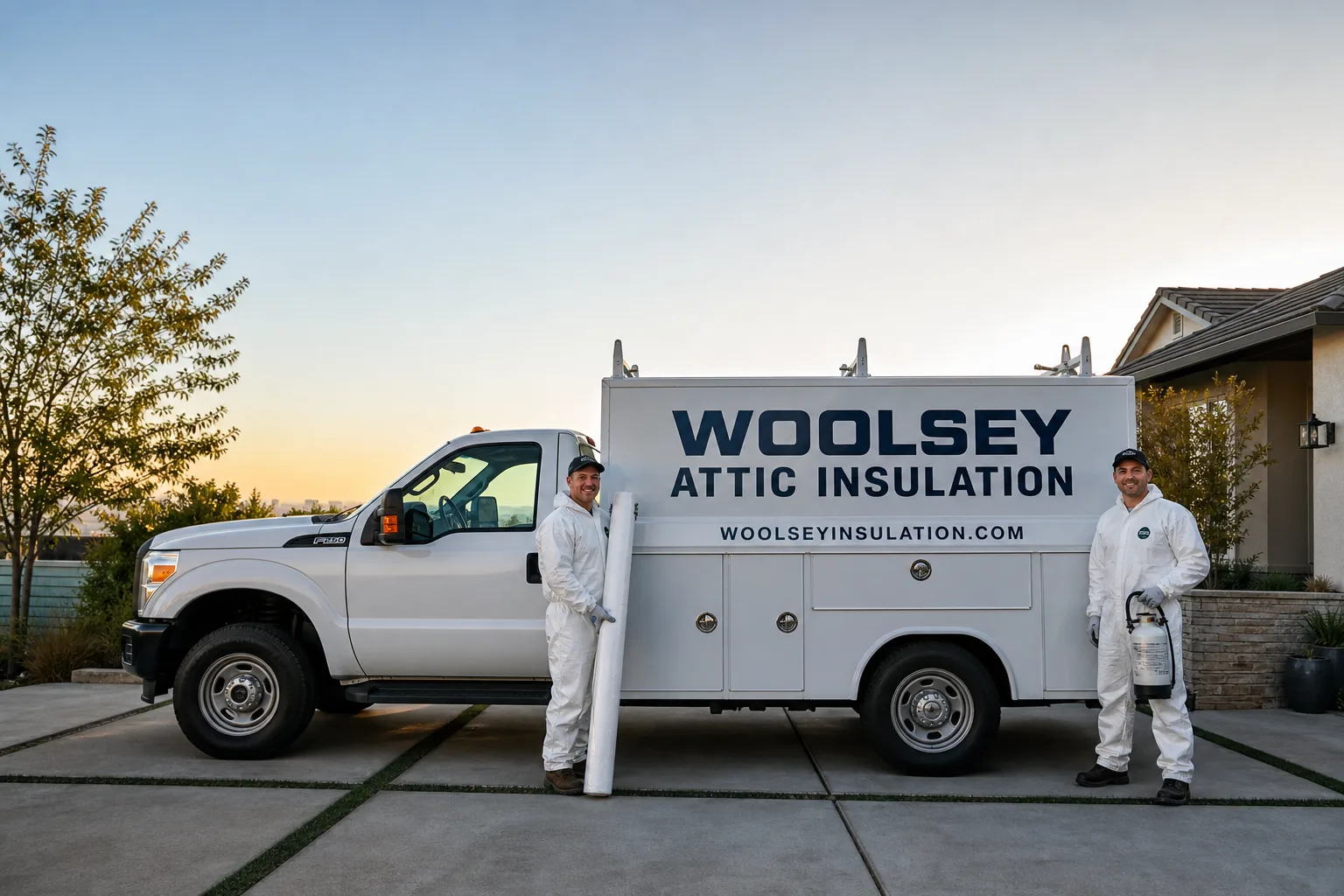
Fast, Reliable Spray Foam Insulation Across Castro Valley
Spray foam insulation in Castro Valley typically costs between $1,200 and $4,800 depending on the area covered, and most jobs are completed the same day. The valley’s inland heat makes this one of the highest-return insulation upgrades in Alameda County. We know the ranch homes off Crow Canyon Road and the hillside split-levels near Lake Chabot like the back of our hand. Call (325) 240-5411 for a written quote before any work starts.
Here’s what you get with Woolsey: a phone answered by a real person, 24/7. A written price delivered before a single technician steps foot in your home. Uniformed, background-checked crews who show up in the arrival window we commit to. And a 365-Day Done Right Promise in writing on every job. That’s the Kingswell Guarantee, and we’ve been backing it since 2002 as part of the Kingswell family of independently owned and operated insulation companies.
Why Woolsey Attic Insulation Is Castro Valley’s Preferred Spray Foam Insulation Company
Castro Valley homeowners call us because we understand the valley bowl’s unusual thermal behavior. Summer afternoons here run 10 – 15°F hotter than San Leandro or Oakland, and clear nights drain cold air down to the valley floor. That dual-season stress means the spray foam spec that works for a coastal house won’t hold up the same way here. We account for that before we ever mix a batch.
Our Spray Foam Insulation team works with eight leading manufacturers, including Icynene, Demilec, and Owens Corning. That means the material recommendation fits your home’s specific construction, not whatever happens to be on the truck. We also know who to talk to at the Alameda County Building Department, which matters here because Castro Valley is unincorporated. Permits don’t go through a city hall like they do in Hayward or San Leandro.
Homeowners from Palomares Hills to Five Canyons tell us the same thing: a live human answered, the price stayed put, and the work held up. That’s not accidental. It’s how we run every job.
Spray Foam Attic Insulation in Castro Valley
Spray Foam Attic Insulation in Castro Valley addresses the single biggest energy leak in the valley’s dominant housing stock: 1950s – 1970s ranch homes and split-levels with settled fiberglass batts that barely slow heat movement anymore. An open-cell spray foam attic application in a typical 1,600-square-foot Castro Valley ranch runs $1,800 – $3,200. Closed-cell runs $2,800 – $5,400 for the same footprint. We give you the exact written number before any work begins.
Open-Cell vs. Closed-Cell for Valley Heat Loads
Open-cell foam expands to roughly 100 times its liquid volume and seals air gaps at the attic floor. It’s the better fit for most Castro Valley attics where cooling-season heat gain is the primary problem. Closed-cell adds vapor resistance and structural rigidity, which matters for roof deck applications and for homes where morning fog pushes moisture into the attic cavity.
Attic Spray Foam and the 10 – 15°F Afternoon Swing
Coastal specs undersize attic insulation for what Castro Valley actually gets. When your attic hits 140°F on a July afternoon and then drops 50 degrees by 3 a.m., standard R-30 batts absorb and release that heat into the living space. Spray foam slows that transfer dramatically. The result is a house that no longer bakes by 4 p.m. when the sun dips behind the ridge.
Spray Foam Wall Insulation in Castro Valley
Spray Foam Wall Insulation in Castro Valley is the fix for the valley’s construction-era truth: many homes built through the mid-1970s never received wall insulation at all. For a typical 1,800-square-foot split-level in the hills off Redwood Road, wall cavity spray foam runs $3,000 – $7,800 depending on access and framing condition. It’s a bigger number than attic work, but the heat-loss math makes it the highest-ROI envelope upgrade available.
Walls on Hillside Homes
Stepped foundations and partial-height walls complicate a standard batt install, which is precisely what spray foam handles well. The liquid expands into irregular cavities, fills gaps around electrical boxes and plumbing penetrations, and seals the wall plane in one pass. No custom-cutting batt after batt, no gaps left behind where the framing steps down.
Sealing Knee Walls and Rim Joists
Split-levels have knee walls galore: short vertical walls where the upper floor meets an unheated garage or crawl space below. These rarely have any insulation. Spray foam seals the knee wall cavities and the rim joist band at the same time, closing the loop that lets heated air escape and cold drainage-night air creep in.
Trusted Brands We Service in Castro Valley
We install and service spray foam from Icynene, Demilec, Owens Corning, Johns Manville, Knauf, and GreenFiber, among eight total manufacturer lines. That range means we’re not locked into one chemistry or one density spec. If your Castro Valley home needs a moisture-tolerant closed-cell foam for a fog-cooled crawl space, we spec that. If it needs open-cell for a hot attic, we spec that instead. Parts and materials are sourced regionally, so turnaround on follow-up work is measured in days, not weeks. And every product is backed by its manufacturer warranty plus our written 365-Day Done Right Promise.
Common Spray Foam Insulation Problems We See in Castro Valley Homes
- Fog-moisture adhesion failure in crawl spaces: Morning marine fog settles into valley-floor crawl spaces and dampens framing. Foam sprayed directly onto fog-dampened wood loses adhesion and traps moisture behind the cured layer. We dry-test the substrate and address vapor drive before spraying.
- Out-of-area contractors pulling the wrong permits: Castro Valley answers to Alameda County, not a city building department. Contractors from Hayward or Oakland routinely file the wrong paperwork, stall inspections, and leave spray foam work unverified. We route every permit correctly the first time.
- Undersized specs inherited from coastal jobs: A spec written for San Leandro or Oakland afternoons doesn’t cover a Castro Valley afternoon. If the foam thickness isn’t calculated for the valley’s 10 – 15°F swing above coastal temps, you pay for an upgrade that underperforms from day one.
- Disturbed crawl spaces after seismic retrofit work: The Hayward Fault runs through Castro Valley, and many homes have had cripple-wall retrofits that left crawl spaces open and framing exposed. Insulation work done years earlier is now compromised, and the open space invites moisture and rodent activity.
Pricing for Spray Foam Insulation in Castro Valley, CA
Here are straight numbers from recent Castro Valley work. Attic open-cell spray foam on a 1,500 – 1,800-square-foot ranch: $1,700 – $3,400. Attic closed-cell: $2,900 – $5,600. Wall cavity spray foam on a split-level: $3,200 – $8,000 depending on access. Crawl space rim joist and band sealing: $900 – $2,400. Roof deck closed-cell for a cathedral ceiling: $4,500 – $9,500. Hillside terrain, unusual framing, and permit inspection scheduling all factor into the final number. You’ll see it in writing before we order materials. Call (325) 240-5411 for a free estimate.
We Also Serve Cities Near Castro Valley
Our crews serve Castro Valley and the surrounding East Bay communities, including San Lorenzo, San Leandro, Union City, and Dublin. If you’re in one of those cities and want the same Spray Foam Insulation in Castro Valley standard of service, call us. Dispatch and scheduling are coordinated from our San Francisco Bay Area office, with local crews who know each city’s permit pathway and housing stock.
Serving Castro Valley, CA - Our Local Coverage Area
We’re based in the Castro Valley area and know this community well. Use the map below to see our service coverage - if you’re nearby, we can almost certainly help.
FAQs About Spray Foam Insulation in Castro Valley
Castro Valley sits in a true inland valley bowl that produces sharper diurnal temperature swings than the flatter cities to the west. Summer afternoons run 10 – 15°F hotter, and clear nights drain cold air down to the valley floor. That means heating and cooling loads are both higher, so the foam thickness and placement that works in Hayward will underperform here. We spec for Castro Valley’s actual thermal profile, not a regional default. Call (325) 240-5411 and we’ll walk your specific house through the math.
Yes, in most cases. Castro Valley is unincorporated Alameda County, so permits and inspections route through the Alameda County Building Department, not a city hall. We handle the full permit process on every job and schedule inspections through the county’s system. This is where out-of-area contractors consistently stumble. We don’t.
Yes, and in fact an already-open crawl space is an ideal time to do the work. Many Castro Valley homes along the Hayward Fault corridor have had cripple-wall retrofits that left the foundation area accessible and framing exposed. Sealing the rim joists, band board, and short knee walls with closed-cell spray foam while the space is open saves you from reopening it later. We pair the foam work with a vapor barrier where the fog-moisture load calls for it.
The two most common failures we see are peel-back from fog-dampened crawl-space framing and shrinkage cracks from the valley’s wide temperature swings. Peel-back shows as foam lifting away from wood in sheets. Shrinkage cracks appear as hairline gaps at the foam-wood interface. Both let air move again and both are fixable. If you’re seeing either, call (325) 240-5411 and we’ll assess it under the 365-Day Done Right Promise if we originally installed it.
We install Icynene, Demilec, Owens Corning, Johns Manville, Knauf, and GreenFiber, among eight total lines. The material depends on the job: closed-cell for moisture-loaded crawl spaces and roof decks, open-cell for hot attics. The choice is made for your home’s actual conditions, not our truck inventory.
A Job We’ll Always Remember in Castro Valley
On a hillside split-level off Proctor Road, our tech found the original 1960s wall insulation had never been installed and the vented crawl space was still torn open from a cripple-wall retrofit a few years back. We sealed the rim joists and knee walls with Icynene closed-cell spray foam, then tied the work into the already-open crawl space with a vapor barrier. The homeowner went from a 15°F afternoon attic swing to a house that actually held temperature between the valley’s hot days and cold drainage nights. That’s the kind of work this terrain and this climate demand.
If your Castro Valley home is fighting the valley’s heat, fog, and cold-air drainage, call us at (325) 240-5411. We’ll answer, we’ll show up, and you’ll have a written price and a written guarantee before the foam ever hits the wall.
Written by Glenn Hartley, Owner at Woolsey Attic Insulation, serving Castro Valley as part of the Kingswell family since 2002.