
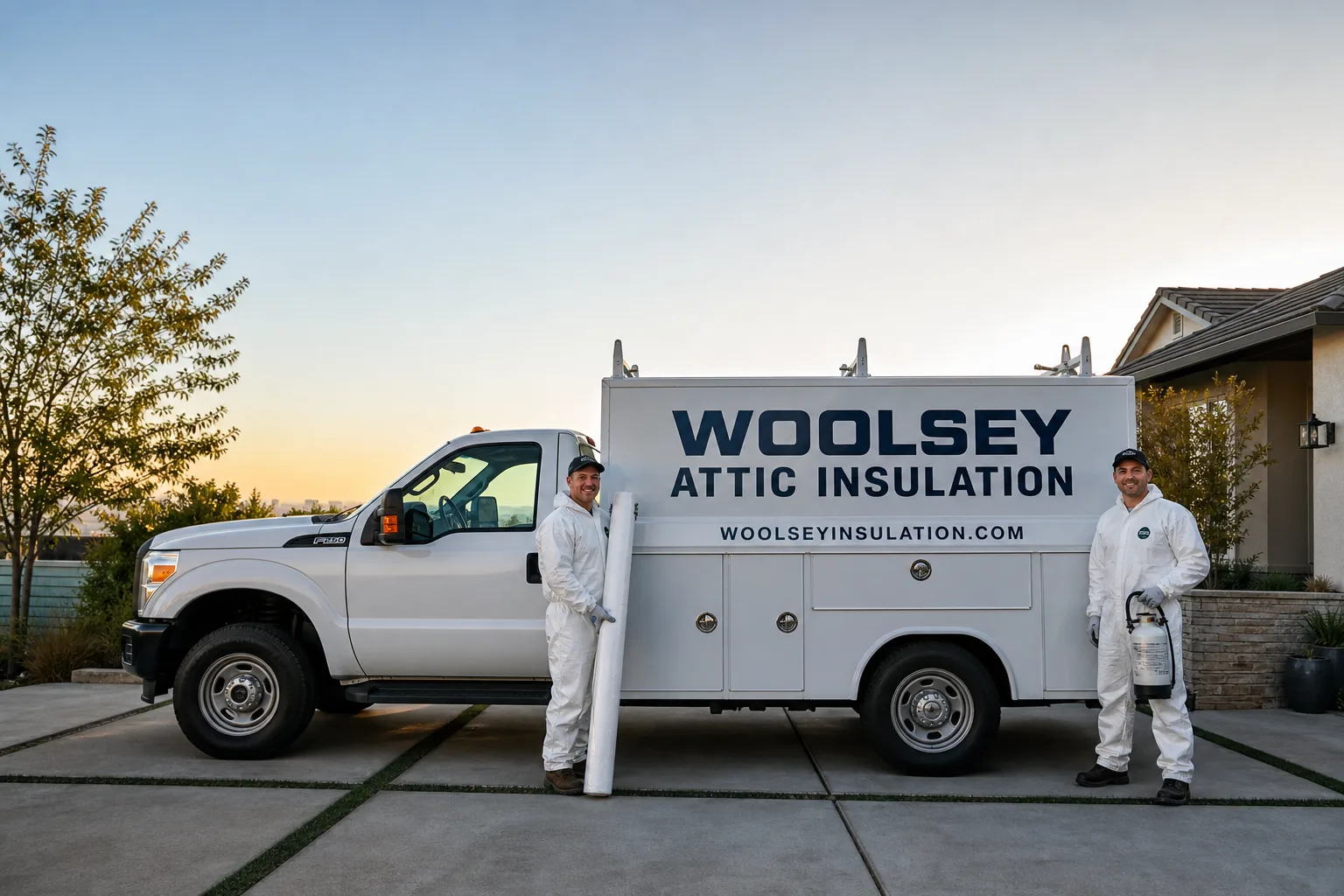
Fast, Reliable Spray Foam Insulation Across Lancaster
Spray foam insulation in Lancaster costs roughly $2.50 to $7.50 per square foot installed, depending on whether you choose open-cell or closed-cell and where it’s going. Most Lancaster homeowners pay between $3,800 and $11,500 for a full attic treatment or garage ceiling job, and we give you the exact written number before any work starts. Call (325) 240-5411 for a free estimate on your Lancaster home.
We know this high desert climate. At 2,350 feet in the Antelope Valley, your insulation has to handle 105°F summer attics and mid-20s winter nights, plus the wind that never really stops. Woolsey Attic Insulation sends crews to Lancaster weekly, and our techs understand the tract-home stock from the 1980s and 1990s that dominates neighborhoods off Avenue K, Avenue J, and 10th Street West. You don’t need a company guessing at high-desert conditions from an hour away. You need someone who knows exactly why your gable end reads 20 degrees hotter than the rest of the attic.
Why Woolsey Attic Insulation Is Lancaster’s Preferred Spray Foam Insulation Company
Homeowners in Lancaster call us because the phone gets answered. Not by a recording, not by a call-back window. A live person picks up 24 hours a day, 7 days a week, and can schedule a Lancaster visit while you’re on the line. Glenn Hartley leads the team, and he’s built Woolsey around a simple promise: every job gets a written price before any work starts, a committed arrival window, a clean job site, and a written guarantee covering 365 days after the work is done. If something’s not right, we come back and fix it at no charge.
We’re not a franchise. Woolsey operates as part of the Kingswell family of independently owned and operated insulation companies, and our Lancaster customers deal directly with the crew doing the work. Our technicians are background-checked and uniformed, so you know exactly who’s walking into your home. The Kingswell Guarantee has been the backbone of this company since 2002, and it’s written into every Lancaster job we do.
Dispatch and scheduling are coordinated from the brand’s Los Angeles office, but the crews serving Lancaster live and work in the Antelope Valley. They know the wind corridors, the stucco tract homes, and the 1950s and 1960s houses near Lancaster Boulevard with no original insulation to speak of. That local knowledge changes how we spec foam, how we probe for failures, and how fast we can get to you when you need help.
How Much Does Spray Foam Insulation Cost in Lancaster?
Here’s what Lancaster homeowners should expect to pay for spray foam work in 2026:
- Garage ceiling spray foam: $2,800 to $6,500 depending on square footage and open-cell versus closed-cell
- Closed-cell attic treatment: $5,000 to $11,500 for full roof deck or floor application
- Open-cell attic application: $3,800 to $8,000 for typical Lancaster tract-home attics
- Rim joist sealing: $900 to $2,400 for a standard single-story Lancaster home
- Spray foam roof deck: $6,500 to $12,000 for typical Antelope Valley ranch and two-story homes
Square footage, access difficulty, and whether we’re removing old batt insulation all move the number. What doesn’t move is the price once we give it to you. The written quote we hand you before any work starts is the price you pay. Period. Call (325) 240-5411 and we’ll send someone to measure your attic or garage and put the number in writing, free.
Garage Spray Foam Insulation in Lancaster
Garage Spray Foam Insulation in Lancaster is one of the most requested services we handle because the Antelope Valley’s high-wind corridor treats garage envelopes harder than almost anywhere in Southern California. Your garage ceiling and the wall shared with the house are the front line for 60-mph Santa Ana gusts driving dust, grit, and temperature swings through every gap in the framing. A typical Lancaster garage runs $2,800 to $6,500 to insulate properly, and the job usually takes one day.
We see two garage types across Lancaster. The 1980s and 1990s stucco-front tract homes off 20th Street West and Avenue L where the garage was never insulated beyond the builder minimum, and the older 1950s and 1960s homes near downtown Lancaster that have bare stud bays and open soffits. Both need air-sealing before insulation, but the older stock usually needs the top plate and rim joist addressed first or the foam never performs.
Wind-Sealing the Garage-to-House Wall
The hidden leak in most Lancaster garages lives in the wall shared with the house. Wind pressure from the Antelope Valley’s open terrain pushes air through electrical penetrations, conduit holes, and top-plate gaps, carrying dust and 105°F summer air into your living space. Closed-cell foam seals those penetrations as a gasket first and an insulator second. This is the single most effective upgrade we do for Lancaster garages, and it’s not how a basin-city insulation crew would approach the job.
Ceiling and Roof Deck Foam in the Garage
If your garage ceiling is uninsulated, the attic above it becomes a solar oven that transfers heat straight down into anything you store and into the floor of any bonus room above. Open-cell foam on the garage ceiling runs $2,800 to $4,500 for a standard two-car Lancaster garage. Closed-cell runs higher, $4,000 to $6,500, but adds structural stiffness and blocks wind-driven moisture that open-cell can’t handle. We can also spray a closed-cell roof deck if you’re converting the garage or want to stop the radiant load before it enters.
Closed Cell Spray Foam Insulation in Lancaster
Closed Cell Spray Foam Insulation in Lancaster is what we recommend for gable ends, rim joists, and any surface facing the Antelope Valley’s wind and dust. At roughly $1.25 to $1.75 per board foot installed, it’s more expensive than open-cell, but the R-value per inch (about R-7) and its air-barrier performance make it worth the premium in this climate. A full closed-cell attic in a standard Lancaster tract home runs $5,000 to $11,500.
Closed-cell earns its cost here because of what the high desert does to insulation. It resists wind-driven dust abrasion far better than open-cell. It doesn’t absorb moisture when Antelope Valley winter air goes below freezing and condensation forms. And it adds shear strength to framing that matters when Santa Ana gusts hit your gable wall at 60 mph. The 1980s and 1990s stucco homes in Lancaster were built to minimum code with R-13 walls and R-19 attics. That was never enough for a 2,350-foot desert elevation, and closed-cell is the correction we most often prescribe.
Gable-End Sealing and Reinforcing
Lancaster gable ends take a beating that insulation crews in Santa Clarita or Palmdale don’t fully appreciate. Wind roars across the open valley floor, hits the gable, and pressure-drives air through every seam in the sheathing. Closed-cell sprayed on the gable interior stops that infiltration at the source. We probe gable cavities first on every Lancaster inspection because that’s where blown-in insulation migrates and where thermal gaps always show up.
Top Plate and Penetration Sealing
Bidirectional thermal cycling, attics hitting 150°F in July and freezing by December, causes spray foam applied too thick or to an unprimed surface to shrink and pull away from the top plate within a few seasons. Closed-cell applied in controlled lifts with proper substrate prep prevents that. On a 1980s stucco-and-wood-frame tract home off West Avenue J near the Antelope Valley College corridor, we opened the garage ceiling to find the original R-19 batts blown flat against the west gable end and a 150°F-plus summer attic that was cooking the closed-cell foam we’d shot in months earlier. Our crew re-probed the gable cavity, sealed the top plate and every conduit penetration with closed-cell spray foam, then finished the lid with a radiant-barrier-facing layer. The homeowner’s August cooling load dropped and the winter draft at the garage door threshold stopped.
Trusted Brands We Service in Lancaster
Woolsey works with eight leading insulation brands, and for Lancaster homes we lean on Owens Corning, Johns Manville, and Knauf when batt or hybrid work makes sense alongside spray foam. The material recommendation always fits your specific home, not whatever’s on the truck. For closed-cell foam, we use quality two-part systems rated for high-desert UV exposure and temperature swings. Stocking decisions for our Lancaster crews are made around the Antelope Valley’s demand patterns, so we can turn material around fast when your job calls for something specific. Every installation carries the same written guarantee and the same 365-Day Done Right Promise, regardless of which named brand we spec.
Common Spray Foam Insulation Problems We See in Lancaster Homes
- Wind-scoured foam at gable ends: Sixty-plus-mph gusts in the Antelope Valley drive dust and grit into attic seams, abrading exposed spray foam until air leaks past the seal. We recommend annual probe inspections on gable-facing surfaces, a maintenance step no LA Basin insulation page accounts for.
- Shrinkage at the top plate: The Lancaster seasonal swing, attics over 150°F in summer, mid-20s at night, causes closed-cell foam to pull away from framing if the substrate wasn’t primed or the lift was applied too thick. The fix is controlled lifts and proper adhesion testing.
- UV degradation at open overhangs and crawl vents: Lancaster’s 2,350-foot elevation accelerates UV breakdown of exposed foam skins, especially on 1950s and 1960s homes near downtown with open overhangs and no vapor management. Once the skin fails, moisture wicks into the cell structure and the foam’s R-value drops.
- Insulation migration at gable ends: High-wind events physically displace blown-in attic insulation, shifting it away from the gable and creating cold and hot spots homeowners blame on HVAC. We probe gable-end zones first on every Lancaster attic inspection because this failure mode is chronic and underdiagnosed here.
Pricing for Spray Foam Insulation in Lancaster, CA
Real numbers for Lancaster. Garage ceiling spray foam runs $2,800 to $6,500. Closed-cell attic work ranges from $5,000 to $11,500 depending on square footage and whether old insulation needs removal. Rim joist sealing is $900 to $2,400. A spray foam roof deck in a standard Lancaster ranch lands between $6,500 and $12,000. What moves the number most is access: a 1980s tract home with a tight attic hatch and low clearance costs more in labor than an older home with open framing. We give you the written price before any work starts, and that price never changes at the door. Call (325) 240-5411 for a free estimate. Someone will answer.
We Also Serve Cities Near Lancaster
Our crews serve Lancaster and the surrounding Antelope Valley communities including Acton, Palmdale, Santa Clarita, and Castaic. Response times vary by distance, but a live person answers the phone 24/7 and can get you scheduled no matter which of these cities you call from. See our full Spray Foam Insulation service page for details on materials and methods.
Serving Lancaster, CA - Our Local Coverage Area
We’re based in the Lancaster area and know this community well. Use the map below to see our service coverage - if you’re nearby, we can almost certainly help.
FAQs About Spray Foam Insulation in Lancaster
The Antelope Valley’s 60-mph wind gusts drive dust and grit into garage penetrations, abrading exposed foam at the gable ends and overhangs until air leaks past the seal. Combine that with Lancaster’s 80°F seasonal temperature swing and you get thermal cycling that causes foam to shrink and pull away from framing within a few seasons if it wasn’t applied correctly. Our crews prep and seal differently here for exactly that reason. Call (325) 240-5411 to have your garage inspected.
Most Lancaster homes benefit from a hybrid: closed-cell at the gable ends, top plate, and rim joist where wind and moisture attack, and open-cell across the main attic floor where cost per R-value matters most. Closed-cell runs about $1.25 to $1.75 per board foot and open-cell roughly $0.70 to $1.00. We’ll spec the right combination for your home and put the price in writing before any work begins.
Wind-driven insulation migration. High-wind events in the Antelope Valley physically shift blown-in attic insulation away from gable ends, leaving bare drywall zones that register as cold or hot spots in specific rooms. We probe gable-end cavities first on every Lancaster inspection because this is chronic and rarely diagnosed. Fixing it usually involves re-sealing the gable with closed-cell foam and correcting the original air barrier.
Yes. Attics in Lancaster routinely exceed 150°F in July, and that heat loads into the living space through the ceiling. Closed-cell on the roof deck or open-cell on the attic floor cuts that transfer substantially. Homeowners we’ve worked with off Avenue K and 20th Street West typically see the biggest drop in cooling cost after we seal top-plate penetrations and gable ends, not just add insulation depth. We can give you an honest assessment of what your specific attic needs.
Annually, before the summer heat load arrives. The wind corridor and UV exposure at 2,350 feet mean foam in open overhangs, garage headers, and gable-facing surfaces degrades faster than in basin cities. We recommend a yearly probe inspection of your garage ceiling and gable ends. It’s a quick visit, and if anything’s failing, our 365-Day Done Right Promise covers the repair at no charge. Call (325) 240-5411 to schedule one.
Woolsey was a name built on wool, the first insulation. Woolsey keeps the idea in the name: real material, honestly priced, doing real work. If you live in Lancaster and you’re tired of insulation contractors who change numbers at the door or never call back, give us a call at (325) 240-5411. We’ll answer, we’ll show up, and we’ll put every promise in writing before the first spray gun leaves the truck.
Written by Glenn Hartley, Owner at Woolsey Attic Insulation, serving Lancaster and the Antelope Valley since 2002.