
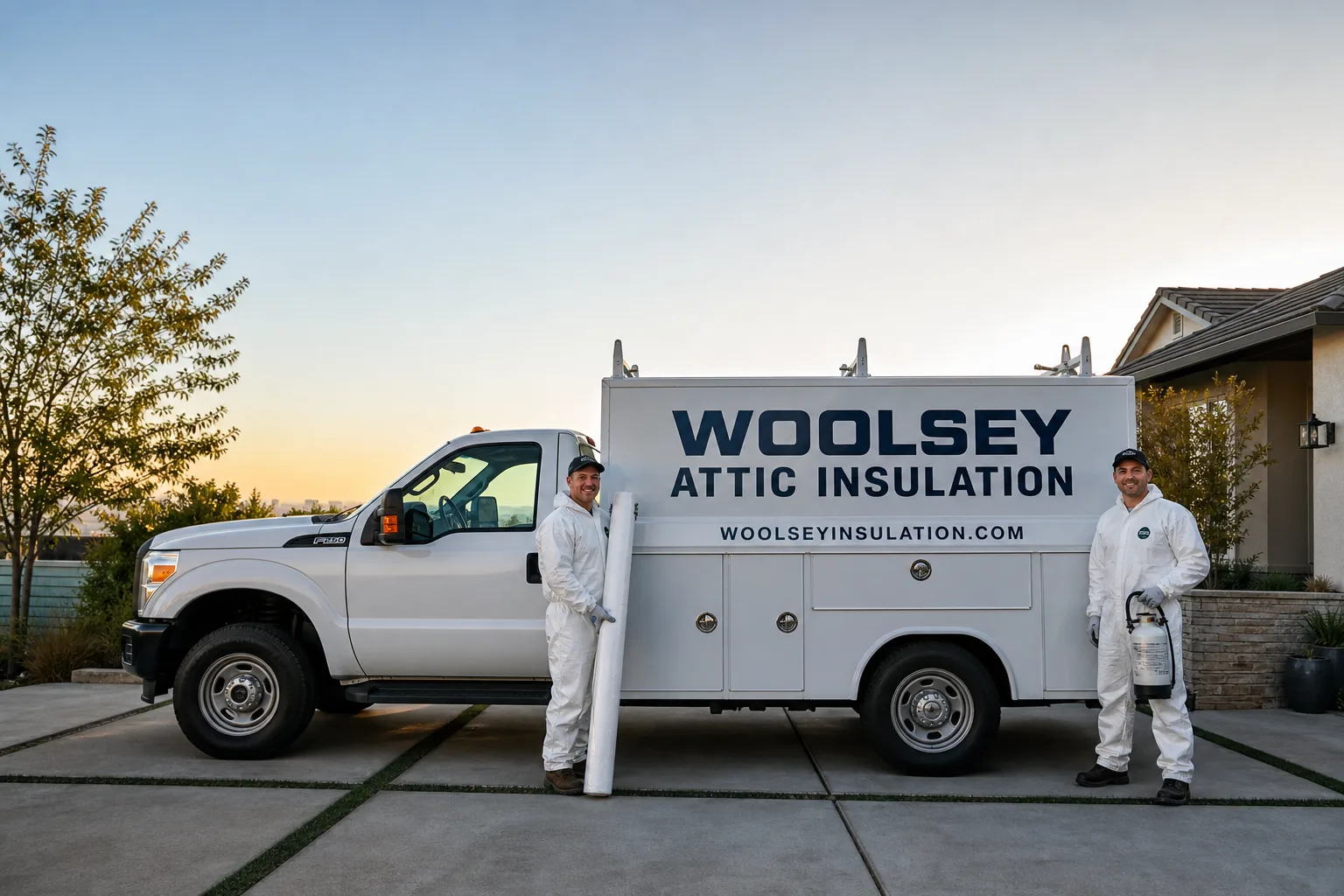
Fast, Reliable Spray Foam Insulation Across Pico Rivera
If you own a home in Pico Rivera built between the late 1940s and mid-1960s, chances are your attic and exterior walls were never insulated to anything close to today’s standards, because California’s Title 24 energy code didn’t exist when your house went up. Woolsey Attic Insulation specializes in retrofitting these exact homes with Spray Foam Insulation that seals the gaps older construction left behind. Our crews serve Pico Rivera daily, and we answer the phone live around the clock at (325) 240-5411.
Why Woolsey Attic Insulation Is Pico Rivera’s Preferred Spray Foam Insulation Company
Pico Rivera’s housing stock is almost entirely post-war tract construction: single-story wood-frame ranches with 2×4 exterior walls, built fast between 1948 and 1968. We know these homes because we’ve been inside hundreds of them. The attic spaces are low-pitched and cramped. The original sheathing is often the same plywood put down in 1955. The room additions so common in this densely owner-occupied city are notorious for having no insulation at the transition walls where the addition meets the original framing. None of this surprises us anymore.
Glenn Hartley has built the Woolsey name on showing up when we say we will, pricing the job before we touch your walls, and putting every warranty term in writing. The Kingswell Guarantee covers every Pico Rivera job with a written price before work starts, a committed arrival window, a clean job site, and a 365-day written guarantee on the work. If something isn’t right within that year, we come back and fix it at no charge. That’s the whole promise, in writing, every time.
We serve the whole city, from the neighborhoods around Rio Hondo Park and the 90660 ZIP code down to the homes off Rosemead Boulevard and the 90662 side by the San Gabriel River. Our techs are background-checked and uniformed, so you know exactly who’s walking through your front door. When you call (325) 240-5411, a live person answers, not a voicemail tree.
Crawl Space Spray Foam Insulation in Pico Rivera
Crawl Space Spray Foam Insulation is one of the most effective retrofits for Pico Rivera’s raised-foundation ranch homes, because the crawl space under your floor is often the single biggest unsealed air gap in the house. Many of these post-war foundations were built with open venting and no vapor barrier worth mentioning. That means in summer, hot air from outside gets pulled into the crawl space, and in winter the moisture from the river corridors makes its way up through your floorboards.
We apply spray foam directly to the crawl space rim joist and, when appropriate, to the subfloor, sealing the envelope from below. For Pico Rivera homes near the Rio Hondo, where localized humidity runs higher than surrounding areas, we often recommend closed-cell foam specifically for its built-in vapor retarder. The goal isn’t just insulation, it’s stopping the moisture and air movement that make your floors feel cold in January and your AC work harder in July.
Rim joist sealing for raised foundations
The rim joist, the board that runs around the perimeter of your foundation, is where conditioned air leaks out and outside air leaks in. In Pico Rivera’s older homes this joint was rarely sealed at all. We spray closed-cell foam into each joist bay, cutting off the air exchange that makes rooms above the crawl space noticeably hotter or colder than the rest of the house.
Vapor control near the river corridors
Homes in the western and eastern edges of Pico Rivera, closer to the Rio Hondo or San Gabriel river channels, deal with more morning humidity than houses in the center of the city. That moisture climbs into the crawl space and can warp wood or feed mold over time. Closed-cell spray foam acts as a vapor barrier and an insulator in a single application, which is why we lean on it heavily for these areas.
Most crawl space spray foam jobs in Pico Rivera run between $1,800 and $4,200 depending on square footage and access. You’ll have a written price before we order a single can of foam.
Garage Spray Foam Insulation in Pico Rivera
Garage Spray Foam Insulation matters in Pico Rivera more than it does in most cities, because so many homeowners here have converted their attached garages into living space, workshops, or home offices. Walk down Passons Boulevard or any residential street off Whittier Boulevard and you’ll see the telltale signs: a garage door that’s been framed over, a window added, drywall on walls that were never insulated.
Here’s what we see on nearly every garage conversion: the transition wall between the original living space and the garage addition has zero insulation, and the garage ceiling, if it was drywalled at all, has maybe a thin layer of degraded fiberglass batting from the 1980s. In summer, the attic above that garage ceiling hits 150°F or more, and that heat pours directly into whatever room sits beneath it. Spray foam applied to the garage ceiling and the wall between the house and the garage cuts that transfer dramatically.
Sealing the garage ceiling before the floor
The biggest mistake we see is insulating the garage walls and skipping the ceiling. In Pico Rivera, the attic above a converted garage is often the hottest space in the entire house. Open-cell spray foam on the garage ceiling slows that heat before it reaches the living area below. That’s the single highest-impact move you can make in a converted garage.
Transition wall detailing
Where the original house stops and the addition starts, there’s usually a gap or a stud cavity that was never filled. We detail these transition walls specifically, filling the cavity fully and sealing the seam where the two structures meet. Spray foam’s expansion makes it the only insulation that gets into these odd, cramped spaces without leaving voids.
Garage spray foam jobs in Pico Rivera typically run between $1,200 and $3,800 for ceiling and transition wall work. Your written quote covers the entire scope before we start.
Trusted Brands We Service in Pico Rivera
We work with eight leading insulation manufacturers so the material we recommend fits your home, not whatever happens to be on the truck. For Pico Rivera’s post-war framing and the river-corridor humidity we see, we frequently specify Owens Corning and Icynene closed-cell foams for their vapor management and high R-value per inch in tight 2×4 wall cavities. We also regularly install Johns Manville open-cell foam where attic ventilation and breathability matter more than a vapor seal. Your quote will name the specific product and why it’s the right one for your house. We don’t stock generic foam and we don’t substitute brands without telling you first.
Common Spray Foam Insulation Problems We See in Pico Rivera Homes
- Foam delamination on original 1948 – 1968 roof sheathing. Morning river-corridor humidity settles on old plywood sheathing overnight, and if a tech applies closed-cell foam while that surface is still damp, the foam can blister and peel weeks later. We always verify sheathing dryness before spraying, especially on the older homes near Rio Hondo Park and the west side.
- Bare ductwork baking in 150°F attics breaking the foam’s effectiveness. Post-war duct replacements in Pico Rivera often left metal ducts uninsulated or poorly wrapped. If you spray foam the roofline without sealing and wrapping those ducts, the R-value gain gets undercut immediately, and the homeowner blames the foam. We seal ducts with mastic first, then insulate.
- Missed transition walls at room additions. When a 1954 house gets a 1987 family room added on, the wall where the two meet is rarely framed with insulation in mind. That thermal bridge lets heat pour through even after the rest of the house is upgraded. Spray foam alone won’t fix it unless the transition is specifically detailed, which is standard for us on every Pico Rivera job.
- Open-cell foam in wrong humidity zones. Open-cell foam is great for some applications, but in crawl spaces near the Rio Hondo or San Gabriel corridors, the added moisture can saturate the foam and cut its performance. We specify closed-cell in these areas specifically for its vapor-retarder properties.
Pricing for Spray Foam Insulation in Pico Rivera, CA
Spray foam insulation in Pico Rivera runs a wide range because every one of these post-war houses is different. Expect open-cell spray foam pricing to land around $0.50 to $1.10 per board foot, while closed-cell runs $0.90 to $1.80 per board foot. A full attic retrofit on a typical 1,200-square-foot ranch home in Pico Rivera usually falls between $4,500 and $8,500. Rim joist sealing in a crawl space starts around $1,800. We give you the exact written number before any work starts, and that number doesn’t change at the door. Call (325) 240-5411 for a free estimate, and we’ll tell you honestly what your house needs and what it’ll cost.
We Also Serve Cities Near Pico Rivera
If you live just outside the city line, you’re still in our service area. We handle spray foam work in Montebello, Santa Fe Springs, Whittier, and Bell Gardens, running crews from the same schedule and the same Spray Foam Insulation in Pico Rivera team. Same pricing, same guarantee, same live person on the phone at (325) 240-5411.
Serving Pico Rivera, CA - Our Local Coverage Area
We’re based in the Pico Rivera area and know this community well. Use the map below to see our service coverage - if you’re nearby, we can almost certainly help.
FAQs About Spray Foam Insulation in Pico Rivera
Yes, and it’s actually one of the best retrofit options for these specific homes. Spray foam’s expansion means it fills the entire 2×4 stud cavity without settling, and closed-cell foam delivers R-6.5 to R-7 per inch, which is roughly double what fiberglass batting gives you in the same space. For Pico Rivera’s 1948 – 1968 tract housing, where wall cavities are narrow and often irregular, closed-cell spray foam gives you the highest R-value possible without tearing out drywall. Call (325) 240-5411 and we’ll walk you through what your specific walls can support.
Because Pico Rivera sits between two river corridors, the Rio Hondo and the San Gabriel, which adds airborne moisture to an already intense inland heat pocket. Summer attic temperatures here routinely exceed 150°F, and morning marine-layer burn-off adds humidity that coastal cities like Long Beach don’t get and inland cities like El Monte don’t carry. That combination makes unsealed garages and crawl spaces bigger comfort and moisture problems here than in surrounding areas, and spray foam is one of the few materials that addresses both heat and vapor in a single pass.
Yes, but only if the ductwork is addressed at the same time. Many Pico Rivera homes had new HVAC ductwork routed through attics that were never designed for it, leaving bare or poorly wrapped ducts baking at 150°F or more in summer. Foam applied without sealing and insulating those ducts will underperform immediately. That’s why we seal ducts with mastic and wrap exposed runs before we spray, so the foam does the job you’re paying for. If you’ve got bare ducts, mention it when you call.
It means we have to check roof-deck and sheathing moisture before applying closed-cell foam, especially on the original 1948 – 1968 roof sheathing. Morning river-corridor humidity can condense on old plywood overnight, and if foam is sprayed onto a damp surface, adhesion can fail and the foam will blister. We schedule moisture checks as part of every Pico Rivera install and won’t spray until we’re certain the surface is dry. Skipping this step is a shortcut we don’t take.
We work with eight leading insulation brands, including Owens Corning, Icynene, and Johns Manville, and we specify the one that fits your home’s specific conditions. For Pico Rivera’s narrow 2×4 wall cavities and river-corridor humidity, closed-cell foams from Owens Corning or Icynene are common recommendations. For open attic spaces where breathability matters, we often use Johns Manville open-cell. The material is named in your written quote before any work starts.
Got a question we didn’t cover? Call (325) 240-5411. A live person answers day or night, and we’ll give you a straight answer without a sales pitch.
Written by Glenn Hartley, Owner at Woolsey Attic Insulation, serving Pico Rivera and the surrounding San Gabriel Valley.