
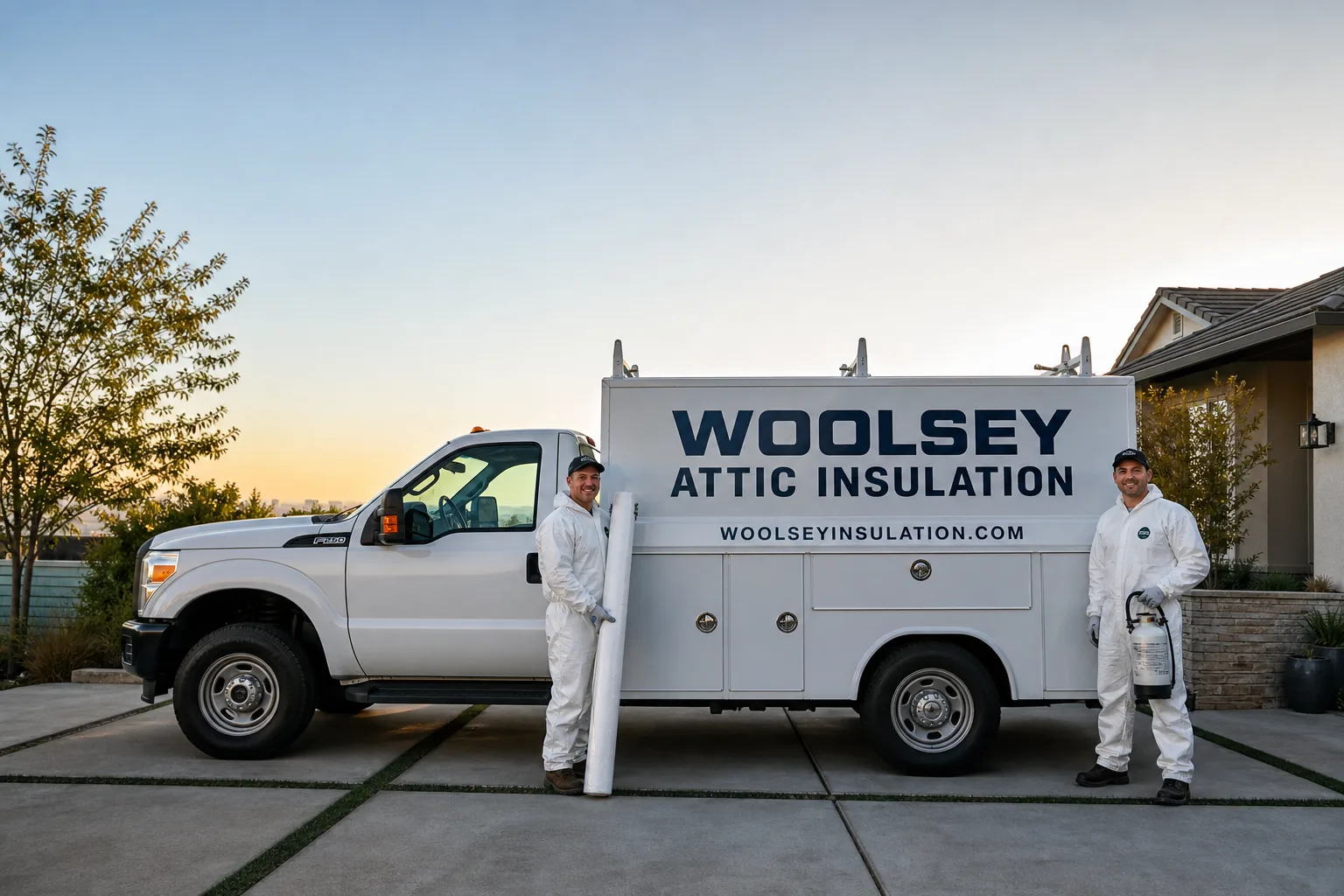
Fast, Reliable Spray Foam Insulation Across San Jose
Spray foam insulation in San Jose costs between $2.50 and $6.50 per square foot installed for most homes, with rim joist projects running $1,800 to $3,400 and crawl space work landing between $3,500 and $7,000 depending on square footage and cavity depth. Our crews are in San Jose daily, typically reaching homes in Berryessa, Cambrian, Willow Glen, and Blossom Valley within one to two business days of your call. We’re a niche insulation company, not a general contractor, so when you call (325) 240-5411, you reach a person who knows spray foam chemistry, San Jose housing stock, and Title 24 permitting inside and out.
Woolsey was founded in 2002 under the Kingswell name, and every job we run in San Jose operates on one simple rule: a written price before any work starts. Not a ballpark. Not a “we’ll see when we get in there.” A number on paper, before our truck rolls.
Why Woolsey Attic Insulation Is San Jose’s Preferred Spray Foam Insulation Company
San Jose homeowners have a specific kind of house, and we’ve spent years learning exactly how those houses behave. The 1950s through 1970s tracts that dominate Berryessa, Cambrian, and Blossom Valley were all built before California’s 1978 Title 24 energy code existed. That means 2×4 framing, open wall cavities, and attic insulation that often measures R-11 or less. When summer temperatures push past 100°F in the Santa Clara Valley, those cavities become heat tunnels. Spray foam applied correctly seals them. Applied incorrectly, it traps moisture and creates a bigger problem than the one you paid to fix. We know the difference because we’ve corrected the mistakes of out-of-town crews who didn’t understand San Jose’s legacy construction.
Our San Jose customers consistently tell us the same three things after a job: the price we quoted is the price they paid, the crew showed up inside the window we promised, and the job site was cleaner when we left than when we arrived. That’s the Kingswell Guarantee, in writing, on every job. It covers the work for a full 365 days. If something isn’t right within that year, we come back and fix it at no charge. Glenn Hartley, who leads our team, has built the entire Woolsey operation around the idea that a guarantee should mean something more than words on a website.
Rim Joist Spray Foam in San Jose
Rim joist spray foam in San Jose seals the band of framing where your floor meets your foundation wall, a spot that leaks air in nearly every pre-1978 ranch home in the city. On a 1961 ranch off Payne Avenue in Willow Glen, we opened a rim joist and found bare 2×4 framing with kraft-faced batts sagging between balloon-framed stud bays and no original insulation whatsoever. Our crew used Icynene to dense-seal the rim joist, then continued the spray foam down into the crawl space to cut the stack-effect air leaks that were pulling 100°F valley attic air into the living space. The homeowner’s cooling load dropped noticeably on the next PG&E cycle and the stucco patching stayed invisible against the original 1960s finish. That’s a typical day in San Jose for us.
Rim joist work in San Jose typically runs $1,800 to $3,400 for a single-story ranch, less if the crawl space access is clean and the joist bays are uniform. Older Willow Glen and Naglee Park Victorians and Craftsman homes run higher because balloon framing creates irregular cavities that require more foam and more careful application.
Air Sealing First, Insulation Second
Foam is only half the job. In San Jose’s inland valley climate, the real energy penalty comes from air movement through open framing. We air-seal every rim joist cavity before applying closed-cell foam, because an airtight R-15 cavity outperforms a leaky R-30 cavity every time.
Closed-Cell for Rim Joist Work
We almost always recommend closed-cell spray foam for rim joists in San Jose. It adds structural rigidity to older foundations, acts as a vapor barrier, and won’t absorb the seasonal moisture that rises from Santa Clara Valley soil. Open-cell has its place in attics and walls, but rim joists see too much ground moisture for it.
Crawl Space Spray Foam Insulation in San Jose
Crawl space spray foam insulation in San Jose addresses one of the most overlooked sources of summer cooling loss in the city: the open, vented under-floor areas beneath thousands of 1950s and 1960s ranch homes. Those crawl spaces pull in outside air, hold moisture against floor joists, and allow the stack effect to draw 100°F attic air down through balloon-framed wall chases and up into your living space. Sealing that envelope with spray foam changes the physics of the whole house. Typical San Jose crawl space projects run $3,500 to $7,000 for an average 800 to 1,500 square foot single-story home, depending on ceiling height, access clearance, and whether we’re sealing rim joists as part of the same job.
We do recommend doing rim joists and crawl space together when we can. The foam cure process is similar, the prep work overlaps, and the air-sealing benefit compounds. You’ll also pay less per square foot because we’re already on site with materials staged and mixed.
How We Apply Crawl Space Foam in San Jose
Closed-cell foam goes onto the underside of the floor deck and up the foundation walls to the sill plate. We mask off vents, cover your furnace returns, and protect any plumbing or wiring in the cavity. After the foam cures, usually within a few hours, the crawl space becomes a semi-conditioned buffer zone instead of an open vent to the outside.
What San Jose Crawl Spaces Tell Us
Every crawl space in Santa Clara County has its own character. Some are tight, dusty, and filled with decades of old pest-control debris. Others are dry with clean 8-mil vapor liners. We price the job based on what we actually find during a pre-job walkthrough, not after the crew arrives. You get a written number before any foam is sprayed.
Trusted Brands We Service in San Jose
We install Johns Manville, Knauf, and CertainTeed spray foam systems, among others, because San Jose homes deserve material choice that fits the structure rather than whatever is stacked on our truck. Different foams perform differently: closed-cell from Johns Manville gives maximum R-value per inch for San Jose’s hot attics, Knauf’s open-cell product suits wall cavity retrofits where breathability matters, and CertainTeed foams offer strong performance in rim joist and crawl space applications. If your existing insulation is one of these brands and you need repairs or spot-work, we can handle that too. Our San Jose inventory is stocked with common replacement components, and we can usually match existing foam chemistry within a week.
Common Spray Foam Insulation Problems We See in San Jose Homes
- Legacy balloon framing left unsealed. Willow Glen and Naglee Park homes built before 1930 often have open wall chases that run from crawl space to attic. Spray foam applied only to the attic floor or rim joist without sealing those chases leaves a hidden convection loop that keeps pulling hot valley air through the walls.
- Degraded kraft-faced batts encapsulated behind foam. Many 1950s through 1970s San Jose tract homes still have original fiberglass batts in 2×4 wall cavities. Some contractors spray foam directly over them, trapping moisture against the sheathing. After one wet winter, the foam blisters or pulls away. We remove or remediate degraded batts before foam application.
- Title 24 compliance overlooked on permit-pulled jobs. Any spray foam work bundled with a pulled HVAC permit in San Jose triggers California Title 24 review. A HERS rater must inspect and sign CF1R/CF2R documentation before the job closes. Out-of-state contractors and even many Bay Area generalists miss this step, and the job stalls for days after the foam is already in place. We pre-schedule the HERS rater before we spray.
- Stucco patching failures after cavity injection. San Jose’s stucco-clad ranch homes require drilling through exterior stucco to reach open wall cavities. If the patch isn’t matched to the original finish, you see every injection point from the street. We use color-matched patching and texture blending, and our crews have repaired enough 1960s stucco to know what it takes to disappear.
Pricing for Spray Foam Insulation in San Jose, CA
Here are honest numbers for San Jose, not national averages. Open-cell attic spray foam in a typical 1,200 square foot ranch runs $2.50 to $4.00 per square foot installed. Closed-cell runs $3.50 to $6.50 per square foot due to higher material cost and R-value per inch. Rim joist sealing for a single-story home lands between $1,800 and $3,400. Crawl space encapsulation with spray foam runs $3,500 to $7,000 for most San Jose homes. What moves the number: square footage, cavity depth, access difficulty, whether we’re removing old insulation, and whether a Title 24 HERS rater needs to be scheduled. We give you a written price before we spray a single ounce of foam. Call (325) 240-5411 and we’ll schedule a walkthrough, usually within a day or two.
We Also Serve Cities Near San Jose
Our crews serve the entire South Bay from our San Jose service area, and we regularly run jobs in Milpitas, Santa Clara, Sunnyvale, and Campbell. If you’re in one of those cities, the same pricing, the same written guarantee, and the same crews apply. We know the housing stock across Santa Clara County, and we treat every job with the same Spray Foam Insulation standards we bring to our San Jose work.
Serving San Jose, CA - Our Local Coverage Area
We’re based in the San Jose area and know this community well. Use the map below to see our service coverage - if you’re nearby, we can almost certainly help.
FAQs About Spray Foam Insulation in San Jose
Spray foam makes more sense than blown-in for many San Jose homes because the city’s dominant 1950s through 1970s ranch stock has open 2×4 cavities and balloon-framed chases that blown-in cellulose or fiberglass can’t air-seal. Blown-in insulation fills a cavity. Spray foam seals it. In San Jose’s inland valley climate, where summer highs push 95 – 105°F and the diurnal temperature swing runs 30 degrees, air leakage through those open cavities is the primary driver of cooling costs. Foam also won’t settle or slump the way blown-in material does over a decade in a hot attic. If your home is a post-1978 Title 24 build with sealed cavities, blown-in may make sense for your attic floor. For anything built before that, spray foam addresses the actual problem. Call (325) 240-5411 and we’ll tell you which approach fits your house, not which one we prefer to sell.
Yes, spray foam meets Title 24 requirements in San Jose, but only if the paperwork is handled correctly. When insulation work is bundled with a pulled HVAC permit, California requires CF1R and CF2R documentation signed by a certified HERS rater. We pre-schedule the HERS inspection before we spray, so the rater verifies the installed R-value and air-sealing measures while the foam is still fresh and accessible. The job closes the same week instead of stalling for days. If you’re not pulling an HVAC permit, the Title 24 HERS requirement doesn’t apply, though we still follow all applicable building codes. For an exact scope and written price on your San Jose project, call (325) 240-5411.
Yes, we can seal your rim joist and crawl space in a single San Jose visit in most cases. The two jobs share prep work, material staging, and safety setup, so doing them together reduces total project time and cost per square foot compared to scheduling them separately. A typical single-story ranch in Cambrian or Blossom Valley with accessible rim joists and a clean crawl space can be done in one to two days. Older Willow Glen or Naglee Park homes with balloon framing and tight crawl access may take longer because the cavities are irregular and require slower, more careful application. We’ll give you a written timeline and written price before we start, and our 365-day guarantee covers both parts of the job. Call (325) 240-5411 for a free walkthrough.
Your stucco is carefully patched and blended to match the original finish after any exterior drilling. San Jose’s 1950s through 1970s ranch homes require drilling through stucco to reach open wall cavities or rim joist areas, and the patch quality is what separates a good job from a bad one. We use color-matched stucco patching material, blend the texture with the surrounding finish, and for most homes the injection points become invisible from six feet away. On the 1961 Willow Glen ranch we worked on recently, the patching disappeared against the original 1960s finish. If you’re in a historic district like Naglee Park with specific exterior requirements, we’ll flag that during the walkthrough and plan the patching approach accordingly. The Kingswell Guarantee covers the stucco repair work for 365 days.
Yes, spray foam specifically helps with San Jose’s 30-degree day-to-night summer temperature swing because it stabilizes the thermal boundary of your house. When nighttime lows drop into the 60s after a 100°F day, uninsulated or poorly insulated homes radiate stored attic heat back into the living space for hours after sunset. Closed-cell spray foam slows that heat transfer dramatically, and the air-sealing it provides prevents the stack effect from pulling hot attic air into the house as it cools. Homes we’ve treated in Berryessa and Blossom Valley report the cooling effect most noticeably in the evening, when the AC used to run hardest. For an exact assessment of how much spray foam could reduce your San Jose cooling load, call (325) 240-5411. Estimates are free and the written price is binding.
Written by Glenn Hartley, Owner at Woolsey Attic Insulation, serving San Jose since 2002.