
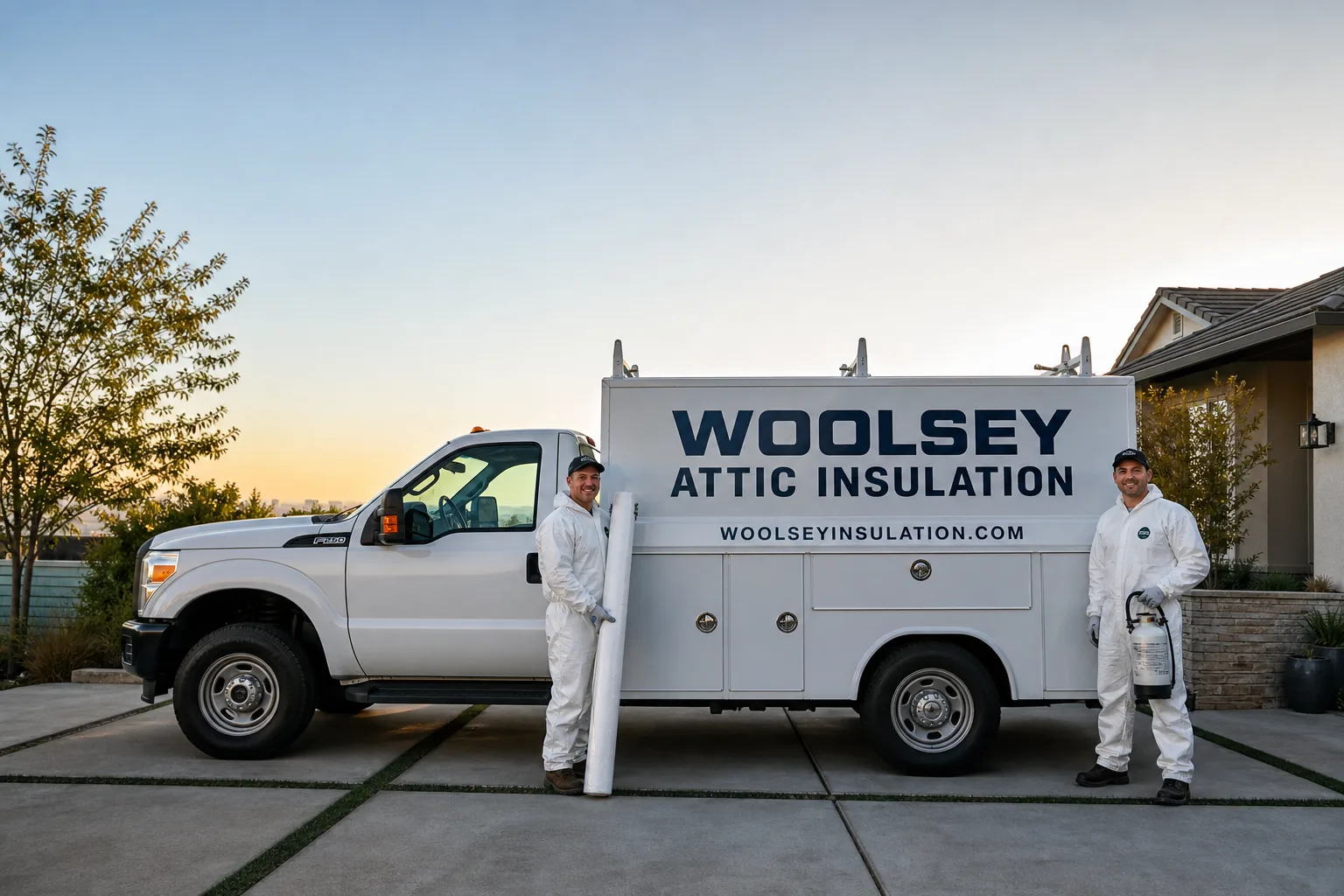
Fast, Reliable Spray Foam Insulation Across Selma
Spray foam insulation in Selma costs $2.10 – $5.40 per board foot for open-cell and $3.00 – $7.75 for closed-cell, with a typical rim joist job running $1,200 – $2,800 and a full wall retrofit on a 1,200-square-foot older ranch home landing between $6,500 – $14,000. We give you the exact written number before any work starts. That matters in Selma, where pre-Title 24 homes built during the raisin-packing boom often have nothing in the walls at all. Woolsey crews serve Selma from the Fresno, Central Valley office, and we’re typically on-site within 24 – 48 hours of your call. Call (325) 240-5411 and a live person picks up, day or night.
Why Woolsey Attic Insulation Is Selma’s Preferred Spray Foam Insulation Company
Selma homeowners have been burned before. A contractor quotes one price, shows up with another, then disappears when the work fails six weeks later. We hear it constantly. So we put every promise in writing through the Kingswell Guarantee: a written price before the first crew member arrives, a committed arrival window, a clean job site, a written guarantee on the work, and a free return visit if anything fails within 365 days. That’s the whole deal. Glenn Hartley built Woolsey on the idea that insulation contracting shouldn’t require a leap of faith.
Our technicians are background-checked and uniformed. You know exactly who’s walking into your home off Floral Avenue or down near the historic downtown core. And when you call (325) 240-5411, a real person answers. No voicemail maze. No “we’ll call you back in 2 – 3 business days.” That’s how we run Spray Foam Insulation work across Fresno County, and it’s how we run it in Selma.
The Kingswell Way is simple: say the price, show up in the window, leave it cleaner than you found it, put the guarantee in writing, and come back if it fails. Every job, no exceptions.
Spray Foam Wall Insulation in Selma
Spray Foam Wall Insulation is the highest-impact retrofit for Selma homes built between the 1940s and 1970s, because those 2×4 wall cavities were often left completely empty when the homes went up. We’re not topping off existing insulation. We’re starting from zero, which means the before-and-after difference is immediate and dramatic. The process involves removing any old debris or dust-caked material from the cavity, then spraying a two-part liquid foam that expands on contact, seals every gap, and cures into a solid air barrier with an R-value that actually performs in both a 150°F summer attic and a tule-fog winter.
When 2×4 Cavities Are Empty
This is the classic Selma condition. The home went up during the agricultural boom, Title 24 didn’t exist, and nobody insulated the walls. We verify the cavity condition before quoting, because a visual check of the outer wall tells you nothing. The fix is full-cavity spray foam, not a batt stuffed over empty framing, which still leaves air gaps and does almost nothing for comfort or bills.
Dust-Compressed Cavity Prep
Here’s what’s different in Selma specifically: decades of raisin-drying dust and field particulate settle inside wall cavities. That fine agricultural residue coats the studs and sheathing, and if you spray foam directly over it, the foam won’t adhere properly. It delaminates. We remove that layer before spraying. Skipping that step is the top reason spray foam jobs fail in this town.
Rim Joist Spray Foam in Selma
Rim Joist Spray Foam addresses the band where your floor framing meets the foundation, and in Selma’s older ranch homes near the historic core, those rim joists are almost never sealed at the sill plate. Tule-fog damp and cold air pour into the floor system all winter, while summer heat radiates up through unsealed gaps. We spray closed-cell foam into the rim joist cavities, sealing the entire perimeter of the home at the floor line and cutting off a significant source of air infiltration that wall insulation alone can’t fix.
Why the Rim Joist Gets Skipped
Most insulation companies quote walls and attic, then ignore the rim joist, because it requires working in tight crawlspace or basement-level access. But in a 1950s Selma ranch, an unsealed rim joist can account for a surprising share of total air leakage even after the walls are done. We check it on every older-home retrofit.
Tule Fog Moisture Protection
Closed-cell foam at the rim joist doesn’t just insulate. It also blocks the moisture-laden air that tule fog pushes against the foundation for weeks at a stretch. That damp air condenses on cold framing, and over years it feeds mold and rot in the floor system. Sealing the rim joist is moisture control as much as it is insulation.
Trusted Brands We Service in Selma
We stock and install multiple insulation brands, so the material recommendation fits your Selma home, not whatever happens to be on the truck. For spray foam work, we regularly use Icynene for closed-cell rim joist and wall cavity retrofits, and Demilec for open-cell attic applications. For blown-in and batt complement work, we carry Owens Corning and Johns Manville products. That material choice means faster turnaround for Selma customers, because we’re not waiting on a single-supplier backorder. You get the right product for your specific house, and we explain the difference in plain language before you commit.
Common Spray Foam Insulation Problems We See in Selma Homes
- Foam delaminating from dust-caked cavities. A prior contractor sprays directly over decades of raisin-drying particulate without cleaning the studs and sheathing first. The foam can’t bond, and within months it pulls away from the framing. We strip and re-prep every cavity before spraying.
- Unsealed rim joists left untreated. Walls get insulated, the attic gets topped off, but the sill plate area stays wide open. Cold winter air and damp tule-fog moisture keep moving through the floor system, and the homeowner wonders why the house still won’t hold temperature.
- Batt stuffed over empty 2×4 framing. Someone added fiberglass batts into a wall that originally had nothing, but the cavity still isn’t air sealed. The labeled R-value on the batt looks fine, but the actual thermal performance is far below what it should be in both summer and winter.
- Dust-compressed attic insulation giving false confidence. We pulled back an attic section near Floral Avenue and found blown-in material caked and compressed by agricultural particulate, reading far lower on actual R-value than the original label claimed. Depth alone is a poor indicator of performance in Selma.
Pricing for Spray Foam Insulation in Selma, CA
A rim joist spray foam job on a typical Selma ranch home runs $1,200 – $2,800 depending on perimeter length and access. Full wall cavity spray foam on a 1,200-square-foot older home runs $6,500 – $14,000, open-cell at the lower end and closed-cell at the higher end. Spray foam roof deck work on a garage ceiling in Selma typically lands between $1,400 – $3,200. These aren’t vague guesses; they’re the ranges we quote every day in this market. Every job gets a written price before any work starts, so the number we quote is the number you pay. Call (325) 240-5411 for a free, no-pressure estimate on your specific home.
We Also Serve Cities Near Selma
Our crews handle Selma and the surrounding San Joaquin Valley communities, including Fowler, Parlier, Kingsburg, and Reedley. If you’re in one of those towns and need spray foam on an older ranch home, the same Kingswell Guarantee applies: written price, real arrival window, clean job site, guarantee in writing, and a free return visit if anything fails within 365 days.
Serving Selma, CA - Our Local Coverage Area
We’re based in the Selma area and know this community well. Use the map below to see our service coverage - if you’re nearby, we can almost certainly help.
FAQs About Spray Foam Insulation in Selma
Yes, and Selma’s older housing stock is exactly where spray foam makes the biggest financial difference, because you’re starting from a true zero-R baseline rather than topping off existing material. Full-cavity spray foam turns an empty, air-leaky 2×4 wall into a sealed, high-performance assembly. The upfront cost is higher than just stuffing batts in, but the year-round comfort and bill reduction are immediately noticeable. Call (325) 240-5411 and we’ll walk through the numbers on your specific home.
Because agricultural dust from decades of surrounding raisin drying and field operations settles into the insulation, compressing it and filling the air pockets that give it its R-value. A tape measure reading of 12 inches might actually perform like 6 inches. We see this constantly in Selma’s older homes. The fix is removal and replacement, not just adding more material on top of compromised insulation.
Rim joist spray foam seals the band where your floor framing meets the foundation, which in 1940s – 1970s Selma ranch homes is almost never sealed. That gap lets cold, damp winter air and 150°F summer heat move through the entire floor system. We spray closed-cell foam into that band, cutting off a major air-infiltration path that wall and attic work can’t address. It’s a small job with disproportionate impact in this housing stock.
Both. Selma’s dual-season thermal demand means insulation has to retain heat in winter and block it in summer. Closed-cell spray foam does both: it keeps conditioned air inside during the cold, damp weeks when tule fog suppresses daytime temperatures into the low 40s, and it blocks the 105°F – 110°F summer heat from penetrating the wall assembly. Older Selma homes with uninsulated walls suffer in both seasons, which is why the retrofit pays back year-round.
We use Icynene for closed-cell wall cavity and rim joist work on older Selma homes, and Demilec for open-cell attic applications where appropriate. We also work with Owens Corning and Johns Manville for complementary batt and blown-in needs. The material choice depends on your specific home and the job, not on what we happen to have loaded on the truck that day. Call (325) 240-5411 and we’ll recommend the right product for your house.
Written by Glenn Hartley, Owner at Woolsey Attic Insulation, serving Selma and the surrounding San Joaquin Valley.