
Fast, Reliable Spray Foam Insulation Across Signal Hill
Spray foam insulation in Signal Hill typically costs $2,400 – $7,800 for a full attic or wall retrofit, with smaller rim joist jobs running $900 – $1,800. Most Signal Hill homes we visit need the work done within two weeks, and we schedule crews from our Los Angeles dispatch office to arrive inside a committed window, not a vague “sometime Thursday.” If you’re losing heat through uninsulated cavities in a pre-war bungalow or feeling drafts in a 1990s townhome, call (325) 240-5411 and we’ll give you a written price before any work starts.
Signal Hill isn’t like the flatland cities around it. The hilltop exposure, the older oil-boom housing stock, and the methane zone rules that cover much of the city all change how spray foam should be specified and installed. Our Spray Foam Insulation team handles these conditions regularly, and we’ll walk you through what your home actually needs instead of selling you whatever’s on the truck.
Why Woolsey Attic Insulation Is Signal Hill’s Preferred Spray Foam Insulation Company
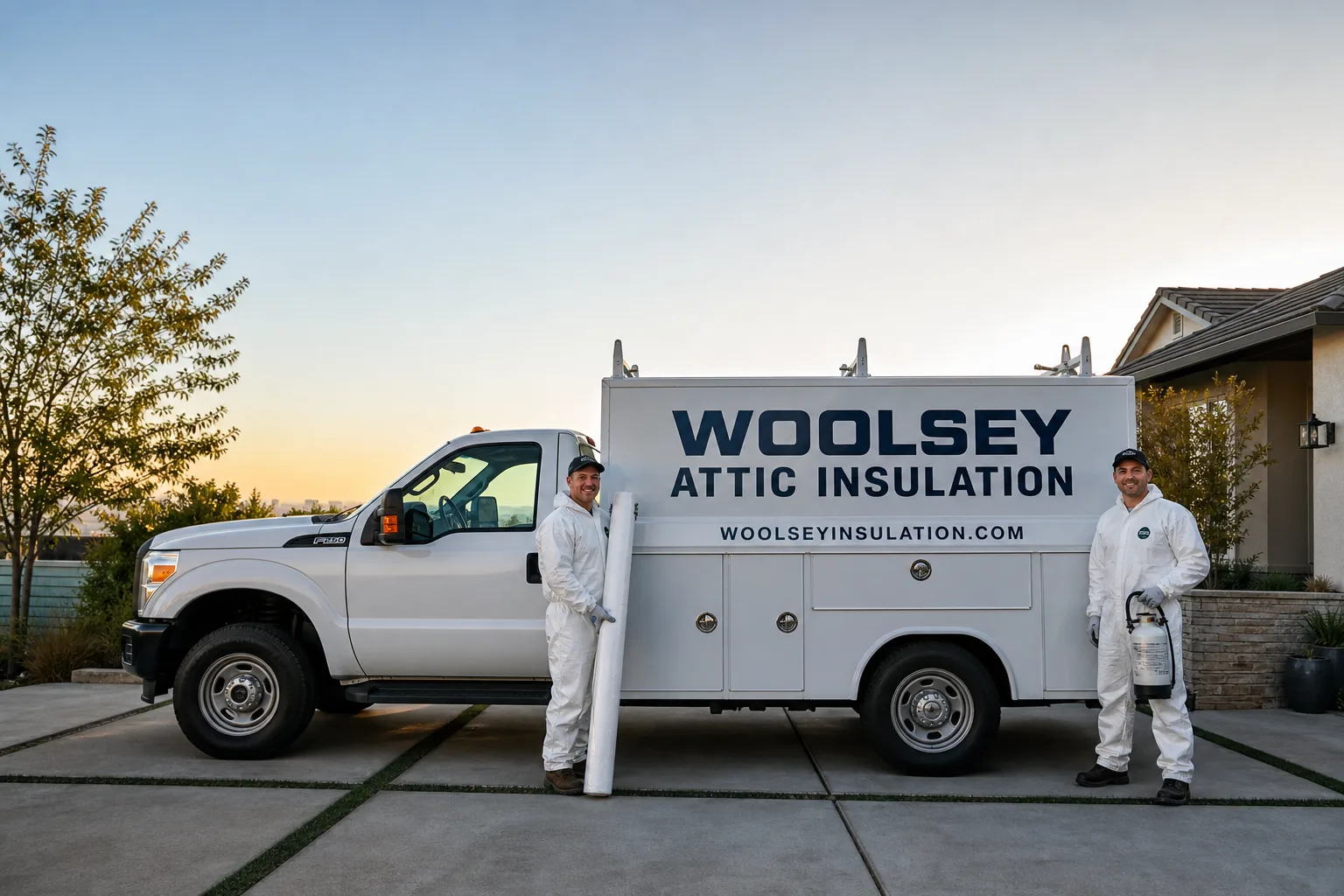
Woolsey Attic Insulation is part of the Kingswell family of independently owned and operated insulation companies, founded in 2002. Glenn Hartley leads our crews, and the standard hasn’t changed: a written price before work begins, a live person answering the phone at 3 a.m., and a 365-day guarantee in writing on every job. Signal Hill homeowners call us because the first conversation is honest, not a sales pitch.
Our technicians are background-checked and uniformed, so when the doorbell rings, you know exactly who’s walking in. We’ve worked on bungalows off Temple Avenue, townhome complexes near the 405, and newer builds on the north slope. The homes differ. The expectation doesn’t.
We answer our own phones, 24 hours a day, 7 days a week. No answering service, no call-back window. Call (325) 240-5411 and a real person picks up.
Open Cell Spray Foam in Signal Hill
Open Cell Spray Foam is the workhorse for Signal Hill attics and above-grade walls: a two-part liquid that expands on contact and fills cavities with a soft, breathable foam that air-seals and insulates at about R-3.6 per inch. Most Signal Hill residential open-cell jobs run $2,400 – $5,800, depending on square footage and how much prep the existing envelope needs.
On the pre-war oil-boom cottages scattered across the hill, open-cell is often the safer thermodynamic choice than closed-cell. These balloon-frame walls were built to breathe, and the persistent marine layer means moisture moves through them differently than in a modern sealed assembly. Open-cell allows the wall to dry to the interior while still stopping the wind-driven air that hits exposed Signal Hill rooflines harder than a few blocks down in Long Beach proper.
Matching Foam to the House, Not the Truck
We carry Icynene, Demilec, Owens Corning, and Johns Manville open-cell products, and the recommendation depends on what your Signal Hill home actually needs. A 1930s cottage with no cavity insulation and a history of condensation staining wants air-sealing first, then open-cell at roughly 5.5 inches. A 1998 townhome with party-wall sound issues may want a different density or a hybrid approach. We’ll tell you which and why, in writing, before we touch a wall.
What the Job Involves Here
On a typical Signal Hill open-cell job, we first seal top plates, rim joists, and any chases that run into the attic. Then we spray the cavities, trim back over-expansion, and verify the depth with a gauge. Cleanup happens the same day. Your written price covers all of it, and the 365-Day Done Right Promise covers what happens after we leave.
Spray Foam Insulation Contractors in Signal Hill
Spray Foam Insulation Contractors working in Signal Hill need to understand methane zone coordination, pre-war framing, and hilltop wind exposure before they ever mix a barrel of foam. Most Signal Hill spray foam installations with Woolsey run $2,400 – $7,800, with the final written number tied to your home’s square footage, framing type, and whether the work touches a sub-slab assembly. Call (325) 240-5411 for a free estimate that doesn’t move after the doorbell rings.
A contractor who doesn’t know Signal Hill’s methane zone maps can compromise a sub-slab vapor barrier without realizing it. A contractor who doesn’t know the difference between a 1938 balloon-frame cottage and a 2005 infill townhome might pack the wrong foam into the wrong assembly and trap moisture behind it. Those failures are expensive to reverse. We see them on hill parcels regularly, and we fix them the right way the first time.
Sequencing Around a Sub-Slab Gas Barrier
Much of Signal Hill lies inside a city-mapped methane zone, and that changes the job order. On flagged parcels, the under-slab vapor and gas barrier must stay continuous, which means we coordinate our rim joist and crawlspace work so we never bridge or puncture that assembly. It’s an extra coordination step that contractors working in flatland cities like Lakewood or Torrance essentially never deal with. We do it on routine work here.
The Written Number Comes First
The Kingswell Way is simple: say the price, show up in the window, leave it cleaner than you found it, put the guarantee in writing, come back if it fails. Every Signal Hill job gets a written price before work starts, every single time. No door-step surprises, no “we found something else while we were in there.” If we find a problem we couldn’t have seen from the initial walk-through, we stop, we show you, we re-price in writing, and you decide.
Trusted Brands We Service in Signal Hill
We work with eight leading insulation brands and choose the material that fits your Signal Hill home, not whatever happens to be on the truck that day. Owens Corning and Knauf open-cell foams give us consistent expansion and cured R-value on standard attic and wall jobs. Johns Manville products serve well in tighter cavities and rim joist applications where we need predictable lift. We stock the parts and accessories Signal Hill customers most often need, so a routine open-cell job on a Temple Avenue bungalow doesn’t stall waiting on a special-order nozzle or hose fitting. If your home’s best foam is an Icynene or Demilec product, that’s what we spray, and we’ll explain why in plain language before you sign anything.
Common Spray Foam Insulation Problems We See in Signal Hill Homes
- Foam bridged over a methane vapor barrier. On flagged hill parcels, prior insulation crews sometimes spray rim joists or crawlspace bays without detailing around the sub-slab gas assembly. The foam bridges the barrier, gas mitigation is compromised, and the owner now has a code violation and a liability exposure they didn’t create. We tape, detail, and keep the assembly continuous before we spray.
- Closed-cell foam packed into pre-war balloon-frame walls. The 1920s – 1940s cottages near Hill Street and Temple Avenue were framed to breathe. Closed-cell’s vapor-retarding properties trap marine-layer moisture inside the assembly, and within a few years you get interstitial condensation against the sheathing and the start of stud rot. The fix usually means removal, which costs far more than doing it right the first time with an open-cell product.
- Air-sealing skipped before foam application. On Signal Hill’s hilltop, consistent onshore Pacific breezes drive air through open balloon-frame top plates and chases at the attic line. High-pressure foam sprayed into those bays without first stopping the air paths just buries the problem under insulation. We seal top plates, rim joists, and chases before we spray, because wind-driven infiltration is the whole game up here.
- Condensation staining on uninsulated stud bays. The daily marine layer keeps relative humidity stubbornly high, and older wall cavities with zero insulation run cold enough overnight to condense moisture along the studs. We’ve opened walls in oil-boom-era cottages and found exactly that staining pattern. Air-sealing plus open-cell at proper depth stops the cold surface and lets the assembly dry toward the interior.
Pricing for Spray Foam Insulation in Signal Hill, CA
Here are the numbers we see on Signal Hill jobs. A rim joist spray foam project on a 1,200-square-foot bungalow typically runs $900 – $1,800. An open-cell attic job on the same home runs $2,400 – $4,200. Wall retrofits on pre-war balloon-frame construction run $3,800 – $7,800, depending on how much plaster repair and air-sealing the assembly needs. A garage ceiling spray foam job runs $1,200 – $2,600. These are honest ranges for this market, not teaser numbers we’ll revise at your door. The exact written number comes after a walk-through, and it’s yours before any work starts. Call (325) 240-5411 for a free estimate.
On one 1938 oil-boom-era cottage near Temple Avenue and Hill Street, we opened the walls to find open balloon-frame cavities with zero insulation and a marine-layer condensation line staining the studs. We air-sealed the top plates and rim, then closed the bays with Icynene open-cell foam at roughly 5.5 inches so the wall could dry to the interior instead of trapping coastal humidity. In the same crawlspace we taped and detailed around the existing methane vapor barrier rather than bridging it, keeping the sub-slab gas assembly continuous before we reinstalled the subfloor. The homeowner reported the back bedroom, previously the coldest room in the house, held temperature evenly through the following winter.
We Also Serve Cities Near Signal Hill
Woolsey crews serve Spray Foam Insulation in Signal Hill and the surrounding communities, including Long Beach, Hawaiian Gardens, Seal Beach, and Los Alamitos. If you’re up the hill or just down the street, call (325) 240-5411 and we’ll get you a written price, not a vague ballpark.
Serving Signal Hill, CA - Our Local Coverage Area
We’re based in the Signal Hill area and know this community well. Use the map below to see our service coverage - if you’re nearby, we can almost certainly help.
FAQs About Spray Foam Insulation in Signal Hill
Yes, on parcels inside the city-mapped methane zone, which covers much of Signal Hill, the under-slab vapor and gas barrier must stay continuous through any insulation work touching the crawlspace, rim joists, or subfloor. We tape and detail around that assembly rather than bridging or puncturing it, which keeps the mitigation system intact and the job code-compliant. If you’re not sure whether your lot is flagged, call (325) 240-5411 and we’ll help you figure it out.
Yes, and it’s common work for us here. Those pre-war homes were built rapidly with little or no wall insulation, but they were framed to breathe. We use open-cell foam rather than closed-cell in those assemblies so moisture from the marine layer can still dry toward the interior instead of getting trapped against the sheathing. Get a free estimate at (325) 240-5411.
Signal Hill rises roughly 170 feet above the coastal plain, and its rooflines and upper wall assemblies take stronger, more consistent onshore breezes than the flatland below. That wind-driven air pushes through open balloon-frame top plates and chases, carrying moisture and heat loss with it. In Long Beach proper you can get away with insulation alone; up here, air-sealing first is the difference between a job that works and a foam job that buries the problem. Call us at (325) 240-5411 for an assessment.
Those attached-unit developments present party-wall sound and thermal challenges specific to dense infill construction, so we typically specify a higher-density open-cell product or, where the assembly calls for it, a closed-cell product from Johns Manville, Demilec, or Icynene. The choice depends on the wall stack-up and what’s already behind it, and we’ll explain the recommendation in writing before we spray. Call (325) 240-5411 for specifics on your unit.
Closed-cell foam can trap moisture if it’s installed in a pre-war balloon-frame wall that was never designed for a vapor retarder, and that’s a failure mode we see on hill bungalows. Open-cell foam is vapor-permeable, so it air-seals while still letting the assembly dry toward the interior. The right product depends on your home’s framing and year of construction, and we’ll specify it honestly. Call (325) 240-5411 for a written recommendation.
Written by Glenn Hartley, Owner at Woolsey Attic Insulation, serving Signal Hill since our founding in 2002.