
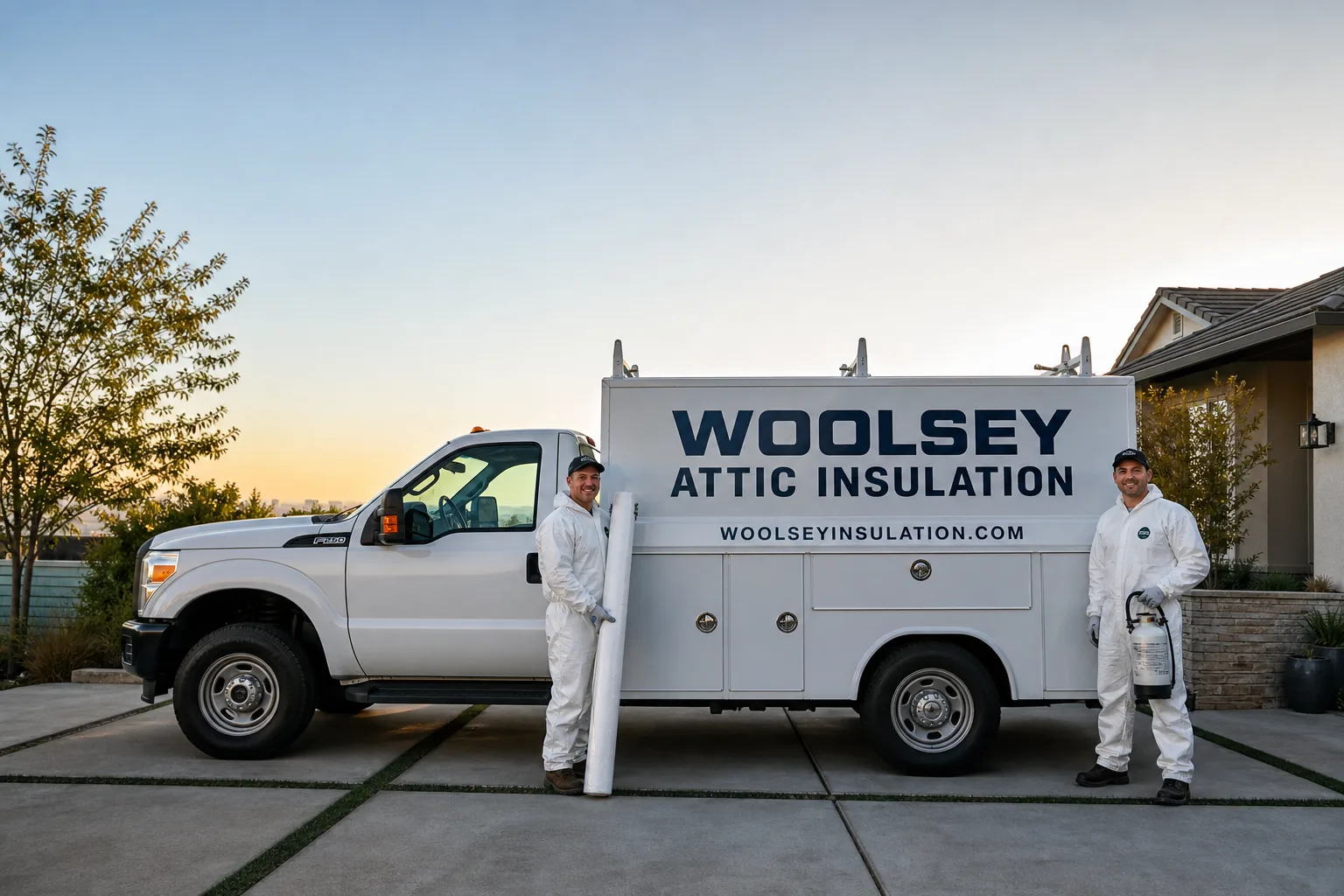
Fast, Reliable Attic Insulation Across Benicia
Attic insulation in Benicia costs between $1,800 and $6,400 for a typical single-family home, with the majority of jobs landing in the $2,700 to $4,200 range. Blown-in work runs $1,800 to $3,800, batt replacement lands $2,400 to $5,200, and a full removal-and-reinstall in a historic Victorian can reach $6,400. You get the exact written number before any work starts. That’s the Kingswell Guarantee, and it’s how Woolsey Attic Insulation has worked in Benicia since Glenn Hartley took the reins. Call (325) 240-5411 and a live person answers, day or night.
We know Benicia’s houses the way only a local crew can. The salt air off the Carquinez Strait. The balloon-frame Victorians near First Street that still have open wall cavities from 1905. The 1960s tracts off Southampton Road where settled batt has thinned to nothing under decades of re-roofing. This isn’t a generic attic job market. It’s a very specific one, and we treat it that way.
Why Woolsey Insulation Is Benicia’s Preferred Attic Insulation Company
Homeowners across Benicia tell us the same thing: they’ve had a contractor change the price at the door, or never show in the promised window, or leave a repair that failed six weeks later. Woolsey runs differently. The Kingswell Guarantee puts a written price in your hand before any work begins, commits us to a real arrival window, and backs every job with a 365-day written guarantee. If it isn’t right within a year, we come back and fix it at no charge. That’s in writing, on every single job, no exceptions.
Our techs are background-checked and uniformed, so you know exactly who is walking through your door. You’ll see the same face from the estimate to the final walkthrough. Glenn Hartley has built this crew around one principle: say the price, show up in the window, leave it cleaner than you found it, put the guarantee in writing, come back if it fails. That’s the Kingswell Way, and it’s the reason Benicia homeowners keep calling us instead of taking a chance on a dispatcher you’ll never meet.
And the phone? A real person answers 24 hours a day, 7 days a week. Not a voicemail maze, not a call-back window. You call (325) 240-5411 at 2 a.m. because the attic hatch is dripping condensation onto the hallway ceiling, and you get a voice on the line who can schedule a Benicia tech. That matters in a town where the wind never really stops.
Attic Mold Removal in Benicia
Attic mold removal in Benicia is a job we handle frequently because the Carquinez Strait’s sustained marine moisture creates condensation conditions inside under-vented attics that inland cities like Fairfield or Dixon just don’t see. Mold grows when warm, humid air from the living space rises through ceiling penetrations, hits cold roof sheathing, and condenses back into the insulation. Benicia’s year-round damp marine airflow means this happens in every season, not just after a wet winter.
When a Benicia homeowner finds black spotting on the underside of roof sheathing or smells that musty attic odor in upstairs bedrooms, the insulation itself is usually colonized and needs to go. We don’t spray-and-pray. We remove the contaminated material, air-seal the ceiling plane from the living space below, correct the ventilation balance where needed, and install fresh insulation that won’t feed the next outbreak. Typical mold remediation with insulation removal in a Benicia attic runs $3,200 to $5,600, depending on attic size and how far the mold has spread. You get a written line-item price before we touch anything.
How We Handle Moisture Sources First
Mold doesn’t start in the insulation. It starts with a moisture source: a bath fan venting into the attic, a can light leaking conditioned air, a rim joist that’s been sweating against the cold sill plate. In Benicia, the wind pressure off the Strait makes these leaks more aggressive. Before we remove moldy insulation, we identify and seal the source. Otherwise you’d be paying for the same job twice, and we won’t do that to a Benicia homeowner.
Removal and Reinstall, Not Surface Spray
Surface treatments on moldy attic insulation don’t work in this climate. The moisture load is too persistent. We remove the contaminated material, HEPA-vacuum the affected framing, treat the sheathing, and re-insulate after the area has been dried and sealed. A moldy attic in the historic district near First Street needs the same rigorous process as a moldy attic in a 1970s tract off East 5th. The Strait doesn’t discriminate.
Attic Insulation Removal in Benicia
Attic insulation removal in Benicia is required more often than homeowners expect, and it’s almost never optional once you see what’s actually up there. Old fiberglass batt, rodent damage, re-roofing debris, or an old blown-in layer that’s been compressed to half its original R-value: these are removal jobs, not top-up jobs. In Benicia’s 1950s to 1970s tract homes, we regularly pull out batts that have been walked over, rained on, and trampled by three generations of roofers. The simplest fix is full removal and a fresh install.
Removal runs $1,400 to $2,600 on its own for a typical Benicia attic, before new insulation goes in. The combined removal-and-reinstall job typically lands between $2,800 and $5,200. Here’s why you want that number in writing before work starts: the price shouldn’t change when the crew opens the hatch and sees the real condition. With Woolsey, it won’t. You get a written number up front, and the crew honors it.
When Rodents or Pests Have Moved In
Benicia’s older housing stock, especially the Victorians with their open wall cavities and gappy construction, attracts rodents. They nest in insulation, leave waste throughout it, and turn it into a health problem. Attics in the waterfront neighborhoods have an additional complication: the same wall cavities that funnel Strait wind upward also act as rodent highways. When we remove contaminated insulation, we also identify the entry points so the new insulation doesn’t become a fresh nest. That’s part of the job, not an extra add-on.
Vermiculite and Older Loose Fill
Some Benicia homes built before the mid-1980s may still have vermiculite loose fill, which can contain asbestos. We don’t disturb it without testing. If testing comes back positive, we coordinate with a licensed asbestos abatement contractor before any new work proceeds. For plain old rock wool or sawdust-era fill, we handle removal directly, same day in most Benicia neighborhoods.
Trusted Brands We Service in Benicia
We work with eight leading insulation brands, and for Benicia’s mix of Victorians and mid-century tracts, we lean on three: GreenFiber cellulose for dense-pack wall retrofit in historic balloon-frame construction, Owens Corning loose-fill for attic blow-in over settled existing insulation, and Johns Manville batt for clean-bay replacement in newer or remodeled attics. The material recommendation fits the house, not whatever happens to be on the truck that day. We stock enough depth of these brands to handle a fast turnaround in Benicia, and our crews know which material works best in Strait-facing attics with real moisture load. For our full range of service offerings, see our Attic Insulation overview.
Common Attic Insulation Problems We See in Benicia Homes
- Balloon-frame stack-effect drafts in historic Victorians. The open wall cavities in Benicia’s oldest homes run from sill to roof, and the Carquinez Strait’s sustained wind pressurizes the southwest-facing walls so hard that conditioned air gets pulled straight up into the attic. Adding attic insulation alone doesn’t stop this, because the leak is in the wall cavity, not the ceiling plane. We find wall plates that read as 15°F colder than the room on a windward wall near First Street.
- Settled and compressed fiberglass batt in 1950s to 1970s tracts. Decades of re-roofing traffic and attic storage have flattened much of the original batt in Benicia’s mid-century neighborhoods down to half its original thickness. A 1972 rancher off Southampton Road with original batt often measures R-11 when the attic needs R-38 or better for this climate. The thin coverage lets Strait wind push straight through the ceiling plane, and the rooms directly under the attic never hold temperature.
- Marine moisture condensing on rim joists and crawlspace insulation. Benicia’s persistent marine air off the Strait condenses on poorly detailed rim joists faster than in drier Solano cities like Dixon or Vacaville. Insulation that looks fine from the attic hatch can be hiding wood rot at the framing below. When we inspect an attic in Benicia, we check the rim joist condition every time, because the moisture load here makes this a structural concern, not just a comfort one.
- Re-roofing debris and rodent damage in older attics. Benicia’s older housing stock sees a lot of roof work, and not every roofer cleans the attic after. Debris mixed into insulation, old nails, torn batt edges, and rodent burrows through the fiberglass are regular findings in the waterfront and downtown neighborhoods. The solution is usually removal and fresh install, not a top-up over compromised material.
Pricing for Attic Insulation in Benicia, CA
Simple numbers, because Benicia homeowners deserve them. Blown-in attic insulation for a typical 1,200 to 1,800 square foot Benicia home runs $1,800 to $3,800. Batt replacement runs $2,400 to $5,200 depending on access and the condition of the bays. A full removal and reinstall, which we recommend for most 1950s to 1970s tracts and virtually any Victorian that hasn’t been dense-packed, lands between $2,800 and $6,400. Top-up over existing, settled blow-in runs $1,200 to $2,200 when the underlying material is still clean and dry. Mold remediation with removal starts around $3,200. Every one of these ranges is a real number a Benicia homeowner can expect. Your exact written price, handed to you before work starts, is free. Call (325) 240-5411 for a Benicia estimate.
We Also Serve Cities Near Benicia
If you’re just across the Benicia-Martinez Bridge or up the 680, we serve Benicia and the surrounding communities too. That includes Martinez, Rodeo, Hercules, and Pinole. Same written-price guarantee, same 365-day written warranty, same live person answering the phone when you call (325) 240-5411. Different city, same Kingswell Way.
Serving Benicia, CA - Our Local Coverage Area
We’re based in the Benicia area and know this community well. Use the map below to see our service coverage - if you’re nearby, we can almost certainly help.
FAQs About Attic Insulation in Benicia
Because the draft is in the walls, not the attic. Balloon-frame Victorians in Benicia have open wall cavities running from the sill all the way to the roof, and the Carquinez Strait’s sustained wind pressure drives outside air through those cavities and pulls conditioned air up into the attic. Adding attic insulation helps the top of the house, but it doesn’t seal the wall plates or rim joists where the stack effect actually starts. The fix is blower-door-guided air sealing at the wall and rim joist level before or alongside insulation work. We find this exact condition on southwest-facing walls near First Street all the time. Call (325) 240-5411 and we’ll walk you through what your house needs.
Yes. Benicia sits directly on the Carquinez Strait, a gap in the Coast Range that funnels cold, moisture-laden Pacific air inland with sustained force. That wind-driven infiltration pressure is measurably more intense in Benicia than in Vallejo or inland Fairfield, and it pushes through the ceiling plane of homes with thin or settled attic insulation all year round. In drier, calmer cities, insulation failures show up mostly in winter. In Benicia, comfort complaints happen in every season because the wind never stops. Our crews account for this in every Benicia job we spec.
Remove it when the original batt is compressed, contaminated, or disturbed by re-roofing work. In Benicia’s 1950s to 1970s tracts, we routinely find original fiberglass batt that has settled to half its original R-value and been trampled over by decades of roof work. A top-up over crushed, dirty batt just buries the problem. If the existing insulation is dry, clean, and still holding its loft, a top-up makes sense at $1,200 to $2,200. If it’s matted or full of debris, removal and a fresh blown-in install is the right call, typically $2,800 to $5,200 for a standard Benicia rancher. We’ll show you photos from the attic before you commit to anything.
We remove the contaminated insulation, identify and seal the moisture source, correct the ventilation where needed, and re-insulate. Surface sprays don’t work in this climate because the marine moisture load off the Strait is too persistent. The mold source is usually a bath fan exhausting into the attic, a leaky can light, or a rim joist sweating against the cold sill plate. In Benicia, the wind pressure makes these leaks more aggressive than they’d be inland. Mold remediation with full insulation removal and reinstall in a Benicia attic typically runs $3,200 to $5,600. Call (325) 240-5411 for a written Benicia quote.
We stock GreenFiber cellulose for dense-pack wall retrofit in balloon-frame construction, Owens Corning loose-fill for attic blow-in, and Johns Manville batt for clean-bay replacement jobs. The material fits the house. A Benicia Victorian with open wall cavities needs dense-pack cellulose to slow the Strait-driven stack effect. A 1960s tract home with settled original batt wants fresh blown-in loose-fill over a sealed ceiling plane. We keep enough of each on hand to handle same-week Benicia work without waiting on a distributor, and we’ll tell you exactly which material we’re quoting and why.
Ready to Get Your Benicia Attic Fixed Right?
Call (325) 240-5411 for a free, no-obligation attic insulation estimate in Benicia. Glenn Hartley and the Woolsey crew will give you a written price before any work starts, show up in the promised window, leave your attic cleaner than we found it, and put every promise in writing. 365 days. No fine-print games. Just the Kingswell Guarantee, the way it’s always been done.
Written by the team at Woolsey Attic Insulation, serving Benicia, CA with attic insulation and spray foam work since 2002.