
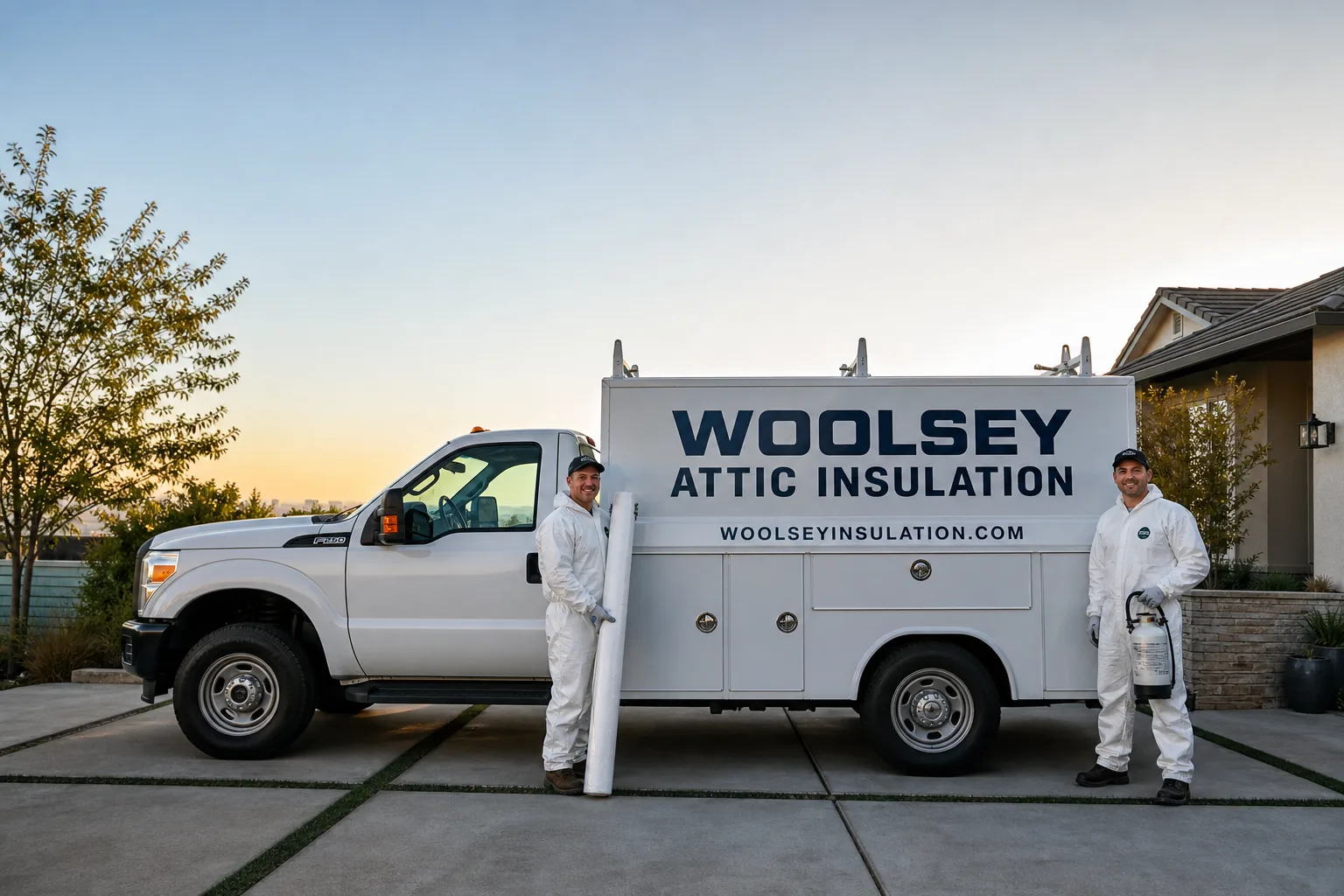
Fast, Reliable Attic Insulation Across Rodeo
Attic insulation in Rodeo isn’t a one-size-fits-all job. Most homes here date back to the 1910s through 1940s, built as refinery worker housing for the Union Oil (now Phillips 66) plant, and many still have knob-and-tube wiring in the attic that has to be remediated before any blown-in product can go in. That’s step one. Step two is dealing with the bay-driven fog and salt air that saturates old fiberglass until it collapses. We know both problems well, and we’ll give you a written price before any work starts. Call us at (325) 240-5411 for a free estimate, and we’ll walk your attic with you.
Why Woolsey Attic Insulation Is Rodeo’s Preferred Attic Insulation Company
Woolsey Attic Insulation is part of the Kingswell family of independently owned and operated insulation companies, founded in 2002 and led by Glenn Hartley. We specialize in attic and spray foam insulation exclusively. No roofing, no windows, no HVAC. That focus means every Rodeo job gets treated as a technical problem with a specific solution, not a box-checking exercise.
Our crews know the blocks near San Pablo Avenue, the cottages off Parker Avenue, and the streets that run closest to the bayfront. That matters because a home three blocks from the water has different moisture behavior than one up by the hills. We factor that into every recommendation. And every single job is covered by The Kingswell Guarantee: a written price before work begins, a committed arrival window, a clean job site, a written guarantee on the work, and a free return visit if any repair fails within 365 days.
Phones are answered by a live person 24 hours a day, seven days a week. When you call about your Rodeo attic, you’re talking to someone who can help, not a voicemail maze. Background-checked, uniformed technicians show up on time, and you know exactly who’s entering your home.
Blown In Insulation in Rodeo
Blown in insulation in Rodeo typically runs $1,800 to $4,200 for a standard attic, depending on square footage, access, and whether knob-and-tube remediation is required first. Blown-in fiberglass or cellulose is the workhorse product for the flat and shallow-pitch attics common to refinery-era cottages here, because it fills irregular cavities and settles into the nooks that batt products can’t reach. The job involves air-sealing the attic floor, venting any existing knob-and-tube runs, and then blowing the material to a target R-value, usually R-38 to R-49 for Contra Costa County’s climate zone.
Knob-and-Tube Remediation Before Blown-In
This is the step that separates a legitimate Rodeo insulation job from a risky one. Knob-and-tube wiring is present in a significant share of the original worker cottages, and you cannot safely blow insulation over live knob-and-tube circuits. The insulation traps heat against the old wiring and creates a fire hazard. We identify those runs during the initial attic inspection, quote the remediation separately, and never bury live wiring under new material.
Air-Sealing for Bay-Driven Humidity
Rodeo’s marine fog isn’t just a comfort issue; it’s a moisture-loading problem that pushes humid air into attic cavities through unsealed penetrations. We air-seal around plumbing vents, electrical boxes, and ceiling hatches before the blown-in goes down. In homes near the bayfront, that sealing step is the difference between insulation that performs and insulation that saturates within a few fog seasons.
Insulation Contractors in Rodeo
Insulation contractors in Rodeo are not all set up to handle what these older homes throw at them. A typical blown-in quote from a contractor who doesn’t inspect for knob-and-tube or moisture-damaged legacy batts is a quote that will likely need a callback. We approach every Rodeo job as an insulation and moisture-remediation project first. That means the initial estimate includes a full attic inspection, a written condition report, and a line-item price so you know exactly what you’re paying for before anything gets installed.
What a Proper Rodeo Attic Inspection Covers
We check for knob-and-tube wiring, degraded vapor barriers, collapsed fiberglass in the attic floor, and condensation staining at the ceiling hatch. Those findings shape the recommendation, not the other way around. If your attic needs a top-up rather than a full replacement, we’ll tell you that plainly and price it accordingly.
Written Pricing and the Kingswell Way
The Kingswell Way runs like this: say the price, show up in the window, leave it cleaner than you found it, put the guarantee in writing, and come back if it fails. That’s not a slogan; it’s how each job is structured. You get the written number before a single bag of insulation is loaded onto the truck.
Trusted Brands We Service in Rodeo
We install products from Johns Manville, Knauf, Rockwool, and CertainTeed, among eight leading brands we work with. That gives us the flexibility to match the material to the specific conditions of your Rodeo attic rather than pushing whatever is on the truck. For a fog-exposed bayfront cottage, we may recommend a Rockwool batt for its moisture resistance. For a standard blown-in job in the hills off Parker Avenue, Johns Manville fiberglass performs well and prices fairly. We stock materials locally for fast turnaround, so your Rodeo job doesn’t wait on a distribution center.
Common Attic Insulation Problems We See in Rodeo Homes
- Knob-and-tube wiring blocking safe blown-in installation. Original refinery-era wiring is common in Rodeo attics. Burying live knob-and-tube under cellulose or fiberglass is a code violation and a fire risk, and a real contractor will tell you that before quoting the job.
- Salt-saturated fiberglass that has compacted to near-zero R-value. On a fog-heavy block near the old Union Oil refinery edge of Rodeo, we opened an attic in a 1920s wood-frame worker cottage and found knob-and-tube splices buried under collapsed, salt-damp fiberglass batts that had absorbed enough moisture to compact to almost nothing. Our tech replaced the compromised wiring runs, then installed Owens Corning blown-in over a fresh air-seal deck and added a sealed barrier against the bay-driven humidity, and the owner finally stopped seeing condensation drip at the ceiling hatch.
- Condensation staining that mimics a roof leak. Shallow-pitch roofs over pre-WWII cottages trap moist air against degraded vapor barriers. The staining at ceiling edges and around the hatch often isn’t a roof problem at all. It’s attic humidity with nowhere to go, and the fix is insulation and ventilation work, not roofing.
- Original batt insulation installed decades ago and never replaced. Rodeo homes that got any insulation at all in the mid-century often still have the original material in place. Fiberglass batts from that era were installed at lower R-values and degrade with bay moisture exposure. If your attic has flooring installed over old batts, the effective R-value is likely far below anything useful today.
Pricing for Attic Insulation in Rodeo, CA
Most Rodeo attic insulation jobs land between $1,500 and $6,500. A simple blown-in top-up over a clean, wire-free attic runs $1,500 to $2,800. A full blown-in replacement with knob-and-tube remediation runs $3,200 to $6,500 depending on wiring scope and attic size. Attic batt insulation for accessible attics runs $2,000 to $4,500 when old material must be removed first. Closed-cell spray foam, which we recommend for bayfront homes where moisture resistance matters most, runs $4,500 to $9,500 for a standard Rodeo attic. Every number is a range because your attic’s condition matters, but you’ll get the exact written price before any work starts. Call (325) 240-5411 for a free estimate.
We Also Serve Cities Near Rodeo
Our Attic Insulation crews also serve homeowners in Hercules, Pinole, El Sobrante, and Benicia. If you’re in one of those nearby communities, you can see more about Attic Insulation in Rodeo and the surrounding area, or call us directly for scheduling.
Serving Rodeo, CA - Our Local Coverage Area
We’re based in the Rodeo area and know this community well. Use the map below to see our service coverage - if you’re nearby, we can almost certainly help.
FAQs About Attic Insulation in Rodeo
You can’t blow new insulation over old material in Rodeo if that old material has absorbed bay moisture, compacted, or is covering knob-and-tube wiring. Wet, collapsed fiberglass creates an uneven surface that traps moisture against the attic floor, and burying live knob-and-tube is a fire hazard. In many Rodeo homes, the existing insulation has to come out first so the wiring can be remediated and the air-sealing done properly. Call us at (325) 240-5411 and we’ll inspect your attic and tell you exactly what you’re working with, free of charge.
Yes, and more aggressively than almost anywhere else in Contra Costa County. Rodeo sits at the edge of San Pablo Bay and receives some of the densest marine fog in the region. That persistent humidity pushes moisture into attic cavities and saturates porous insulation, especially legacy fiberglass batts. In homes near the waterfront, we routinely find insulation that has collapsed and compacted to near-zero R-value from moisture absorption. A sealed vapor barrier and moisture-resistant material selection are not upsells here; they’re the standard solution.
Expect an inspection that looks specifically for knob-and-tube wiring, shallow-pitch roof constraints, and moisture intrusion from the bay side. We’ll check the wiring path, the vapor barrier condition, and the current insulation depth before recommending anything. Most refinery-era cottages in Rodeo were built with no meaningful attic insulation, so you may be starting from close to zero R-value. We’ll give you a written condition report and a line-item price, not a verbal estimate that changes at the door.
For homes closest to the bayfront, closed-cell spray foam is often the right choice because it creates an air and moisture barrier that blown-in fiberglass can’t match. It also adds structural rigidity to shallow-pitch roofs. But spray foam costs more, and if your attic has knob-and-tube that hasn’t been remediated, you’re limited to blown-in or batt products until the wiring is addressed. We’ll walk you through the trade-offs for your specific street and exposure, with real numbers for each option.
Look for three things: condensation staining around the ceiling hatch or at ceiling edges, insulation that appears matted or flattened rather than fluffy, and a persistent musty odor in the attic. Old insulation that has simply aged will be dusty and thin but still roughly consistent in depth. Moisture-failed insulation in Rodeo is often visibly dark, clumped, and damp to the touch. We’ll confirm the diagnosis during a free attic inspection, and if replacement is needed, you’ll get the written price before any work begins. Estimates are free, so call (325) 240-5411.
Written by Glenn Hartley, Owner at Woolsey Attic Insulation, serving Rodeo and the San Pablo Bay shoreline.