
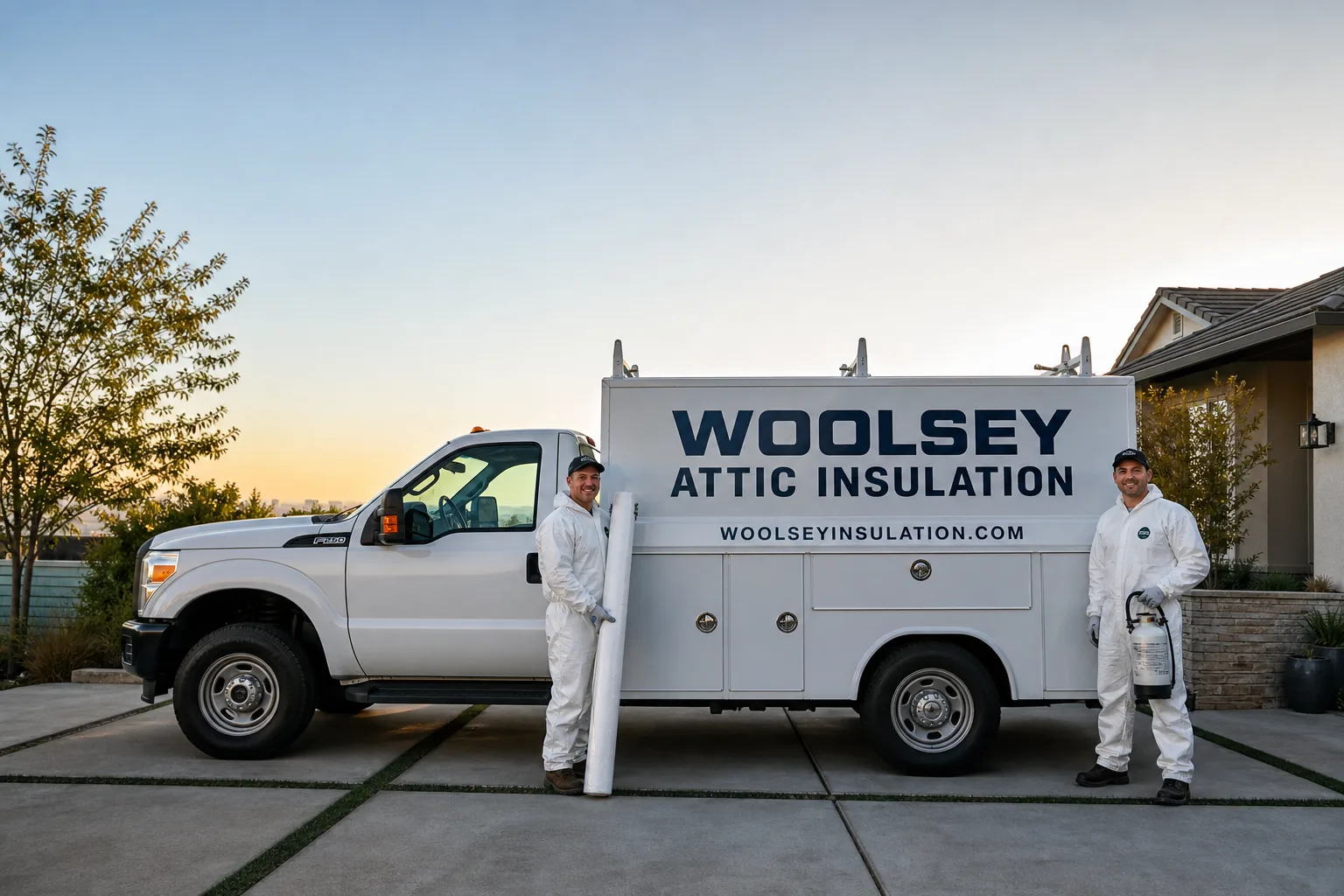
Fast, Reliable Attic Insulation Across Dublin
Attic insulation in Dublin, CA isn’t a luxury upgrade. It’s the difference between a second floor you can actually sleep in during July and a house that fights your air conditioner all afternoon. Most Dublin attics we inspect run R-19 to R-30: the code minimum from when the house was built, and nowhere near enough for what the Altamont Pass delivers every summer. We’re Woolsey Attic Insulation, and we work exclusively on attics and spray foam. If your upstairs bedrooms run 8 to 10 degrees hotter than downstairs, call us at (325) 240-5411 and we’ll tell you exactly what’s going on up there, in plain language, before anyone picks up a hose.
Why Woolsey Attic Insulation Is Dublin’s Preferred Attic Insulation Company
We’ve worked in enough Dublin attics to know what the builders left behind. Fallon Village. Jordan Ranch. Positano. The story is the same in most of them: fiberglass batts laid to the minimum R-value of the build year, recessed can lights that were never sealed, and attic hatches that leak air like an open window. Homeowners in Eastern Dublin don’t usually notice until August, when the second floor stops cooling and the PG&E bill hits triple digits. That’s when we get the call.
Our crews answer those calls with a specific process. We show up in a committed arrival window, not a four-hour maybe. We walk the attic with you or send you photos from inside. We price the job in writing before any work starts, and that number doesn’t move. Every job includes the 365-Day Done Right Promise: if the installation isn’t right within a year, we come back and fix it at no charge. Dublin homeowners have told us, more than once, that they’ve never had a contractor put that in writing before.
Glenn Hartley, who leads our team, built Woolsey around a simple standard: tell the truth about the attic, price it honestly, and stand behind the work. Phones are answered by a live person 24 hours a day, seven days a week. No voicemail. No “we’ll get back to you.” Whether you’re in Dublin Ranch or over near Hacienda Crossings, you get the same answer: a real person who can schedule an inspection.
Attic Ventilation in Dublin
Attic Ventilation in Dublin is what keeps a 140°F attic from becoming a 140°F second floor. Most Eastern Dublin tract homes built between 2000 and 2018 came off the lot with ridge vents and soffit vents that met the code at the time. But Dublin’s afternoon wind events, the ones that barrel through the Altamont Pass, change how those vents actually perform. Wind-driven pressure can overpower passive venting, and if soffit vents are blocked by insulation or painted over, the attic stops breathing. That hot air has nowhere to go except down into your living space.
How Ventilation and Insulation Work Together
Insulation slows heat transfer. Ventilation removes heat that’s already entered the attic. In Dublin’s climate, you need both working. A well-insulated attic with no ventilation still cooks. The roof deck heats up, that heat radiates down through the insulation, and by late afternoon your ceiling feels warm to the touch. A standard attic ventilation prep in Dublin runs $350 to $800 depending on how many baffles and vents need attention.
When a Dublin Home Needs Ventilation Work
If you can feel heat radiating from your ceiling at 6 p.m. in July, your attic ventilation isn’t keeping up. We see this most often in two-story stucco homes where the upper floor sits directly under a sun-baked roof. The fix often includes installing or clearing baffles at the eaves, checking that ridge vents aren’t blocked, and sometimes adding a solar or electric attic fan. In Dublin’s specific heat pattern, a powered fan can cut peak attic temperatures enough to notice the difference in your upstairs hallway.
Radiant Barrier in Dublin
Radiant Barrier in Dublin tackles the problem from a different angle than insulation alone. A radiant barrier is a reflective foil layer installed on the underside of the roof deck. It reflects radiant heat back toward the roof instead of letting it emit down into the attic. In Dublin, where summer attic temperatures routinely pass 140°F, a radiant barrier can drop the attic’s peak temperature by 20 to 30 degrees. That’s not marketing talk. That’s physics: foil reflects radiant heat. Your roof still gets hot; your attic doesn’t absorb as much of it.
Radiant Barrier Cost and Payback in Dublin
A radiant barrier installation in Dublin typically runs $1,200 to $2,800 depending on roof deck size and accessibility. The payback comes in two forms: lower cooling bills and a genuinely more comfortable second floor. For Dublin Ranch and Jordan Ranch two-story homes with large roof decks, the radiant barrier often makes a bigger immediate difference than adding R-value alone. We often pair it with a top-up on the insulation: the barrier handles the radiant load, the insulation handles the conductive load.
Installing Radiant Barrier in Tract Homes
Tract homes built in the 2000s and 2010s have predictable roof geometry, which makes radiant barrier installation straightforward. We staple the foil to the rafters, leaving an air gap that’s essential for performance. Without that gap, the foil conducts heat instead of reflecting it. Our crews understand Dublin’s specific roof pitch and framing conventions; we don’t guess, and we don’t learn on your house.
Trusted Brands We Service in Dublin
We install insulation from manufacturers we trust in Dublin’s heat and wind conditions: Johns Manville, Knauf, and CertainTeed. We’re not locked into one brand, because a 1960s rancher near Dublin Boulevard needs something different from a 2015 Jordan Ranch two-story. The material should fit the home, not whatever happens to be on the truck. Our Attic Insulation team stocks common parts and materials for local jobs, which means most Dublin projects don’t wait on a special order. If a homeowner needs a specific product, we say so upfront and schedule accordingly.
Common Attic Insulation Problems We See in Dublin Homes
- Settled blown fiberglass over recessed can lights. Builders in the mid-2000s blew fiberglass to the code minimum and called it done. Over 15 to 20 years, that material settles, especially around can light penetrations. We’ve pulled insulation back in Dublin attics and found inch-thick voids directly above fixtures: essentially open holes into a 140°F attic.
- Unsealed top-plates and wiring penetrations. The Altamont Pass wind pressurizes your house from the outside. Any gap, any penetration, any seam in the building envelope becomes a pathway for hot air to push in. Most Dublin tract homes were never air-sealed at the top-plate level.
- Builder-grade batt insulation that looks fine but isn’t. R-19 to R-30 batts in a 2×4 or 2×6 cavity meet the code from when the house was built. But that code wasn’t written for Dublin’s 95 – 105°F summer highs. The batts may be intact, and they may still be doing exactly what they were designed to do, but what they were designed to do isn’t enough for this climate.
- Blocked or missing soffit baffles. Insulation installed too close to the eaves chokes off the intake side of your attic ventilation. The ridge vent can’t pull air if air can’t get in at the bottom. In Dublin’s afternoon wind conditions, that imbalance gets magnified.
Pricing for Attic Insulation in Dublin, CA
Attic insulation jobs in Dublin run a wide range because the homes themselves run a wide range. A simple top-up in a smaller rancher typically lands between $1,100 and $1,800. A full replacement with air-sealing in a two-story Jordan Ranch or Fallon Village home can run $3,500 to $6,500. A radiant barrier installation adds $1,200 to $2,800 on top of that. Attic ventilation work runs $350 to $800 for most Dublin homes. What you’ll never get from us is a price that changes at the door. We give you the exact written number before any work starts, and that number is the number. Call (325) 240-5411 and we’ll walk you through what your attic actually needs, with numbers attached.
We Also Serve Cities Near Dublin
Woolsey Attic Insulation serves Dublin and the surrounding Tri-Valley communities. If you’re in Hayward, San Ramon, Pleasanton, or Danville, our crews are already working in your neighborhood. The same written pricing, the same 365-Day Done Right Promise, and the same live person answering the phone apply wherever we go. Call (325) 240-5411 and tell us what your attic’s doing. We’ll take it from there.
Serving Dublin, CA - Our Local Coverage Area
We’re based in the Dublin area and know this community well. Use the map below to see our service coverage - if you’re nearby, we can almost certainly help.
FAQs About Attic Insulation in Dublin
Your cousin in Fremont benefits from the bay breeze and marine layer that keep coastal attics 10 to 20 degrees cooler than Dublin’s. Your Fallon Village home sits at the inland mouth of the Altamont Pass, where hot Central Valley air funnels straight through and pushes attic temperatures above 140°F. Your 2008-era insulation was installed to a code minimum that never anticipated that heat load. Your cousin’s house may have the same R-value, but her attic never gets as hot, so her insulation doesn’t have to work as hard. The fix for your home starts with an attic inspection and usually includes air-sealing and a top-up. Call (325) 240-5411 and we’ll tell you exactly what’s in your attic and what it would take to fix it.
Look at your recessed can lights from below. If you can feel heat radiating from the fixture or see a gap where the trim meets the ceiling, there’s a good chance the insulation around it has settled or was never installed properly. Another tell: the upstairs runs hot while the downstairs stays comfortable, even when the AC runs constantly. In Dublin’s 2000 – 2018 tract homes, settled blown fiberglass over can lights is one of the most common problems we find. The only way to know for sure is to get into the attic, which we do as part of every inspection.
Yes, and it’s a bigger factor than most Dublin homeowners realize. The afternoon wind events that come through the Altamont Pass pressurize your building envelope. If your attic has unsealed top-plates, wiring penetrations, or a leaky hatch, that wind pushes hot outside air into your attic and even into your living space. Insulation alone can’t stop air movement; that’s what air-sealing is for. In Dublin’s wind conditions, insulation without air-sealing leaves performance on the table. We address both in a single scope of work.
In most Dublin homes, yes. If the existing fiberglass is dry, mold-free, and not compressed, we can blow insulation over it to bring the total R-value up to current standards. This is the most cost-effective upgrade for most Eastern Dublin tract homes: the existing insulation stays in place, we air-seal the penetrations, and we add blown-in material on top. In homes with significant rodent activity or water intrusion, we recommend a full removal and replacement instead. We’ll tell you which path makes sense for your attic after we look at it.
In Dublin’s specific climate, a radiant barrier is one of the most effective improvements you can make. Attic temperatures above 140°F are common here from June through September, and radiant heat is the dominant load. A properly installed radiant barrier can drop peak attic temperatures by 20 to 30 degrees, which reduces the amount of heat your insulation has to block and lowers your cooling costs. In a Dublin Ranch or Jordan Ranch two-story with a large roof deck, the math is usually compelling. Call (325) 240-5411 for an exact quote; the estimate is free and the number won’t change after we give it to you.
If your Dublin attic isn’t doing its job, don’t wait until the next heat wave to find out how bad it is. Call Woolsey Attic Insulation at (325) 240-5411. We’ll answer, we’ll listen, and we’ll give you a written price before any work starts. That’s how we do it.
Written by Glenn Hartley, leader at Woolsey Attic Insulation, serving Dublin and the Tri-Valley.