
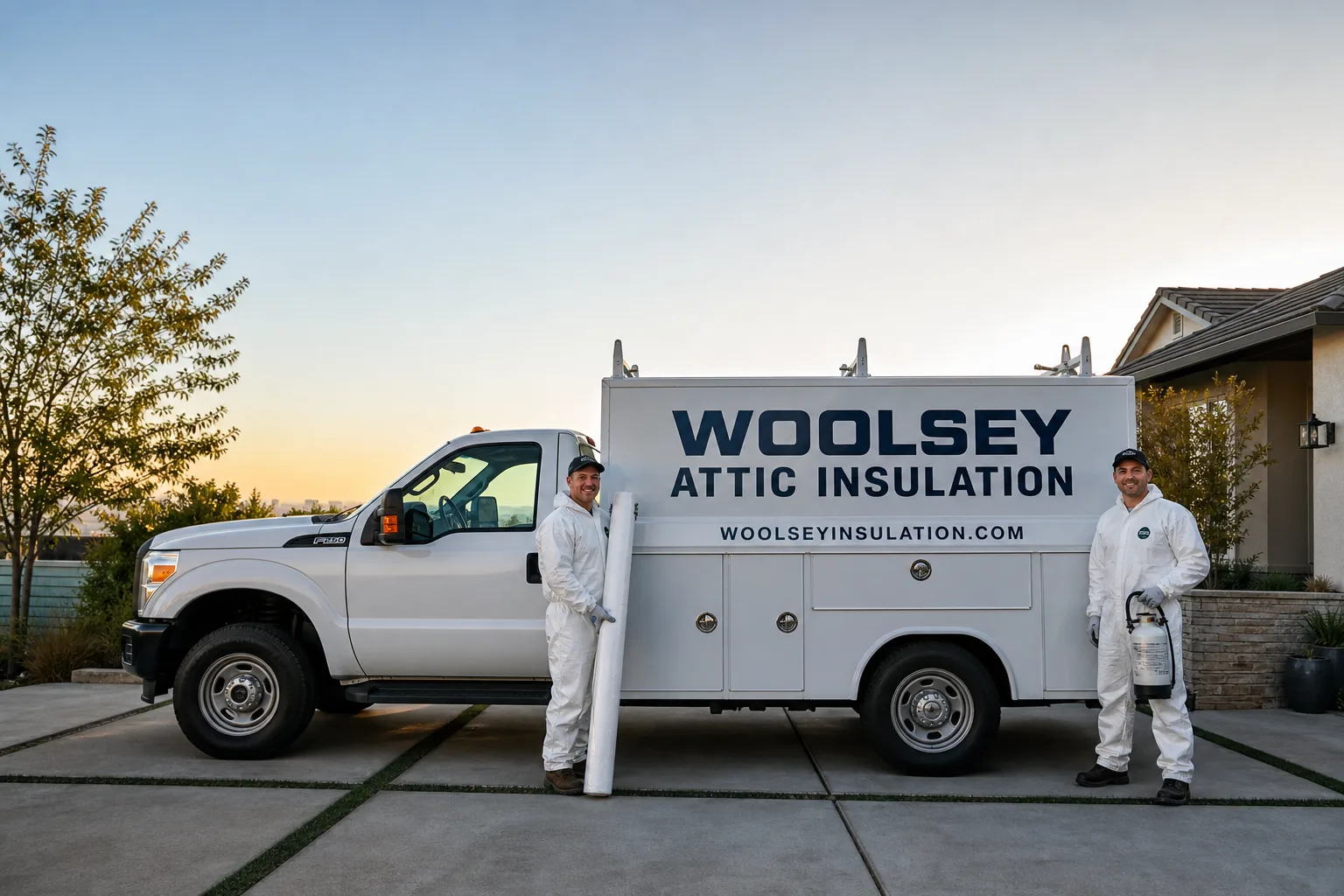
Attic Insulation in Glendale: The Heat Problem Most Contractors Miss
Attic insulation in Glendale is not the same job it is in Burbank, Pasadena, or anywhere on the LA basin floor. The Verdugo Mountains trap heat over the city and hold it there, pushing attic temperatures in uninsulated pre-war bungalows past 150°F on a typical August afternoon. That kind of sustained radiant load destroys cellulose and fiberglass in ways most insulation crews never see, which is exactly why we treat every Glendale job as its own diagnosis rather than a one-size-fits-all install.
Our crews know the difference between a Spanish Revival in Adams Hill with original knob-and-tube and a 1950s stucco box in the flats, because both exist in the same five-mile radius and both fail in completely different ways. If your upstairs rooms climb past 85°F by mid-afternoon even with the AC running, the attic is usually where the problem starts. Call (325) 240-5411 and we’ll walk you through what’s actually happening up there, before we ever ask for a dollar.
Fast, Reliable Attic Insulation Across Glendale
We work on attics in Glendale every week, from the hillside streets of Verdugo Woodlands to the flatland bungalow neighborhoods around Glendale Community College. When you call, a live person answers, 24/7. No voicemail maze. No call-back window. You describe the issue, we give you an honest read on whether it’s urgent, and we schedule a visit. Our background-checked, uniformed technicians drive into Glendale and arrive in the window we committed to, in writing.
Glenn Hartley, who leads our team, spent years pulling back attic hatches in neighborhoods like Tropico and Adams Hill before he’d ever sign off on a new hire. The crew understands how Glendale’s thermal bowl works, how the Verdugos hold heat against the city, and why a 1930s Craftsman in Glendale needs a different material conversation than a 1930s Craftsman in Pasadena. Local knowledge changes the recommendation.
Why Woolsey Attic Insulation Is Glendale’s Preferred Attic Insulation Company
Glendale homeowners call us for the same non-negotiable reasons, and they tell us so plainly. We give a written price before any work starts, every single time. We show up in the window we committed to, in a marked vehicle, in uniform, with a photo ID. We leave the job site cleaner than we found it. And we put a 365-Day Done Right Promise in writing on every job: if the work isn’t right within a year, we come back and fix it at no charge.
We’re independently owned and operated, not a franchise or a corporate branch. The people who answer the phone know what an R-value is and can explain the difference between blown-in fiberglass and mineral-wool batt on the first call. When a Glendale homeowner calls us, they’re talking to someone who’s actually been in a Glendale attic.
Dispatch and scheduling are coordinated from our Los Angeles office, but the crews on Glendale jobs are the same technicians who work the hillside neighborhoods below the Verdugos week after week. They know the narrow street access in Verdugo Woodlands, the parking constraints in Tropico, and which homes still carry original knob-and-tube wiring. That’s not incidental knowledge. It changes how we spec the job.
Attic Ventilation in Glendale
Attic ventilation in Glendale matters more than it does in cities that don’t sit in a thermal bowl against a mountain range. When outside air barely moves and the Verdugos reflect heat back down onto the roof deck, a sealed-up attic becomes a heat trap that radiates directly into the ceiling plane. Ventilation is the first thing we check on any Glendale attic, because insulation placed in an unventilated, 150°F attic performs at a fraction of its labeled R-value.
For most Glendale homes, adding proper intake and exhaust ventilation runs roughly $750 – $1,400 depending on the roof configuration and whether existing vents are functioning or merely decorative. We include the written price before any work starts, so there’s no door-step surprise.
Ridge and Soffit Vent Upgrades
Homes in the Verdugo Woodlands hills and the older flatland neighborhoods often have inadequate soffit venting paired with a single passive roof vent. The fix usually involves adding continuous soffit ventilation and balance at the ridge or gable ends, sized to the attic floor area, so air moves through the assembly rather than baking in place. We see attics in Glendale where a simple vent correction drops mid-afternoon attic temperatures by 20 – 30°F before any insulation is touched.
Powered Ventilation for Low-Slope Roofs
Some 1950s – 1970s Glendale apartment buildings and ranch homes have low-slope or nearly flat roof assemblies where passive venting can’t generate the stack effect needed to move hot air. In those cases, a thermostat-controlled powered vent is often the practical answer, and the cost range in Glendale typically falls between $900 – $1,700 including the unit, wiring, and installation. We’ll tell you honestly if passive venting will do the job first.
Radiant Barrier in Glendale
A radiant barrier in Glendale is not a luxury add-on; it’s the single highest-impact upgrade for homes in the thermal bowl the Verdugos create. Radiant barriers work by reflecting radiant heat away from the attic floor and living spaces, and in Glendale’s sustained 150°F attic environment, that reflective layer can mean the difference between a second floor that holds 78°F and one that climbs to 90°F by 3 p.m. on a summer day.
Radiant barrier installation in Glendale ranges from $1,800 – $2,600 for a typical 1,200-square-foot attic, depending on whether it’s stapled to the underside of the rafters, laid over existing insulation, or installed as part of a new build-out. We’ll tell you which application fits your roof and whether the attic needs ventilation work first.
Rafter-Mounted Radiant Barrier
For open attics in Glendale’s hillside homes, stapling a reflective barrier to the underside of the rafters is the most effective method. It reflects heat away from the attic floor, keeps the attic storage area cooler, and reduces the load on your AC. This method works best in attics with accessible framing, which covers most of Glendale’s pre-war bungalow stock.
Ceiling-Application Radiant Barrier
Where a Glendale attic has tight access or an unusual roof angle, a radiant barrier laid over the existing insulation can still deliver measurable heat-reflection gains. The tradeoff is dust performance over time in a flat application, so we’ll explain the differences honestly and give you a written recommendation based on your specific attic, not a generic script.
Trusted Brands We Service in Glendale
We install and service Attic Insulation materials from Johns Manville, Knauf, and Rockwool, among others. Why those three matter in Glendale: Johns Manville blown-in fiberglass gives you reliable coverage per inch in open attics; Knauf’s batt products work well in constrained spaces where a machine can’t reach; and Rockwool’s mineral-wool batt is the fire-rated material we recommend for homes in the CAL FIRE Very High Fire Hazard Severity Zones below the Verdugos. You get the material that fits your attic, not whatever happens to be on the truck.
Common Attic Insulation Problems We See in Glendale Homes
- Heat-baked kraft facing that crumbles at a touch. The paper facing on original 1940s batt insulation in Glendale attics disintegrates under sustained 150°F+ afternoon heat. The batt sags, loses contact with the ceiling, and the R-value drops before you ever disturb it.
- Knob-and-tube wiring that rules out full-depth blown-in coverage. Pre-war homes in Adams Hill, Tropico, and Verdugo Woodlands often still carry original knob-and-tube stapled along the joists. Burying that wiring under loose fill creates a code violation and a fire risk. A real Glendale contractor knows to maintain clearance and spec a different material.
- Radiant heat overpowering newly installed insulation. Hillside homes below the Verdugos absorb so much radiant energy through the roof deck that attic insulation alone can’t hold performance. Without a reflective barrier or venting upgrade, the new R-value underperforms within a couple of seasons.
- Multi-unit attic assemblies with zero separation. Glendale’s 1950s – 1970s apartment stock often has degraded or absent batt insulation in shared attic spaces, with zero party-wall separation. We routinely open up these assemblies and find original fiberglass matting compacted to less than half its original thickness.
Pricing for Attic Insulation in Glendale, CA
Most attic insulation jobs in Glendale run between $1,900 and $4,600. A typical blown-in attic top-up in a 1,200-square-foot bungalow ranges from $1,900 – $2,400, a full removal and replacement from $3,200 – $4,600, and a radiant-barrier upgrade typically $1,800 – $2,600. The variables are attic access, existing insulation depth, whether knob-and-tube is present, and whether the home sits in a CAL FIRE Very High Fire Hazard Severity Zone. All of it gets priced in writing before any work starts, every single time, no exceptions.
We’ll never give you a range and then “discover” problems at the door. The written price you receive is the price you pay unless you choose to expand the scope of work.
We Also Serve Cities Near Glendale
Our crews work across the Verdugo and San Fernando Valley edge, serving homeowners in Glendale plus Burbank, West Hollywood, Altadena, and Pasadena. If you’re in one of those neighborhoods and the attic isn’t performing in this heat, give us a call at (325) 240-5411. The same written price, the same guarantee, the same people.
Serving Glendale, CA - Our Local Coverage Area
We’re based in the Glendale area and know this community well. Use the map below to see our service coverage - if you’re nearby, we can almost certainly help.
FAQs About Attic Insulation in Glendale
Glendale sits in a thermal bowl against the Verdugo Mountains, so attic temperatures run 10 – 15°F hotter than coastal-adjacent cities and hold that heat longer into the night. That added heat degrades insulation materials faster, makes radiant barriers far more valuable, and changes the material recommendation for home comfort. Burbank’s flat, lower-risk corridors don’t face the same sustained radiant load, and Sherman Oaks doesn’t sit against a mountain backstop the way Glendale does.
Yes, but it requires a different approach. We maintain mandatory clearance around all knob-and-tube conductors, which often means a mineral-wool batt installation instead of loose-fill blow-in. We’ll assess the wiring condition first and give you a written scope that keeps the job code-compliant and safe. Call (325) 240-5411 and we’ll tell you what your attic needs before anything is installed.
If the home sits in a CAL FIRE Very High Fire Hazard Severity Zone, which covers much of Verdugo Woodlands and the slopes below the Verdugos, then yes, we recommend a fire-rated material like Rockwool mineral-wool batt. You still get the R-value, but you also get a material that does not ignite and does not fuel a fire. It’s the rare Glendale market where energy and fire code sit on the same materials list, and we solve them together.
Not usually. In a Spanish Revival under the Verdugo backstop, the ceiling plane saturates with radiant heat even after insulation is installed. You almost always need a reflective barrier or ventilation correction in addition to insulation to see a real temperature drop. We’ll tell you which combination actually works for your specific attic, rather than selling you insulation that underperforms.
Most Glendale attic insulation jobs run $1,900 – $4,600, with blown-in top-ups at the lower end and full removal with radiant-barrier upgrades at the higher end. You’ll get a written price before any work starts, and that price includes the Kingswell Guarantee: a committed arrival window, a clean job site, a written warranty, and a free return visit if anything fails within 365 days. Call (325) 240-5411 for your exact number; estimates are free.
We were up in Verdugo Woodlands recently, on one of the narrow hillside streets below the Verdugos, where a 1938 Spanish Revival bungalow still had original knob-and-tube stapled along the attic joists and paper-faced batt insulation so heat-baked the kraft paper shattered at a touch. Because the house sits in a CAL FIRE Very High Fire Hazard Severity Zone, we couldn’t just blow loose fill and leave it. We air-sealed the top plates, installed a Rockwool batt rated for the assembly, kept the loose-fill depth calibrated so it didn’t bury the knob-and-tube runs, and stapled a radiant barrier to the underside of the rafters to knock down the radiant load. The homeowner’s second-floor room finally stopped hitting 90°F by mid-afternoon. That’s the Glendale job, and it’s not a job you can get from a generic insulation outfit.
Ready to get your attic working for this heat? Call (325) 240-5411 or reach us any hour of the day. We answer live, we give you a straight written number, and we stand behind everything we install for 365 days, in writing. If it isn’t right, we make it right.
Written by Glenn Hartley, Owner at Woolsey Attic Insulation, serving Glendale with written-price attic work and the 365-Day Done Right Promise.