
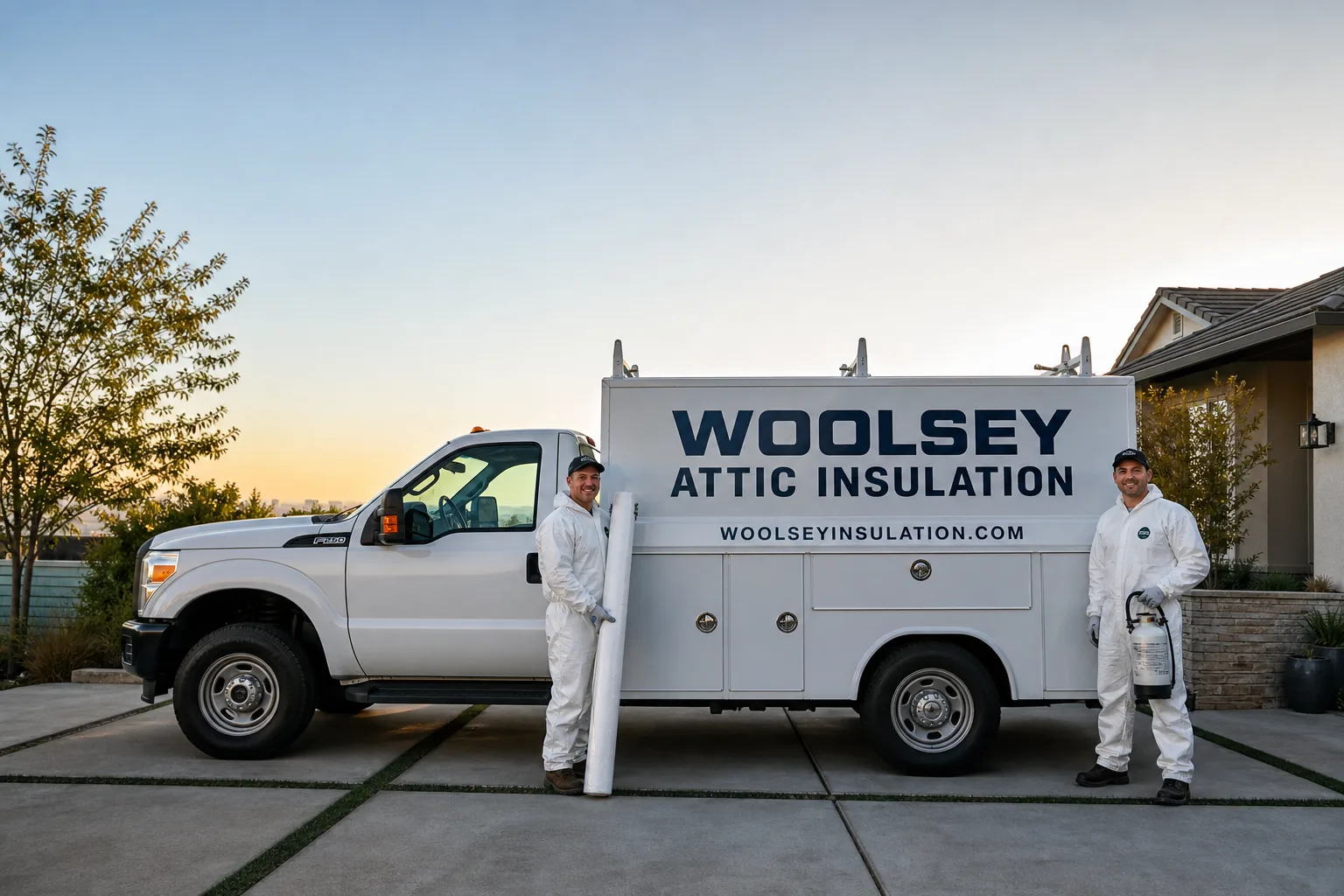
Fast, Reliable Spray Foam Insulation Across Lake Los Angeles
Spray foam insulation in Lake Los Angeles runs $1.90 to $3.80 per board foot for open-cell and $2.60 to $5.20 per board foot for closed-cell, and the right choice for your home depends on how it was built. Most 1960s and 1970s vacation-subdivision homes and manufactured units here were never insulated for true high-desert living, which is why we spend so much time cutting into Lake Los Angeles attics and rim joists. Our crews know the grid streets off 170th Street East, the manufactured home clusters near Avenue O, and the stick-built tracts by Lake Los Angeles Elementary. If your attic still has the original 2 to 3 inches of wind-scoured fiberglass and your power bill climbs every July, call (325) 240-5411 for a free estimate and a written price before any work starts.
Why Woolsey Attic Insulation Is Lake Los Angeles’s Preferred Spray Foam Insulation Company
Lake Los Angeles homeowners don’t tolerate callbacks that go to voicemail. You shouldn’t have to. Woolsey Attic Insulation has answered the phone with a live person 24 hours a day, 7 days a week since our founding in 2002 under the Kingswell banner, and we put every promise in writing before the first crew member arrives. Background-checked, uniformed technicians show up in a committed arrival window, leave the job site cleaner than they found it, and stand behind the work with the 365-Day Done Right Promise. If a spray foam installation in Lake Los Angeles fails within a year, we come back and fix it at no charge. No fine print. No door-step price changes.
Glenn Hartley leads our team with a straightforward philosophy: say the exact price, show up on time, do the job right, and guarantee it in writing. That’s The Kingswell Way. It’s why seasonal residents who leave Lake Los Angeles homes empty for months trust us to seal rim joists and attics that will hold temperature while they’re gone. Wool was the first insulation. Woolsey keeps the idea in the name.
Spray Foam Wall Insulation in Lake Los Angeles
Spray Foam Wall Insulation in Lake Los Angeles means filling the irregular wall cavities of 1960s and 1970s stick-built homes with a two-part liquid that expands on contact and seals gaps airtight. Most of these homes went up as cheap vacation-subdivision shells with fiberglass batts that have since slumped, or worse, were never installed in some wall bays at all. When wind off the Tehachapi Pass corridor pushes through those unsealed wall plates, your heater and air conditioner work against a 40 to 50 degree daily temperature swing. Closed-cell foam at 2 inches delivers roughly R-14 and acts as a vapor barrier, which matters in a climate where winter nights drop below freezing and summer afternoons climb past 100. Open-cell foam at 3.5 inches gives about R-13.5 with better sound dampening but no vapor barrier. For most Lake Los Angeles wall retrofits, we recommend closed-cell.
When wall cavities need foam, not more fiberglass
If you can feel a draft near outlet covers on the north and west walls of your Lake Los Angeles home, that’s the wind corridor doing its work. Original fiberglass in these wall assemblies has often settled to half its rated thickness, and loose-fill simply can’t air-seal the way spray foam can. We’ve opened walls off 170th Street East and found bays with no insulation at all.
What wall foam costs in Lake Los Angeles
Spray foam wall insulation in Lake Los Angeles typically runs $3,800 to $9,500 for a full 1,200 to 1,800 square foot house, with closed-cell at the higher end. Manufactured and mobile homes fall lower because the wall cavities are thinner and irregular, but the prep work takes longer. We give you the exact written number before any work starts.
Rim Joist Spray Foam in Lake Los Angeles
Rim Joist Spray Foam in Lake Los Angeles addresses the most under-insulated part of these 1960s and 1970s homes: the band board where your floor joists meet the foundation. In the original vacation-subdivision builds, this area got nothing. No fiberglass, no caulk, no foam. Just open air above the crawlspace. When Tehachapi Pass wind moves across the Antelope Valley, it pulls heated air out through those rim joists all winter and pushes hot air in all summer. Sealing them with closed-cell foam cuts that stack effect dramatically, and because the foam expands into every gap, it also keeps out the fine desert dust that works into Lake Los Angeles homes.
Why rim joists fail first in Climate Zone 5
Lake Los Angeles sits in California Climate Zone 5, a stricter designation than most of urban LA County. Title 24 now requires R-38 minimum in attics, but the rim joist is where the real energy loss happens in these older shells. We find open rim joists above dirt crawlspaces on nearly every home we inspect in the grid.
What rim joist sealing costs
Rim joist spray foam in Lake Los Angeles runs $1,400 to $3,200 for a typical single-story home, depending on linear footage and crawlspace access. On a converted 1970s vacation-subdivision home off 170th Street East, our crew sealed the rim joists with Icynene and flashed the gable walls after finding 2 inches of wind-scoured fiberglass in the attic above wide-open rim joists. The seasonal owner reported the house held its set temperature through a July triple-digit stretch instead of short-cycling. That’s what a rim joist job is supposed to do.
Trusted Brands We Service in Lake Los Angeles
We work with eight leading insulation brands so the material recommendation fits your Lake Los Angeles home, not whatever happens to be on the truck. For these high-desert retrofits, we frequently specify Icynene open-cell for attic roof decks where sound control matters, Demilec closed-cell for rim joists and crawlspace walls that need vapor resistance, and Owens Corning or Johns Manville when a hybrid approach makes sense. We stock contractor-grade material in our Los Angeles dispatch yard and coordinate local crews serving Lake Los Angeles directly, so scheduling stays tight even for snowbird homeowners who need work done in a narrow window between trips. Call (325) 240-5411 and a live person will help you sort out which material actually fits your house.
Common Spray Foam Insulation Problems We See in Lake Los Angeles Homes
- Wind-displaced fiberglass under spray foam. The original 1970s blown fiberglass in these attic floors has been pushed around by Tehachapi Pass wind for decades, leaving 2 to 3 inches where R-38 is now required. Spray foam applied directly over settled material loses adhesion and bridges air pockets. We remove the failed material first or the foam can’t do its job.
- Open rim joists and crawlspace walls. The stick-built and manufactured homes in the Lake Los Angeles grid were never insulated at the band board, which is exactly where high-desert wind pulls conditioned air out of the floor all winter and bakes it in all summer. Closing those gaps changes how the whole house feels.
- Thin, irregular wall cavities in manufactured homes. Mobile and manufactured units have wall cavities as shallow as 2×3 studs with belly boards that off-gassing two-component foam can distort if sprayed too thick in one pass. This requires a lighter lift, multiple passes, or open-cell instead of closed-cell to avoid bowing the exterior skin.
- Snowbird vacancies that mask air leaks. Homes that sit empty for months don’t show their air sealing problems until the owner returns and the HVAC runs constantly. Spray foam that cures and seals while the house is vacant means you come back to a shell that already holds temperature, instead of one that’s been fighting the desert the whole time you were gone.
Pricing for Spray Foam Insulation in Lake Los Angeles, CA
Open-cell spray foam in Lake Los Angeles attics typically runs $3,200 to $7,800 depending on roof deck square footage and access. Closed-cell jobs run $4,500 to $12,500 for full wall and rim joist retrofits. Rim joist sealing alone lands between $1,400 and $3,200, and garage ceiling spray foam usually runs $900 to $2,400. What moves the number is cavity depth, how much failed material we have to pull out first, and whether the home is stick-built or manufactured. You’ll get a written price before any work starts, every time, with no door-step changes. That’s The Kingswell Way, and it’s included on every job. Call (325) 240-5411 for a free estimate.
We Also Serve Cities Near Lake Los Angeles
Our Spray Foam Insulation team coordinates from the Los Angeles office and serves Spray Foam Insulation in Lake Los Angeles along with nearby areas including Los Angeles, San Diego, San Jose, and San Francisco. If you’re in a surrounding community and need advice on high-desert spray foam work, call us. We’ll tell you honestly what your house needs and what it doesn’t.
Serving Lake Los Angeles, CA - Our Local Coverage Area
We’re based in the Lake Los Angeles area and know this community well. Use the map below to see our service coverage - if you’re nearby, we can almost certainly help.
FAQs About Spray Foam Insulation in Lake Los Angeles
Because these homes leak air through wall plates and rim joists that blown-in fiberglass can’t seal. Spray foam expands into those gaps and stops the wind-driven air movement that makes Lake Los Angeles homes so expensive to heat and cool. Call (325) 240-5411 and we’ll walk you through what your specific shell needs.
Yes. Foam cures and seals while the house is vacant, so when you return the shell already holds temperature and keeps out the fine desert dust that finds its way into empty homes. No more coming back to a house that’s been baking or freezing for months. Call us before your next trip out and we’ll schedule the work around your calendar.
Mostly 2 to 3 inches of original 1970s blown fiberglass that’s been wind-displaced for decades, far below the R-38 minimum now required under California Title 24 for Climate Zone 5. In a converted vacation-subdivision home off 170th Street East, our crew found exactly that: 2 inches of wind-scoured material and wide-open rim joists above a dirt crawlspace. We sealed the rim joists with Icynene, flashed the gable walls, and the homeowner reported stable temperatures through a July triple-digit stretch. Call (325) 240-5411 for an honest assessment of your attic.
Open-cell is usually the safer choice because manufactured home wall cavities are thin and irregular, and the lower expansion pressure won’t distort belly boards or exterior skins. Closed-cell gives a higher R-value per inch and a vapor barrier, but it needs to be applied in lighter passes. We’ll tell you which fits your unit after seeing it. Estimates are free.
Spray foam’s continuous air seal stops the stack effect that drives those temperature swings through your walls and attic. Once the envelope is sealed, your HVAC isn’t fighting the desert every afternoon and the house holds temperature through the night. Call (325) 240-5411 for a free estimate and a written price before any work begins.
Written by Glenn Hartley, Owner at Woolsey Attic Insulation, serving Lake Los Angeles under the Kingswell banner since 2002.